
The Flight to a “Safe Haven”: What Lies Behind the Record Rise in Global Gold and Silver Prices
28 January 19:45 РОЗБІР ВІД
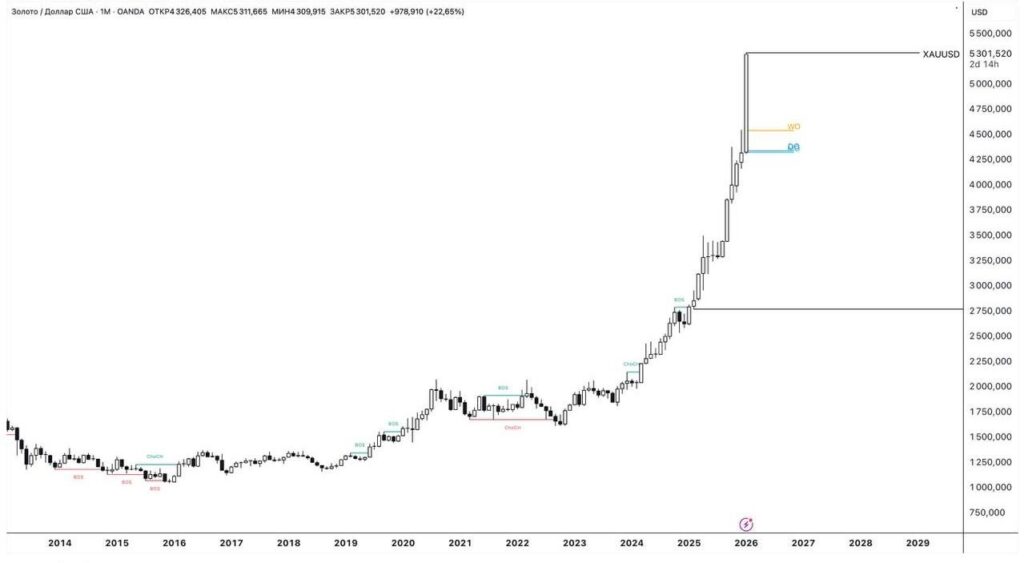
On Wednesday, January 28, gold prices hit a new all-time high, surpassing the $5,200-per-ounce mark. The price surge comes amid a weakening U.S. dollar and a shift in investor sentiment, as investors pull funds out of government bonds and foreign currency assets.
This was reported by Bloomberg.
According to the agency, on Wednesday, the price of gold bullion rose by 1.3%, following a 3.4% jump during the previous trading session—the strongest one-day gain since April.
At the same time, the price of silver rose by nearly 3% and closed near the record high of over $117 per ounce set earlier in the week.
Overall, gold rose 1.1% to $5,234.64 per ounce, while silver rose 2.5% to $114.92. Platinum and palladium also showed positive momentum.
Drivers of Growth
The rise in precious metal prices is occurring against the backdrop of a weaker U.S. dollar, growing geopolitical tensions, and investor flight from currencies and sovereign debt instruments.
U.S. President Donald Trump stated that he sees no problem with the dollar’s decline, which has fallen to its lowest level in nearly four years, emphasizing that currency fluctuations are natural.
The U.S. Dollar Index fell 1.1% on Tuesday—its largest single-day drop since April. As a result, gold and other metals became more affordable for buyers outside the U.S., further supporting demand. Since the start of the year, the price of gold has risen by more than 20% and exceeded $5,000 per ounce for the first time this week. Silver has risen by more than 50% over the same period.
Analysts also cite active purchases of precious metals by central banks, an influx of investments into gold-backed exchange-traded funds, and traders’ expectations of further price increases as additional drivers of growth.
Global gold prices are rising, but not for Ukraine
The rapid rise in gold prices on global markets is a direct consequence of the weakening U.S. dollar and its declining investment appeal. However, for Ukrainian consumers and investors, these developments are practically irrelevant.
This was stated in an exclusive comment for
According to the expert, the rise in the price of gold is a typical reaction of financial markets to the instability of key currencies.
“When the dollar’s investment appeal deteriorates sharply, investors begin to flee to gold. What we are seeing now is a direct result of these very processes,” Pendzin explains.
At the same time, the economist emphasizes that the situation on global exchanges has no direct impact on Ukraine, as the country lacks a fully-fledged market for monetary gold.
“There is currently no gold market in Ukraine. The figures we are discussing now—the sharp rise in the exchange rate, the sharp increase in the price of gold—apply exclusively to the global market, not to Ukraine,” he notes.
Jewelry is not an investment
Separately, Pendzin warns Ukrainians against trying to view jewelry as a form of investment.
“If you want to sell a piece of jewelry, at best it will be bought at the price of scrap gold, not at the value of the jewelry itself,” says the economist.
According to him, one shouldn’t expect to make a profit from reselling jewelry.
“Today, buying jewelry with the expectation that gold will rise in price makes no sense. At most, you’ll get about 50% of the price you paid for the item,” Pendzin emphasizes.
The expert also points out the significant gap between the buying and selling prices of gold in Ukraine.
“When you buy jewelry, it may be valued at less than two thousand hryvnias per gram. That’s normal for our market. But when you buy it, you’ll end up paying the full five thousand per gram,” he explains.
Pendzin is convinced that the rapid rise in global gold prices does not create investment opportunities for the Ukrainian market. In the absence of a developed market for monetary gold and transparent mechanisms for trading precious metals, gold in Ukraine remains more of a consumer good than an instrument for preserving or growing capital.
The Chinese Factor and Demand for Precious Metals
The record rise in gold and silver prices indicates not random fluctuations but a systemic loss of confidence in traditional financial instruments.
This was stated by Taras Zagorodniy, managing partner of the National Anti-Crisis Group.
“This is more related to global investor uncertainty. The issue is not local—it concerns the massive debts of developed nations and the potential for major conflicts, particularly between the U.S. and China,” the expert noted.
According to Zagorodniy, one of the key drivers of rising gold prices is China’s active policy of systematically increasing its reserves of the precious metal.
“Gold is gold. Stocks may vary, but for thousands of years, gold has been considered the equivalent of wealth and a reliable investment asset,” he emphasized.
At the same time, he noted, it is not only gold that is rising in value, but also silver, which was not previously viewed as a classic instrument for preserving capital.
“Even silver, which has never been considered a key investment asset, is breaking records today. This means the world understands: something is coming,” Zagorodniy stressed.
According to the expert, Donald Trump’s economic policy could become an additional risk factor, as it has the potential to trigger a new wave of global instability.
“Everything he does could lead to a Great Depression-style scenario—a deep economic crisis,” noted the managing partner of the National Anti-Crisis Group.
At the same time, Zagorodniy believes that such a scenario could be beneficial to the U.S. economy itself.
“Gold is the ultimate safe haven”: traders’ assessments
The main factor behind the sharp rise in the price of gold has been the unpredictable policies of U.S. President Donald Trump—both domestically and internationally. This is precisely what is driving investors to shift their capital into safe-haven assets.
He spoke about this in a conversation with journalists
According to him, in times of political instability, gold is traditionally seen as the most reliable store of value.
“The reason for the rise in gold prices is Trump’s unpredictable policies, both foreign and domestic. Because of this, investors are shifting funds into gold to preserve their assets, as it has the highest market capitalization and is the safest asset in such times,” Potapenko explains.
Pressure on the dollar and U.S. bonds
According to the trader, the rise in demand for gold is directly reflected in other key financial instruments.
“The consequences of these processes are a decline in the dollar’s exchange rate and a drop in the value of U.S. bonds,” he notes.
Potapenko emphasizes that the rapid rise in prices is changing market participants’ approach, especially in the futures segment.
“Traders are becoming more conservative. If gold is being bought, it is always done with profit-taking and the utmost caution,” the expert says.
According to him, after sharp spikes, the market usually enters a correction phase.
“After such rapid growth, the market typically enters a price correction phase. When exactly it will begin depends on the political situation and could even be triggered by a tweet from Trump,” Potapenko concludes.
Thus, the record rise in gold and silver prices has become a concentrated reflection of global economic and political uncertainty. The weakening of the U.S. dollar, geopolitical risks, active purchases of precious metals by central banks, and growing distrust of traditional financial instruments are forcing investors to return to “safe havens.”
At the same time, for Ukraine, this trend has more informational than practical significance: in the absence of a fully-fledged monetary gold market, precious metals do not serve as an investment instrument. Thus, the world perceives gold as a safeguard against future shocks, whereas for the Ukrainian market, it remains primarily a consumer good rather than a means of preserving or growing capital.










