27% of Ukrainians regularly use AI, according to a KMIS poll
26 March 15:27
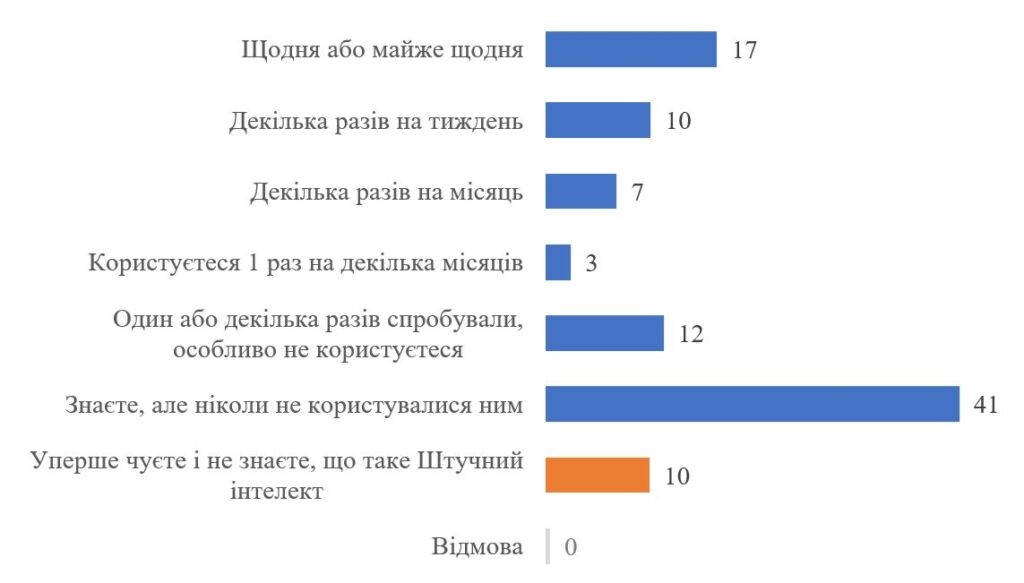
In Ukraine, 27% of Ukrainians use artificial intelligence on a relatively regular basis. At the same time, 63% do not use it at all. This is according to the results of a survey conducted by the Kyiv International Institute of Sociology (KIIS), as reported by "Komersant Ukrainian".
The share of regular users (at least once a week) has grown from approximately 17% to 27%, or by 10 percentage points.
“As the survey results show, the use of AI in Ukraine is only gaining momentum. A significant portion of the population does not yet use these technologies in practice, although awareness levels are already quite high. Twenty-seven percent of Ukrainians are regular AI users (at least once a week), which indicates the formation of a core group of active users, but not yet the widespread adoption of the technology,” says KIIS President Volodymyr Paniotto
KMIIS notes that although awareness of AI is quite high (about 90% are aware of it), actual implementation in everyday practice lags significantly behind. At the same time, about 37% of the population has at least some experience using AI (including even occasional use).
“In an international context, this figure is quite comparable to the level of AI usage in many Western countries, where the share of regular users typically ranges between 20–30%, although in some countries it is already significantly higher. In other words, Ukraine is not an outsider, but it is not yet among the leaders either,” notes Paniotto.
The highest level of regular use is recorded among young people aged 18–29—more than half (58%) of this group regularly use AI. In the 30–44 age group, this figure is only 36%, and among people aged 60 and older—only 9%.
“In today’s world, where technology is rapidly changing the way we live and work, Ukraine must actively utilize artificial intelligence (AI) to ensure development and post-war recovery. AI has great potential to improve the efficiency of the economy, public administration, education, and science, as well as to strengthen the country’s competitiveness on the global stage,” says the president of KIIS
As noted by the Kyiv International Institute of Sociology, these results generally demonstrate that Ukraine is entering a phase of new technology adoption, but this process has not yet become widespread. A significant portion of the population still remains outside the practical use of AI, despite high levels of awareness.
“At the same time, there is significant potential for growth. The experience of other countries shows that the spread of new technologies can occur very quickly once a certain critical level of adoption is reached,” explains Paniotto.
According to KIIS, a nationwide public opinion poll was conducted from January 23 to 29, 2026, which included, among other things, questions about AI usage. Using computer-assisted telephone interviews (CATI) based on a random sample of mobile phone numbers (with random generation of phone numbers and subsequent statistical weighting), 1,003 respondents were surveyed across all regions of Ukraine (territory controlled by the Government of Ukraine). The survey was conducted among adult (aged 18 and older) citizens of Ukraine who, at the time of the survey, resided in the territory of Ukraine controlled by the Government of Ukraine. The sample did not include residents of territories temporarily not controlled by the Ukrainian government (though some respondents were IDPs who had moved from the occupied territories), nor were citizens who had left the country after February 24, 2022, surveyed.
Formally, under normal circumstances, the statistical margin of error for such a sample (with a confidence level of 0.95 and accounting for a design effect of 1.3) did not exceed 4.1%.
Under wartime conditions, a certain systematic deviation is added to the aforementioned formal margin of error.