Why mackerel has risen in price in Ukraine and whether to expect a reduction in price – market forecast
29 December 2025 15:03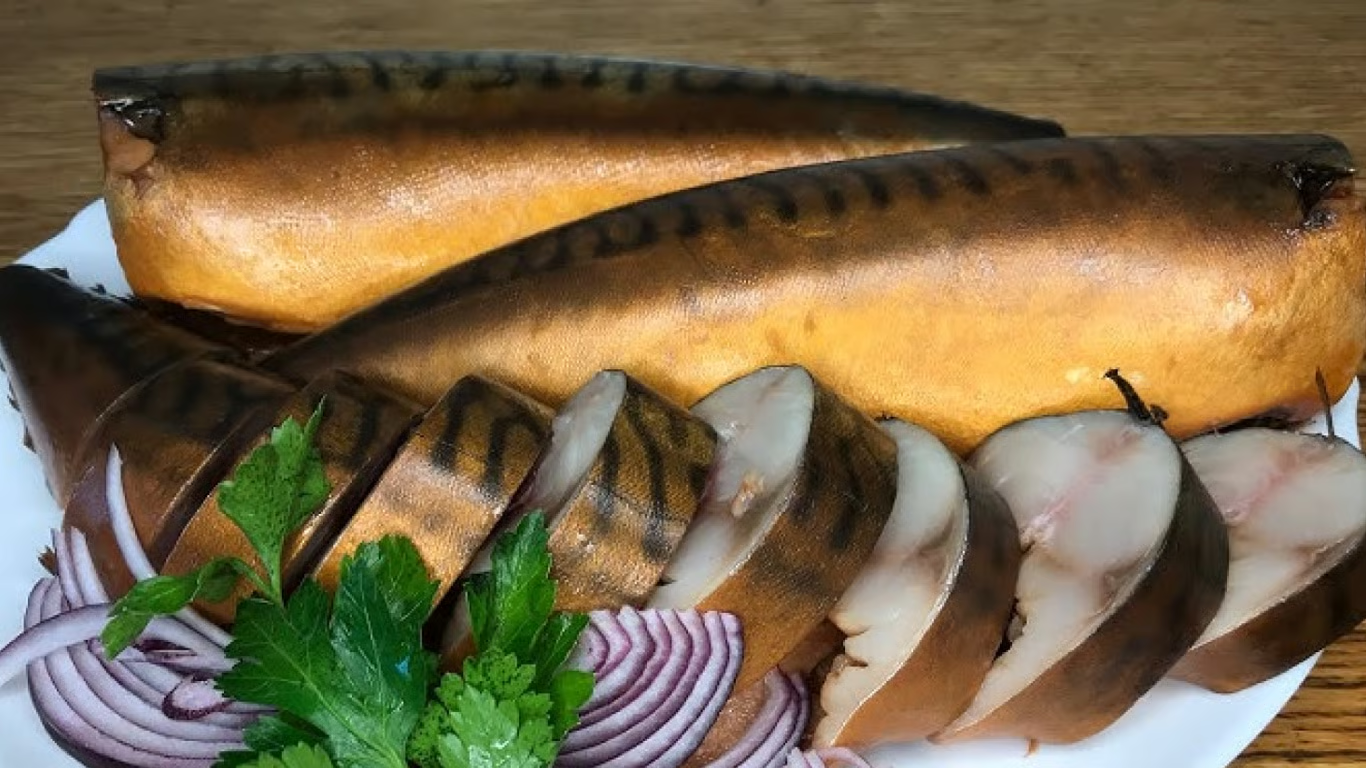 FORECAST
Mackerel, which until recently was considered an affordable “folk” fish, has suddenly become a significant expense for many Ukrainians. Price tags in stores and markets have increased dramatically in recent months, raising a logical question: what is happening to the fish market and should we expect further price increases? Is this a consequence of Ukraine’s internal problems – the war, the exchange rate, power outages – or is the reason much deeper and thousands of kilometers away from our shelves?
As Dmytro Zagumennyi, CEO of the Ukrainian Fish and Seafood Importers Association, told "Komersant Ukrainian", the mackerel story is actually a vivid example of how global decisions and environmental factors directly affect the wallet of Ukrainian consumers. Declining fish populations in the North Sea, scientific research, revision of international fishing quotas, restrictions for key fishing countries – all this triggers a chain reaction that eventually reaches Ukraine, which imports fish from dozens of countries. With stable demand and reduced supply, the price inevitably rises.
“In fact, this is justified quite simply, since the North Sea now has a smaller population of mackerel than it did before, as discovered by scientists who are constantly researching the amount of biological resources in the sea. And because of this, it was decided to reduce the catch quota to allow this biological resource, that is, fish, to recover. This, in turn, led to a decrease in the number of offers, i.e. the amount of fish on the market decreased, and its price actually doubled.
In other words, in the summer, fishing was unrestricted, but somewhere in the middle of the fall, a decision was made to reduce the quota, and this further drove up the price. Moreover, the demand for mackerel remains constant, and, accordingly, due to the limited amount of mackerel available for purchase, this product has actually doubled.
The same story, by the way, happened in 2019 to 2022, when a zero quota was introduced, i.e. fishing was banned altogether, for capelin in Norway and Iceland. Here, by the way, it should be explained that mackerel is caught mainly by Norway, Iceland, the Faroe Islands, and the UK, which is to say that if you look at the map, it is the North Sea, and everyone catches it in approximately the same area.
And it is there that the quota is being reduced, and this has led to a rise in the price of products. The quota is set for the 26th year and, accordingly, at least until next fall, this price will remain,” he explained.
However, mackerel is just one example. Today, the Ukrainian fish and seafood market is under pressure from several factors at once: from the international situation and currency fluctuations to domestic costs of logistics, electricity and storage of products during blackouts. And all of this, as Dmytro Zahumennyi emphasized, affects prices.
“It’s hard to say in general, because everything depends on each country. And Ukraine imports fish from 50 countries. That is, from any part of our planet. And there are many factors that affect the price.
Usually, when the situation is more or less stable, say, in terms of logistics and quotas, fluctuations are insignificant. Perhaps inflation has an impact, pushing prices up a little bit. But such quota revisions are quite rare.
And to say that there will be a significant rise in prices for other types of products, well, we can’t say yet. We need to consider some specific categories. Maybe some shrimp, or salmon, or something else.
Then we can talk about it somehow. In general, so far, the practice over the past ten years, let’s say, shows that there will be no significant changes,” said the head of the Ukrainian Fish and Seafood Importers Association.
The expert also named the main factors in Ukraine that lead to fish health problems. Imports are made for foreign currency, so any exchange rate fluctuations automatically affect the final cost. An additional burden is created by the cost of storing frozen products – generators, fuel, maintaining a temperature regime of -18 degrees in difficult conditions of energy instability. All of this is gradually included in the cost of production and, ultimately, in the price tag for the consumer.
“We are experiencing a rise in price for two reasons. The first one is beyond our control. These are, for example, quotas or some restrictions that push up the price of foreign suppliers. That is, we have no influence on this.
The second component is our internal story. First of all, it is the exchange rate, because all fish is bought for dollars, euros, and other currencies. And there is a difference when, at the beginning of the year, the exchange rate was less than forty, now it is forty-two, maybe forty-three or whatever.
All this will affect the cost.
Another component that is now affecting is these blackouts, the lack of electricity, so to speak. And since the product has to be frozen 24 hours a day, 7 days a week, it is necessary to maintain this temperature regime of 18.
That is, all these generators are actually included in the cost of production. And the Ukrainian supplier may already have a cost advantage because it is spent on maintaining the temperature. And, for example, at the point of sale, or in a retail chain that makes its own markup, or even if it is a local store, it also expects that its costs have increased, and it can no longer sell the same mackerel for 400 hryvnias,” Zahumennyi summarized.