Chornobyl NPP under attack: can the sarcophagus withstand a ballistic attack?
14 February 2025 14:30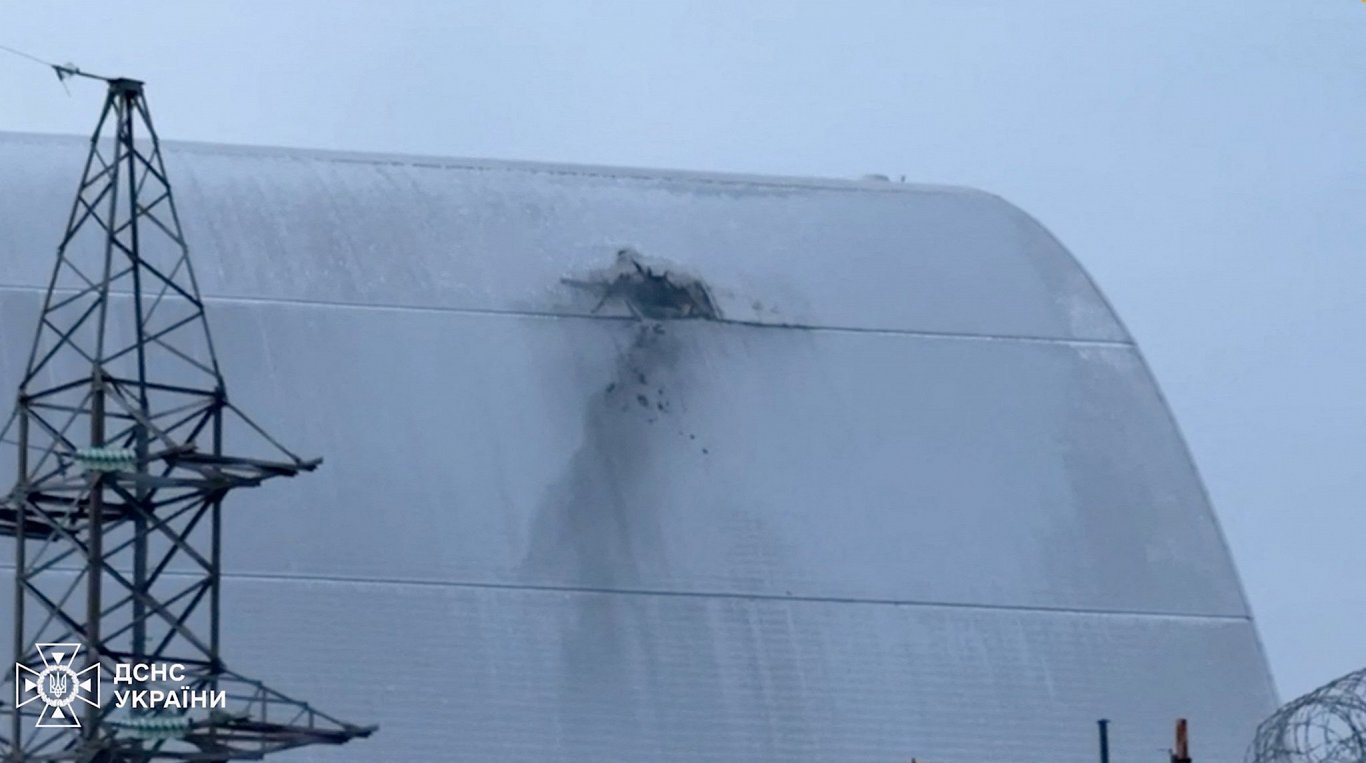
 ANALYSIS
Russia’s kamikaze drone strike on the Chornobyl nuclear power plant has caused serious concern among nuclear safety experts. Mark Zheleznyak, a professor at Fukushima University, emphasizes that although there is no immediate threat of a large-scale radiation leak, attacks on nuclear facilities pose enormous risks. The article of Komersant ukrainskyi

The drone strike on the shelter that protects the world from the consequences of the accident at Chornobyl NPP Unit 4 came as a real shock. Share your first impressions of what you saw in an exclusive commentary
“I participated in the design of the New Safe Confinement in the 2000s, working in the United States to assess possible risks. But even in the worst-case scenarios, we did not consider the possibility of military strikes on this structure,”
– Mr. Zheleznyak said.

Danger of radiation leakage
According to the expert, the sarcophagus that covers the destroyed reactor is not designed for direct missile or drone strikes. However, the damage currently affects only the outer metal shell.
“The drone’s warhead pierced the metal structure, but the internal concrete sarcophagus was not damaged. This is the most important thing. There is currently no threat of massive radiation leakage,”
– the professor emphasized.
He added that some equipment that maintains the climate inside the shelter is partially damaged, which may affect the further condition of the sarcophagus.

It should be noted that according to the State Emergency Service, the radiation background at the Chornobyl NPP is normal.
At the ChNPP industrial site, 0.57 μSv/h was recorded, which does not exceed the permissible values. The monitoring is ongoing.
What will happen if the missile hits the sarcophagus?
“Even if a ballistic missile hits the shelter, the situation will not lead to large-scale radioactive contamination. The explosion may raise radioactive dust into the air, which will spread within a 10-kilometer zone, but it will not be Chornobyl in 1986. Today, there is no longer a working reactor there – only molten fuel masses that have turned into a solid substance remain,”
– Zheleznyak explained.
Is it possible to build a new sarcophagus?
The scientist notes that the construction of another shelter would require significant resources, but it is not an urgent need for now.
“The confinement was created to contain long-term risks, but it was not built with the expectation of war. The first thing to do now is to repair the damage and prevent further attacks,”
– the professor emphasized.
According to him, the attack on the Chornobyl NPP should be a signal to the international community to strengthen security measures and the need to put pressure on Russia by international organizations, including the IAEA.
Threat to Zaporizhzhya NPP
Prof. Zheleznyak drew attention to the situation around the Zaporizhzhya Nuclear Power Plant (ZNPP), which is under the control of Russian troops. It is known that it remains in the focus of attention due to serious risks. There is information that the plant is again on the verge of blackout.
“The situation there [at ZNPP – ed.] is certainly more dangerous than what we have at Chornobyl. The IAEA is recording violations, but their activities are significantly limited by the Russians. They do not see everything, but only what the Russians allow them to see,”
– emphasized Mark Zheleznyak.

Unlike the Chornobyl zone, where the main problem is residual radioactive contamination, the situation at ZNPP is much more serious.
“Here we have six reactors containing active nuclear fuel. Although they are not currently operating, the fuel requires constant cooling, which is provided by the electricity supply,”
– explained the scientist.
The professor emphasized that at the moment the cooling of the plant depends on only two power lines. And during the shelling, one of them is periodically disconnected.
“Diesel generators can temporarily maintain cooling, but this is not a long-term solution. Any disruption in cooling can lead to catastrophic consequences,”
– Zheleznyak warned.
Thus, the situation at Zaporizhzhia NPP remains extremely tense and the risks are high. The scientist called on international organizations to increase pressure on Russia to allow an impartial inspection of the plant.
The attack on the Chornobyl NPP demonstrated that even facilities that should be outside the war zone are being targeted by Russia. Despite the absence of an immediate threat of radiation leakage, the damage to the infrastructure could have long-term consequences. The situation at Zaporizhzhya NPP remains even more alarming, where there is a risk of a nuclear disaster due to unstable power supply. The international community must respond decisively to prevent further attacks on critical nuclear facilities.