Where most toxic substances are produced in Ukraine: official statistics
25 June 2025 16:55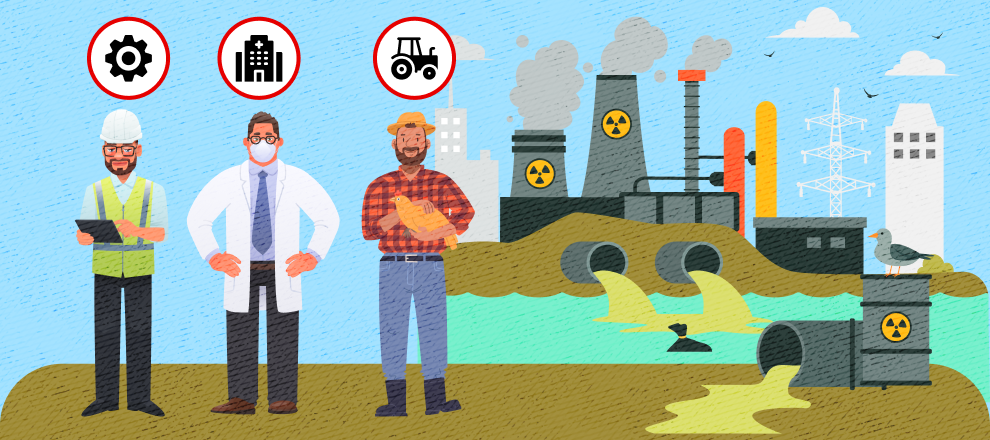 INFOGRAPHICS
Zaporizhzhia region became the absolute “leader” in the generation of hazardous waste – 184 thousand tons, which is more than 31% of the national figure. This is stated in a study by financial analyst Roman Kornyliuk and the R&D center YouControl, "Komersant Ukrainian" reports.
According to YouControl’s calculations based on data from the Ministry of Environmental Protection and Natural Resources, business in Ukraine generated more than 592 thousand tons of hazardous waste in 2024. The largest amount of pollutants is generated by the non-metallic industry, medical institutions, and the agricultural sector.
The study used a comprehensive analysis of official data from the Ministry of Environmental Protection and Natural Resources, supplemented by visualization of spatial and sectoral trends. At the same time, an attempt was made to assess the extent to which the Ukrainian corporate sector is ready to implement environmentally responsible practices in the field of hazardous waste management and what this means in terms of ESG approaches.
ESG is a set of specific factors and indicators of how a company operates in relation to the environment and society. ESG factors are the principles of sustainable development that stand for:
Environmental;
Social – social aspect;
Governance – governance.
Geography of hazardous waste
Given the active transformation of the economy and growing expectations for environmental responsibility of businesses, waste management – especially hazardous waste – is becoming key in the context of ESG approaches. However, the real level of environmental risks remains largely non-public or fragmented in the public domain.
According to the results of the analytical study, in 2024, legal entities in Ukraine generated more than 592 thousand tons of hazardous waste. These volumes are extremely unevenly distributed: some regions accumulate tens of percent of the total toxic mass, while others remain almost “clean” white spots in official statistics.
Zaporizhzhia region became the absolute “leader” in hazardous waste generation – 184 thousand tons, which is more than 31% of the national figure. The main factors here are the concentration of heavy industry, in particular metallurgical and chemical production, as well as the energy sector, which traditionally generates the largest volumes of hazardous industrial sludge and other hazard class I-II waste.
The city of Kyiv ranks second with over 61 thousand tons. The capital region is de jure home to not only large industrial complexes, but also logistics, medical, construction, and service companies, which are also sources of toxic substances.
The top five regions with the highest waste load also include Lviv – 53.8 thousand tons; Dnipro – 52.0 thousand tons; and Volyn – 37.1 thousand tons.
For Lviv and Volyn regions, the high figures are partly explained by the coal industry, processing enterprises, and the active development of production with recycled materials, where hazardous waste is an inevitable by-product.
At the opposite end of the regional ranking are Donetsk (39 tons), Kherson (11 tons), and Luhansk (7 tons) regions. In this case, the low figures are due to a full-scale war, occupation of the territories or temporary loss of control over them, which makes it impossible to keep correct statistical reporting through registration of the full volume of waste generation and accounting.

The uneven generation of hazardous waste is a challenge for environmental policy, as the distribution of hazardous waste by region shows several key trends:
- The toxic load is concentrated in industrial regions with a large share of the manufacturing industry.
- Waste generation data may be underreported or missing in the combat zones, which distorts the overall picture.
- A large share of waste is generated not only by traditional “heavy” industry, but also by service sectors such as logistics, healthcare, and business services.
Implementation of effective ESG strategies requires detailed zoning of regional environmental risks, a transparent system of accounting for hazardous waste generation and disposal, and changes in approaches to government and corporate control in the area of sustainable development.
The non-metallic industry, medical facilities, and the agricultural sector generate the most hazardous waste in Ukraine
Despite the war risks and economic instability, Ukraine’s industrial and agricultural sectors continue to operate actively. At the same time, this also means the steady generation of a large volume of hazardous waste, ranging from chemically aggressive substances to biologically active components that can have a significant impact on the environment and human health.
The non-metallic industry is a clear leader in the generation of hazardous waste. It leads by a significant margin, generating more than 201 thousand tons of hazardous waste – 34% of the total. This sector includes quarries for the extraction of sand, crushed stone, clay, and mineral processing enterprises. They are characterized by waste containing heavy metals, abrasives, and reagent residues that can pollute groundwater and air.
Medical facilities are the 2nd largest generator of hazardous waste, with 80.7 thousand tons of hazardous waste coming from medical facilities. After the pandemic and in the context of military operations, this figure has increased significantly. Medical waste includes infectious materials, used medicines, ampoules, biological residues, and other potentially hazardous substances that require special handling. Thus, a side effect of the positive social impact on public health is the toxic burden on the environment from the healthcare system.
The agricultural sector, despite its often invisible pollution to the public, ranks third in terms of total hazardous waste generated – 65.4 thousand tons. The source of toxic residues from agricultural enterprises is pesticides, herbicides, veterinary drugs, and livestock waste. Despite the “natural” image of the agricultural sector, it is a serious source of chemical load, which often remains outside the scope of environmental control.
Other key sectors include food, coal, water, metallurgy, and electronics, each of which generated hazardous waste in the range of 25 to 40 thousand tons. These sectors share a common feature: chemically active production cycles and limited environmental modernization. In particular, in electronics production, waste can contain cadmium, lead, arsenic and other extremely toxic elements.

The new ESG Profile module in YouControl shows what you need to pay maximum attention to when assessing environmental risks, social responsibility, and corporate transparency of partners. This is the first module in Ukraine for a comprehensive automatic assessment of ESG risks of companies. The module allows you to quickly assess the ESG risks of a counterparty, including the potential level of environmental and social impact (E&S) in accordance with the categorization of activities (according to the methodologies of the Enterprise Development Fund (EDF) and the European Bank for Reconstruction and Development (EBRD)). The tool helps to identify potential risks, determine “growth areas” for improving ESG performance, and prepare for cooperation with international financial institutions.

ESG and corporate responsibility: the need of the hour
The high rates of hazardous waste generation in various sectors indicate the need for deeper integration of ESG principles into business operations. It is not only about accounting and reporting, but also about implementing closed production cycles, using safer technologies, and building infrastructure for disposal and recycling. Systematic work in these areas is the key to minimizing the environmental footprint and increasing the sustainability of companies in the long term.
Читайте нас у Telegram: головні новини коротко