A contract for a century. Why Marchuk is suing for his paintings
12 December 2025 11:37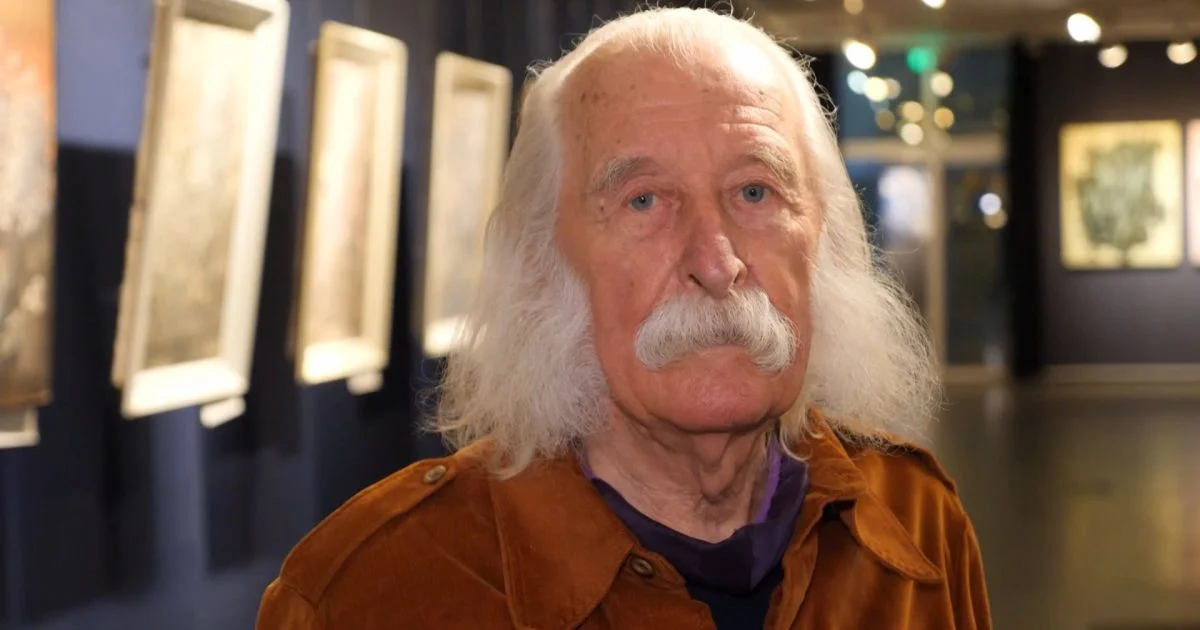 ANALYSIS FROM
The legend of Ukrainian painting Ivan Marchuk is forced to defend in court the copyright to his paintings, which he gave away for 100 years by signing a document that was handed to him. Among those who received the right to dispose of his works were the son of the former MP and assistant to the Minister of Internal Affairs Avakov, Ihor Apostol, and a number of other people. How did the famous artist end up in the center of the scandal, found out
The copyright story came to light after Natalia Burlachenko, owner and director of Big Wines, a wine producer and importer in Ukraine, who has been legally cooperating with Marchuk since 2022 under a contract (five prints are already on bottles, and ten more are approved for the future), received a claim from Mykhailo Apostol for exclusive rights.
In November 2025, the 98-year-old artist publicly accused the “Judas among the apostles” of trying to appropriate all his copyrights. And he announced that he was going to court to defend justice.
“Through deception and fraudulent methods, back in 2020, an agreement was imposed on me that I had no intention or need to sign. On the day of signing, I realized its essence and immediately appealed to its main initiator, Mykhailo Apostol, demanding that any further actions be stopped and received assurances that the document was not valid,” Marchuk wrote.
He trusted his friends and signed without reading it
This story began in 2020, when Marchuk signed a license (copyright) agreement without reading it, under which four people – lawyer Serhiy Pavlenko, businessman Mykhailo Synytsia, ex-MP’s son Ihor Apostol, and Tamara Strypko (the artist’s assistant) – received an exclusive license to use the copyright to all his paintings for a period of 100 years for only UAH 10,000. At the same time, the “caring” new owners left Marchuk with a 5% royalty.
The artist and his assistant call the deal “the scam of the century” and claim: Marchuk was misled, he did not receive any money, and he signed because he had long been friends and trusted Mykhailo Apostol.
According to the artist, when in 2024 he learned that the person he considered and called a friend was introducing himself as the owner of the copyright to my works, he tried to talk to him, but he did not answer his calls or letters.
And, as Ivan Marchuk noted, even then he and Tamara Strypko, the only witness to those events and the person who has been responsible for organizing all his exhibitions and creative projects over the past two decades, tried to humanly resolve this misunderstanding.
“In that case, we were thinking more about enabling Mykhailo Apostol to save face, as we could not believe that what he proposed could be his real intentions,” the artist wrote.
The defendant is switching the tables
Mykhailo Apostol responded to the accusations against him by saying that the situation around the Maestro (Ivan Marchuk) has acquired signs of a systematic seizure of his heritage. In his opinion, a person who introduces herself as his “assistant” (Tamara), by means of isolation and manipulation, has gained unlimited control over the artist, his property and creative heritage.
the “assistant” systematically alienated Marchuk from his daughters, friends (including the author of the text) and his inner circle. She began to speak publicly on behalf of the artist, shaping his public image and statements (“we want”, “we are satisfied”). People who actually helped Marchuk were slandered (for example, Volodymyr Bulba, who participated in the return of 101 paintings and the creation of a film about him). And the entire collection of paintings was taken abroad under the cover of war. There was information about the transfer of the Marchuk estate in Kaniv and other assets to its control.
The apostle concluded that under the guise of loud accusations and the creation of an image of “enemies”, a classic scheme of slow but consistent appropriation of the national heritage – the creative and material heritage of a genius – is taking place. The silence of the family was perceived as weakness, which led to escalation. A heritage of this level is not private property, but a value for the whole of Ukraine and future generations.
And, as Mykhailo Apostol stated in his latest address on his Facebook page, the issue raised is actually much deeper.
“We are talking about who actually owns the collection of our genius today, who disposes of it at their discretion and who will own it in the future. May God grant the Maestro many more years of life,” the Apostle said.
And, according to him, now the entire collection is abroad and is actually controlled by an “assistant” who communicates on behalf of the artist, creating the illusion among fans of his work that they are communicating with him personally. In fact, Marchuk hasn’t been corresponding or reading messages himself for a long time; he only selectively reads out what is available and what he considers relevant. And he advised the artist to draw up a will that would dot the i’s and cross the t’s.
You will have to “sweat it out” in court
The artist called the Apostle’s public reaction today blasphemous.
“He keeps trying to appropriate what his family members have created, humiliates me, throws mud at people close to me, and openly distorts the facts, avoiding explaining the situation in essence. Can I feel safe after this? I really hope for a fair court decision. And at the same time, I need protection from such “friends” for whom what I have created is much more precious than my life,” emphasized Ivan Marchuk.
The Ternopil court has been considering the claim to invalidate the agreement for five months. However, according to copyright lawyers, the process will be lengthy, and the outcome will depend on the evidence collected.
“A statement of misrepresentation (“imposed agreement”). This is a direct indication of a possible ground under Article 229 of the Civil Code of Ukraine (material misrepresentation). If it can be proved that the essence of the contract (a complete assignment of rights, and not, for example, an order to organize exhibitions) was intentionally distorted or concealed, this is grounds for invalidity.
His statement that he “realized its essence on the day of signing and immediately requested… to stop it” is a critically important fact. It shows that he did not agree to the terms, did not accept them, and therefore his further behavior does not mean approval of the agreement. This interrupts the opposing party’s possible arguments about “actual acceptance of the terms”. The “assurances that the document is not valid” from the initiator of the agreement (M. Apostol) received on the same day is a powerful argument. If this is confirmed (by witnesses, correspondence), it proves that even the other party initially understood the dubiousness of the deal or gave false guarantees,” says
[Kommersant] lawyer Sergey Slyusarenko.
The court may take into account the special trust relationship in which the transaction was made. Abuse of trust can strengthen the position of mistake or even point to fraud (Article 230 of the Civil Code of Ukraine), which also leads to invalidity.
The problem is to prove the fact of fraud
But the main problem, according to the lawyer, is evidence “in words”. The biggest risk is the absence of written or audio recordings that directly record the moment of deception. Most arguments (promises, the essence of conversations) are based on testimonies and personal statements. This always makes the process less predictable.
“Time has passed between 2020 (signing) and 2024. The other side will use this as an argument: “If you were deceived, why did you keep silent for 4 years? You de facto agreed to the agreement.” Here it is important to prove that the true extent of the consequences (for example, the fact of registration of rights in the name of the Apostle) became known only in 2024. It will be necessary not only to prove the fact of deception, but also to convince the court that the mistake was in the essential terms of the contract (for example, “I thought I was signing a representation agreement, not a full assignment of copyright”), and not in minor details,” the lawyer believes.
Obviously, the defendants will actively defend themselves using the formal force of the signed document. They may have their own interpretations of the events and perhaps even their own “evidence” (for example, that all the terms and conditions were explained).
“In this case, the goal is not just to terminate, but to recognize the agreement as void (invalid from the moment of conclusion). In this case, all the rights transferred under it should revert to Marchuk,” the lawyer emphasizes.
The story of Marchuk is a classic case where the formal force of a document collides with the material truth about deception. The outcome will depend on how convincingly the other party can prove not the fact of signing (which is not disputed), but the fact of abuse of trust and misrepresentation when signing it.
Reference
This is not the first time that the artist’s works have been threatened. In 2017, 101 of Marchuk’s paintings worth about $10 million disappeared after being transferred to an “agent” for an alleged exhibition in the Prado in Madrid. The exhibition never took place, and the agent stopped contacting him. The paintings were returned to the author.
The collection of the People’s Artist Ivan Marchuk includes more than 5 thousand paintings. The average price of a painting is $5-10 thousand. In the summer of 2024, Ivan Marchuk’s painting “The Moon Rises Over the Dnipro” was sold for a record $300 thousand at the Goldens auction in Kyiv. In 2022, another of Marchuk’s paintings, The Garden of Temptation, was sold for $120 thousand at a charity auction.
Author: Alla Dunina