Day two of the NATO summit: what Zelenskyy will return with
25 June 2025 15:08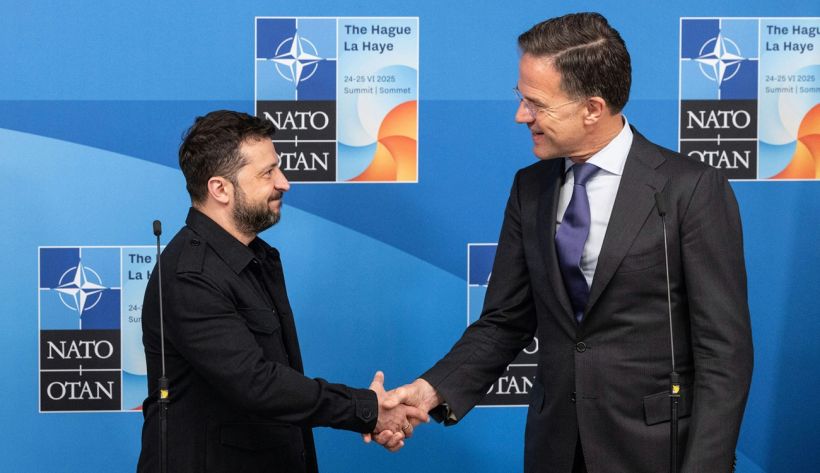
on June 25, the second and final day of the two-day NATO summit is taking place in The Hague. The leaders of the Alliance are focusing on key challenges to European security, continued support for Ukraine, and measures to deter Russian aggression, reports
On the eve of the meeting, NATO Secretary General Mark Rutte said that the Alliance is at a stage of critical geopolitical changes, when the level of global threats is growing. According to him, the allies are preparing to make a number of ambitious decisions, including a plan to increase defense spending to 5% of GDP. They are also expected to confirm their full and unwavering support for Ukraine, including the provision of all necessary resources for its defense.
One of the main topics of discussion will be building the capacity of the defense industry of NATO countries to meet the growing demand for weapons and ammunition.
Rutte emphasized that the current summit is transformative, as the allies are facing new challenges – first of all, Russia’s war against Ukraine, which is supported by authoritarian states such as North Korea, Iran and China. China’s rising military activity is also a concern and will be a separate issue for discussion.
Summit participants seek to ensure that NATO’s defense systems have sufficient production capacity to ensure the security of both individual countries and the entire Euro-Atlantic area.
NATO Summit: Rhetoric changes, but positions remain firm
Political analyst Dmytro Snegirev in a commentary for
According to Dmytro Snegirev, despite the general recognition of the importance of cooperation with Ukraine, the issue of its membership remains stalled due to the opposition of at least four countries.
“Hungary, Slovakia, the United States, and, most notably, Turkey are categorically against Ukraine’s accession to NATO. This was stated by Hungarian Foreign Minister Peter Szijjarto, referring to Orban,” Snegirev said.
If the information about the Turkish “no” is confirmed, it will mean that the prospect of Ukraine’s membership in the Alliance is postponed indefinitely.
NATO membership – a historical perspective or an illusion
The analyst emphasizes that, taking into account the positions of these countries, Ukraine should reconsider its foreign policy strategy:
“The issue of Ukraine’s accession to NATO should be considered not as a realistic goal for the coming years, but as a long-term historical perspective. And this requires adjustments, in particular in the development of the Armed Forces and the defense industry,” he emphasizes.
Today, according to Snegiryov, the Ukrainian military-industrial complex meets only 40% of the needs of the Armed Forces:
“This is catastrophically low. We remain dependent on arms supplies from the West. And sometimes – on the moods of politicians in countries that cannot be called unconditionally friendly to Ukraine,” the expert says.
Another alarming signal that sounded on the background of the summit was the statement on the conditionality of the fifth article of the NATO Charter.
“It is a direct indication that in case of Russian aggression, the Alliance may sacrifice one of the countries. In informal discussions, the Baltic states, in particular Estonia, were mentioned. This calls into question the very essence of collective security,” Snegirev said.
According to the expert, the main conclusion is simple: we have to develop our own army, our own industry and our own security system. This does not mean giving up on NATO, but it does mean a sober understanding of reality.
“NATO is blocked, bilateral alliances are becoming more important”
Managing Partner of the National Anti-Crisis Group Taras Zahorodniy in a commentary for
According to the expert, we should not expect any breakthrough decisions from the summit:
“To be honest, we shouldn’t expect anything new from the summit. NATO today is a dead structure, blocked from the inside. The real formation of a new security architecture in Europe is already underway, based on bilateral alliances, mutual dependence, and an understanding of common risks,” Zagorodnyi said.
As an example of an effective new format, he cites Ukraine’s recent accession to the Northern Europe Initiative Expeditionary Corps:
“Partnership with the Baltic States, Poland, Romania, and Northern European countries is much more important for Ukraine – it is there that we see real allies who understand the seriousness of the threats and are ready to act,” he explains.
According to Zahorodnyi, Ukraine should focus on strengthening direct relations with key partners, including Britain, Norway, France, and Poland.
“It is much more important for Ukraine that President Zelensky has already met with the British royal family three times this year. You don’t just get there – it’s evidence of trust and a serious partnership,” he emphasizes.
He also notes that Norway is a strategic partner that not only provides financial support but also demonstrates a willingness to take practical action.
Thus, experts urge not to focus on collective structures that are paralyzed by political contradictions, but instead to develop a flexible network of direct alliances with countries that are really ready to support Ukraine against the backdrop of growing threats.