Institute of National Memory recognises Bulgakov as a symbol of Russian imperial policy
4 April 2024 10:28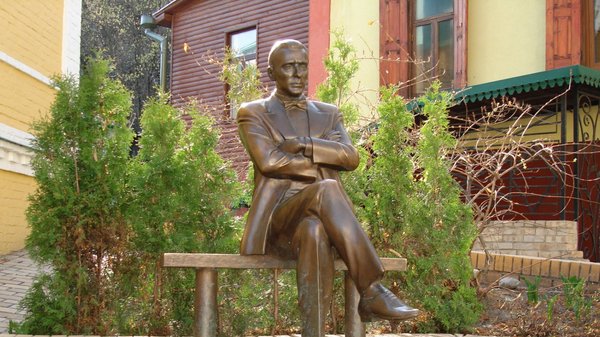
Writer Mikhail Bulgakov has been recognised as a symbol of Russian imperial policy, and the presence of monuments in his honour in the public space is considered propaganda for Russia’s imperial policy.
This is stated in the conclusion of the Expert Commission of the Ukrainian Institute of National Memory, Komersant ukrainskyi  reports.
Thus, the commission believes that Bulgakov, despite living in Kyiv, despised Ukrainians and Ukrainian culture, hated the Ukrainian desire for independence and spoke negatively about the formation of the Ukrainian state and its leaders.
It is noted that his obsessively declared disdain for Ukraine is rooted in the fact that his family was sent to Kyiv from the Oryol province for colonial activities. His father, a Russian theologian, a lecturer at the Kyiv Theological Academy, was a censor and was involved in the oppression of Ukrainian culture. His son continued the conscious strategy of blocking the right of the Ukrainian nation to a separate path from Russia.
The conclusion also states that among all the writers of that time, he “stands closest to the current ideologues of Putinism and the Kremlin’s justification of ethnocide in Ukraine”.
According to the Ukrainian Institute of National Remembrance, there is not a single positive Ukrainian character in the writer’s works. Instead, he parodies or mockingly distorts the Ukrainian language, mocks the Ukrainian Autocephalous Church and denies the very existence of the Ukrainian nation.
In particular, the story “On the Night of the 3rd” has an anti-Ukrainian orientation due to the “grotesque depiction” of the soldiers of the 1st Regiment of the Ukrainian Blue Division.
The commission of the Institute of National Memory sees in Bulgakov’s story “I Have Killed” the narratives of current Kremlin propagandists Alexander Dugin, Vladimir Solovyov and Olga Skabeyeva. In addition, they say that this work echoes current calls for the destruction of Ukrainians and contains the ideology of fascism.
Therefore, the Institute of National Memory stated that the naming of geographical objects, names of legal entities, place names, and the erection of monuments in his honour in Ukraine was the embodiment of Russification as part of Russian imperial policy.