The Kazan BRICS Declaration: assessments
24 October 2024 10:14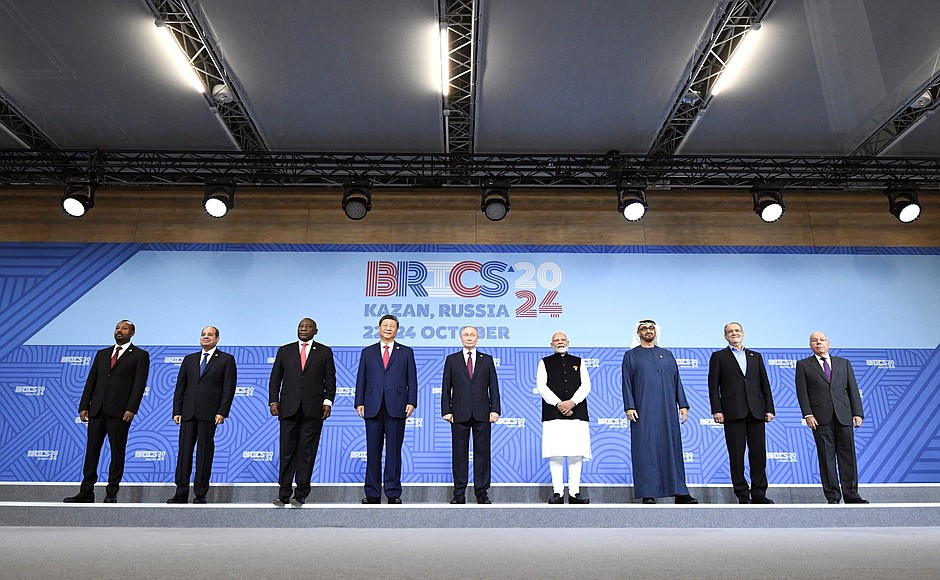
 ANALYSIS
The BRICS summit, a global geopolitical grouping founded by Russia, China, India and Brazil, has ended in Kazan. Not all of the leaders of these countries attended the event – Brazilian President Luiz Inácio Lula da Silva did not come because he allegedly suffered an injury when he fell in the bathroom. Instead, UN Secretary-General Antonio Guterres came to shake hands with the world’s main terrorist.
One of the key questions that interested Ukrainians and many in the world was what position the summit participants would take on Russian aggression in Ukraine. As it turned out, the BRICS members are in no hurry to support Russia with both hands.
The final declaration of the Kazan summit mentions Ukraine only once – in paragraph 36.
“We recall the national positions on the situation in and around Ukraine, as expressed in the relevant fora, including the UN Security Council and the UN General Assembly. We emphasise that all states should
act in accordance with the purposes and principles of the UN Charter in their entirety and interrelatedness. We note with satisfaction relevant offers of mediation and good offices,
aimed at ensuring a peaceful settlement of the conflict through dialogue and diplomacy,” the declaration reads,
– the declaration reads.
Thus, the summit participants stressed that each state remains committed to its position on the Russian-Ukrainian war. This was noted in particular by the Ministry of Foreign Affairs of Ukraine. It noted that Russia had failed to “export” its neo-imperialist views on changing the world order to the BRICS summit participants, and that there was, in fact, no alternative position to the “Global South”.
“The Declaration demonstrated that the BRICS as an association does not have a single position on Russian aggression against Ukraine. We are convinced that this is due to the support of the absolute majority of these countries for the goals and principles of the UN Charter, as also stated in the statement. Such support is incompatible with support for aggression or changing borders by force, and therefore incompatible with support for Russia and its aggressive war against Ukraine,”
– the Ministry of Foreign Affairs said, presenting the situation in a rosy light.
Follow us on Telegram: top news in a nutshell
However, the Institute for the Study of War (ISW) agrees with this assessment:
“The adoption of the Kazan Declaration on the second day of the BRICS summit in Kazan, Tatarstan, on 23 October demonstrated that Russia has not yet secured international support or created an alternative security structure as the Kremlin wishes.”
The Foreign Intelligence Service of Ukraine emphasised that even leaders of such loyal states as Cuba and Serbia did not come to Russia. While last year’s summit in South Africa brought together more than 30 world leaders, this year less than 20 came to Russia.
“Despite the Russian side’s attempts to promote the event as a geopolitical victory for Russia, the absence of many representatives of the association negates the Kremlin’s intentions,”
– the intelligence officers say.
The top leaders who did attend, namely Xi Jinping and Narendra Modi, also did not publicly voice exactly what Russia would have liked. The Chinese leader said that China “has chosen the right way to build relations between the two countries, based on the principles of non-alignment, non-confrontation and non-alignment against third parties”. And Modi, despite his warm embrace with Putin, also repeated his traditional message: the war “must be resolved by peaceful means” and India supports “the early establishment of peace and stability”.
Although these positions are far from pro-Ukrainian, it is clear that Russia has not yet succeeded in creating a monolithic and unified striking force against the West.
The results of the Kazan summit are positively assessed by those who are entitled to do so. For example, fugitive Ukrainian traitor Oleg Tsarev, who is simply obliged to support the Kremlin’s general line, saw the declaration as a positive for Russia:
“The final BRICS declaration contains no mention of the need to refrain from strikes on energy, shipping, or the use of nuclear weapons. The hopes that the BRICS countries would put pressure on Russia in favour of Ukraine did not come true,”
– tsarev wrote.
Follow us on Telegram: the main news in a nutshell