Officials’ crypto: how officials “encrypt” millions in Bitcoin and USDT
25 August 2025 19:11 INFOGRAPHICS
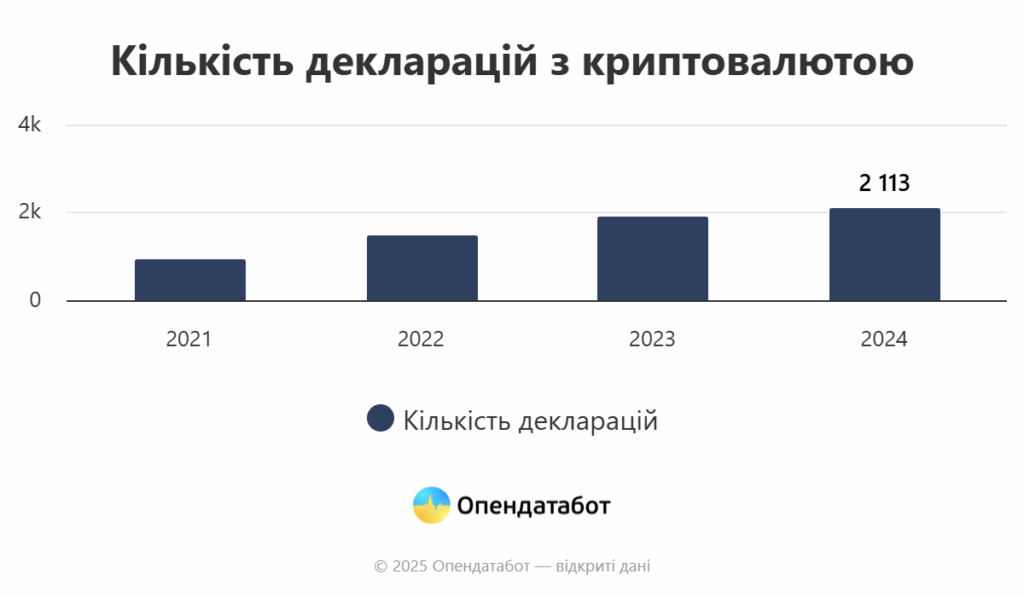
Officials are increasingly declaring cryptocurrencies – this year, more than 2,100 such entries appeared in their declarations, which is 10% more than a year earlier and 2.2 times more than before the war. However, at the same time, new “schemes” have emerged to help civil servants hide their wealth, "Komersant Ukrainian" reports, citing information from the National Agency for the Prevention of Corruption (NAPC).
The total value of crypto assets in the declarations of officials for 2024 is approximately UAH 786 million (an increase from UAH 526 million in 2023 and UAH 371 million in 2022).
Who declares what in Ukraine
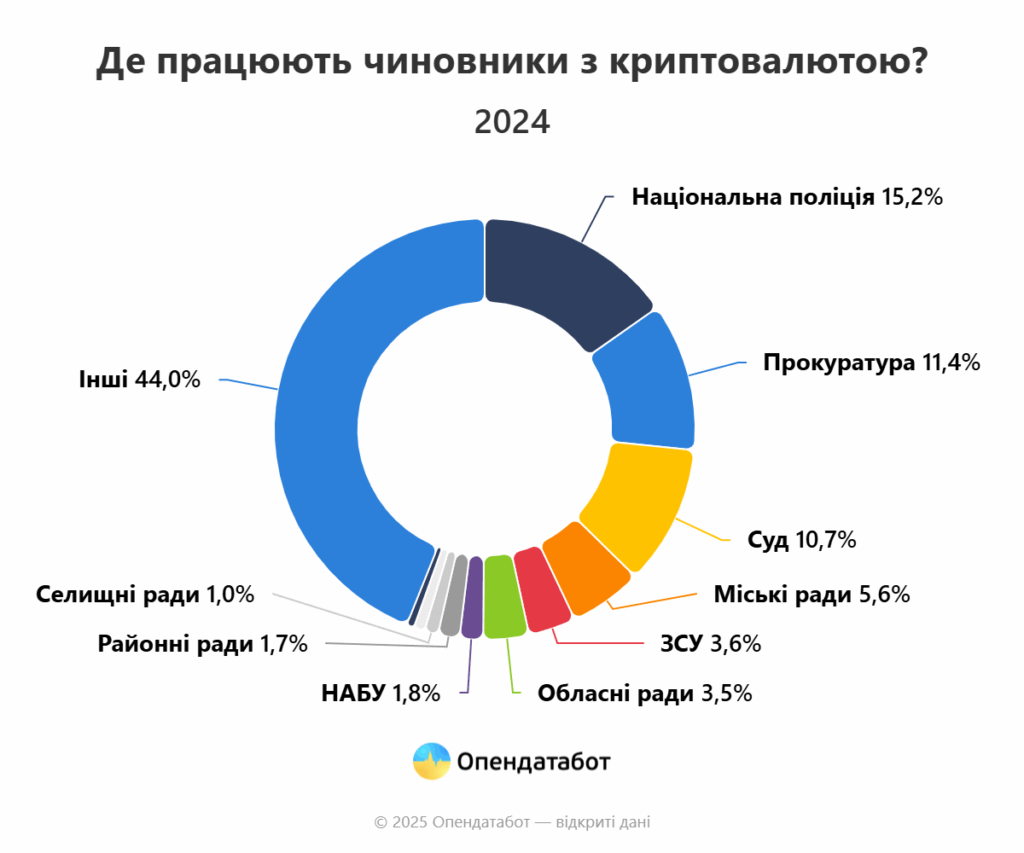
Cryptocurrencies are most often mentioned in declarations by representatives of law enforcement agencies:
- representatives of the National Police – 322 declarations (15.2%);
- prosecutors – 240 declarations (11.4%);
- judges – 227 declarations (10.7%);
- city council officials – 119 declarations (5.6%);
- Armed Forces of Ukraine – 77 declarations (3.6%);
- nABU employees – 38 declarations (1.8%).
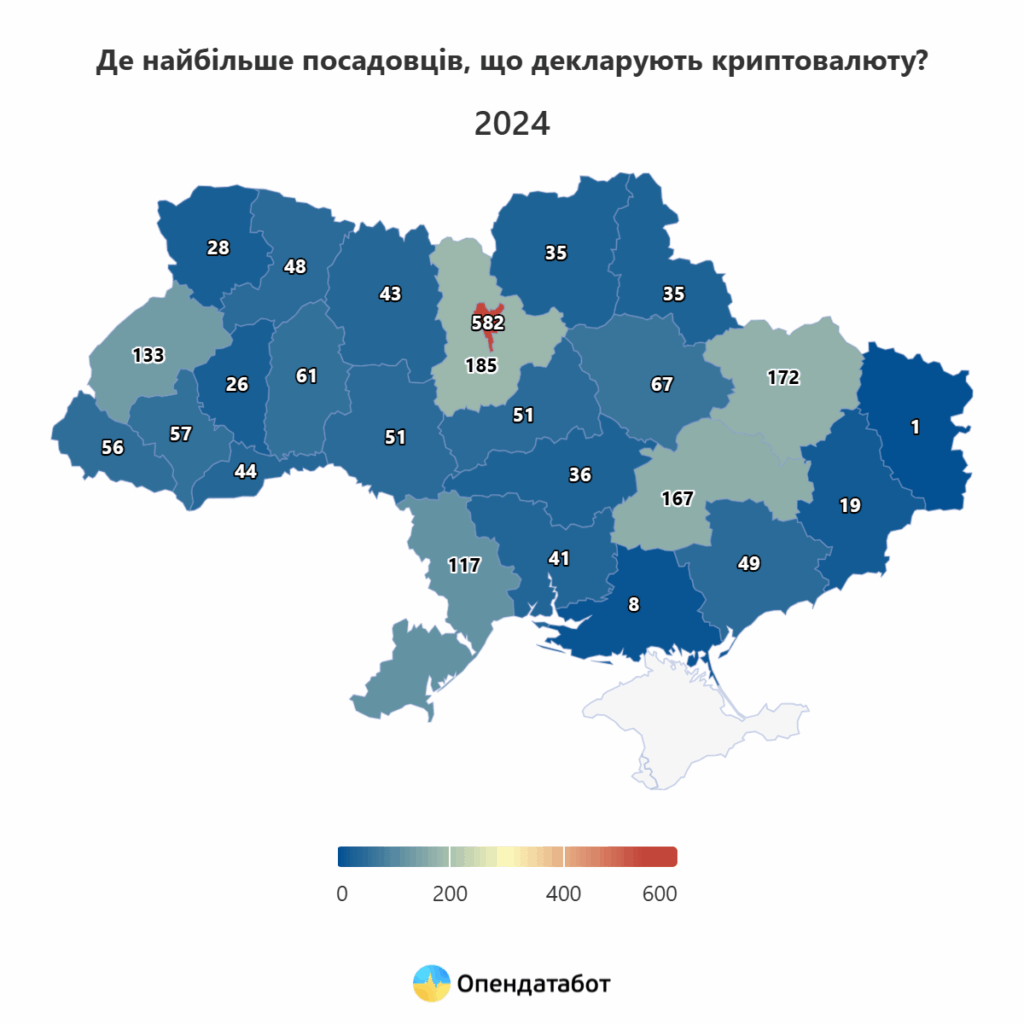
In terms of the regional structure, Kyiv and its region are the leaders (582 and 185 declarants), followed by Kharkiv (172 declarants), Dnipro (167 declarants), and Lviv (133 declarants).
What virtual monetary assets are popular with officials in Ukraine
The most popular cryptocurrencies among officials are:
- USDT (Tether) – 802 mentions in declarations;
- Bitcoin (BTC) – 731 mentions;
- Ethereum (ETH) – 713 mentions.
Which officials own the largest crypto assets
The top declarations include:
- Oleh Bondarenko (Chairman of the Verkhovna Rada’s Environmental Committee) – 80 BTC (~279 million UAH);
- Sergiy Maisel (MP) – 200 ETH (~UAH 15.5 million);
- Vitaliy Brovko (Head of the Department of the Prosecutor General’s Office of Ukraine) – 847,908 USDT (~35 million UAH).
Read also: A new era of corruption: how cryptocurrency has become a means of bribery in Ukraine
The most common violations during cryptocurrency declaration
The most common violation in the declaration of cryptocurrency is the inability to confirm its presence. Often, officials declare significant crypto assets without providing evidence of their reality: there are no verified crypto wallet addresses, stock exchange statements, or even screenshots. Usually, these are assets that, according to the declarants, were acquired many years ago for symbolic amounts. Declaring fictitious assets is a deliberate violation that cannot be explained by inattention or ignorance of the rules.
Among the most common explanations given by declarants who declared unconfirmed cryptocurrency are loss of access to the wallet due to a forgotten password, theft of hardware, or loss of a physical key. However, they do not provide any documentary evidence, although modern crypto wallets usually include recovery mechanisms. Another common explanation is the purchase of assets for cash through unidentified persons or illegal services without any supporting documents.
In addition to declaring unconfirmed assets, a common type of violation is the submission of false data on real cryptocurrency assets: their value, quantity, and date of acquisition. Declarants often rely on the market rate as of December 31 (the end of the reporting period), which is incorrect. According to the Law, the declaration must indicate the value of the asset based on the actual costs of its acquisition. There are also cases of deliberate underreporting of the value at the time of acquisition to avoid additional questions about the origin of funds.
NACP audits have repeatedly revealed facts of false declaration of crypto-savings by officials.
For example, the former head of the State Migration Service in Odesa region declared 37 BTC worth over UAH 57.7 million in his wife’s name, but could not provide evidence of his wealth. He has already been notified of suspicion under Art. 366-2 of the Criminal Code of Ukraine. The penalty for the crime includes a fine, community service or restriction of liberty, as well as deprivation of the right to hold certain positions.
Another example is the former head of justice in Dnipro, who declared income from the sale of crypto assets worth more than UAH 2.5 million without any documents to support it.
Another civil servant (deputy director of the State Enterprise “Hall of Official Delegations”) declared 10 BTC (~5.8 million UAH). The official did not provide any supporting documents for the declared asset, but stated that he had made a mistake when filling out the declarations. The declarant’s explanation was refuted during the full audit. The National Police of Ukraine is conducting a pre-trial investigation under Art. 366-2 of the Criminal Code of Ukraine.
Дивіться нас у YouTube: важливі теми – без цензури
NACP control tools in the field of cryptocurrency
The NACP has technical means to verify the origin of crypto assets – including analysis of blockchain transactions, verification of public addresses and cooperation with cyber police. Abuse is often based on the inability to verify assets: wallets are declared, but no evidence is attached – no screenshots, no stock excerpts.
Although the number of cryptocurrency declarations by public officials is growing, they often remain unconfirmed or contain deliberately false information. This is not only a risk to the credibility of the public sector, but also a source of potential investigations and criminal prosecution. Comprehensive inspections by the NACP, combined with cooperation with law enforcement agencies, are becoming an important tool for financial control and fighting corruption.
Читайте нас у Telegram: головні новини коротко