Where Ukrainians are leaving: Top countries that have accepted IDPs
29 October 2025 20:05
According to official figures, 5.6 million people have been forced to leave their homes and seek refuge in Europe because of Russia’s military aggression against Ukraine. This is reported by "Komersant Ukrainian" with reference to information from the UN Refugee Agency.
Most Ukrainian refugees went to:
- Germany – 1,233.3 thousand people;
- Poland – 1,006.9 thousand
- Czech Republic – 397.3 thousand;
- France – 73.6 thousand;
- Spain – 247.9 thousand;
- Italy – 175.1 thousand;
- Great Britain – 254.6 thousand.
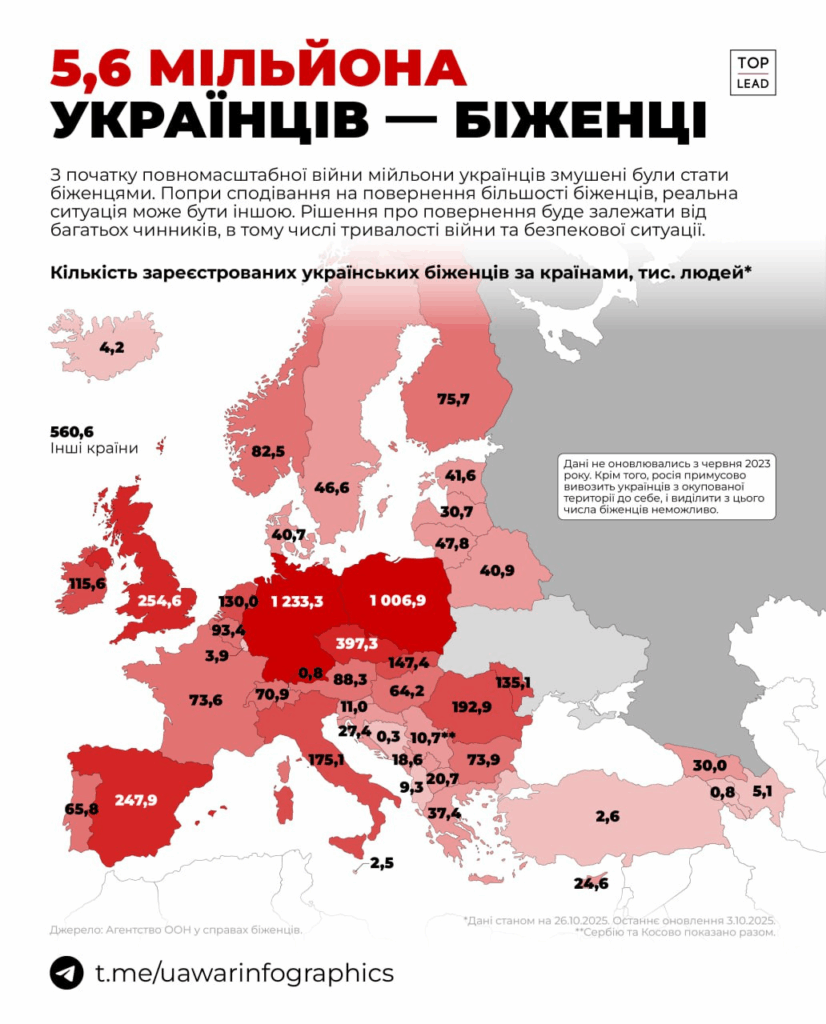
Significant clusters of IDPs were registered in the Netherlands – 130.0 thousand, Belgium – 93.4 thousand, Austria – 88.3 thousand, Switzerland – 70.9 thousand, Ireland – 115.6 thousand. Significant figures are recorded in Romania – 192.9 thousand, Hungary – 64.2 thousand, Slovakia – 147.4 thousand, Moldova – 135.1 thousand. In general, this is the largest forced demographic flow in the history of Ukraine, which requires a long-term policy of return and integration.
The data is relevant as of 10/26/2025. At the same time, it should be understood that Russia is forcibly removing Ukrainians from the occupied territories to its territory, and it is impossible to identify refugees among these displaced persons. Therefore, the global figure of 5.6 million does not reflect the full picture of forced deportations and internal displacement in Ukraine.
In addition, the statistics are based on the list of registered Ukrainians who have applied for temporary protection and related statuses in European countries. The actual scale may be larger and the structure more mobile due to movements within the EU.
Geography of settlement
The most popular countries for Ukrainians, Germany and Poland, have hosted more than 2.24 million refugees together, providing large-scale programs of temporary protection, housing, access to healthcare and education.
Central Europe (primarily the Czech Republic, Slovakia, Romania, and Hungary) has become a transit hub, but is gradually turning into a permanent place of residence for some families who have left Ukraine.
And Moldova, with 135.1 thousand displaced persons, remains one of the busiest destinations in terms of refugee-to-population ratio.
In contrast, Scandinavian countries provide dispersed accommodation, focusing support on language and vocational courses.
Ukrainians fleeing the war also settle in:
- Estonia – 41.6 thousand,
- Latvia – 30.7 thousand,
- Lithuania – 47.8 thousand.
- Norway – 82.5 thousand,
- Sweden – 46.6 thousand,
- Finland – 75.7 thousand,
- Denmark – 40.7 thousand,
- Iceland – 4.2 thousand.
In the south of the European continent, Greece (37.4 thousand), Turkey (2.6 thousand), Malta (2.5 thousand), Bulgaria (73.9 thousand) received our fellow citizens
65.8 thousand Ukrainians settled in Portugal. Another 560.6 thousand forced migrants are in other regions.
Read also: Escape from mobilization: how and where men have left Ukraine since 2022
5.6 million refugees abroad: how the diaspora is changing the economies of Ukraine and the EU
The concentration of refugees in industrialized EU countries has had a two-sided effect. For the countries that host IDPs, it is an additional labor resource in the segments of scarce labor: logistics, care, HoReCa, construction, and IT.
But for Ukraine, this means a significant outflow of skilled labor, some students and researchers, and a long-term risk of families being “fixed” abroad. At the same time, remittances from the diaspora partially support consumer demand in the country, and skills and savings acquired abroad can accelerate the recovery if targeted return programs are implemented.
Watch us on YouTube: important topics – without censorship
Return or integration forever? What does the Government of Ukraine offer?
The decision to return depends on the duration of the war, the security situation, access to housing, work and education in Ukraine. It is important for the government to synchronize reconstruction programs with return instruments:
- tax incentives for small businesses;
- grants for relocation;
- restoration of schools and kindergartens;
- targeted support for rental housing;
- fast validation of diplomas and experience gained in the EU.
It is important to develop municipal “return portals” that will bring together vacancies, training, healthcare, and integration services into one digital route.
Read us on Telegram: important topics – without censorship