Tensions are rising in three regions at once: an IDF officer has assessed the risk of a new global war
16 March 17:31
The global security situation is rapidly deteriorating in several regions around the world. North Korea is launching a dozen ballistic missiles toward the Sea of Japan, Japan is forming a crisis response headquarters and reviewing its military policy, statements about a possible new conflict are being made in the Balkans, and Iran is directly threatening Ukraine, calling it a “legitimate target.” At the same time, Belarus’s self-proclaimed president, Alexander Lukashenko, is once again intimidating neighbors with the threat of using the “Oreshnik” missile. Against the backdrop of these events, a question that seemed far-fetched just a few years ago is being asked with increasing frequency: Is the world entering a phase of major global confrontation? Several regional crises—in East Asia, the Middle East, and Europe—are beginning to overlap, forming a dangerous geopolitical configuration. What is really behind these events, where are the real military risks, and where are the political signals or information maneuvers— [Kommersant] investigated.
The Balkans: Is a New War in Europe Possible?
IDF Reserve Officer Grigory Tamar analyzed these events in an exclusive commentary for “Kommersant Ukrainian.” Despite the loud statements from the Serbian leadership, Tamar considers the scenario of a large-scale conflict in the Balkans unlikely. In his opinion, Albanian policy plays a key role in preventing escalation.
Despite the loud statements from Serbian leadership, Tamar considers the scenario of a large-scale conflict in the Balkans unlikely. In his view, Albania’s policy plays a key role in preventing escalation.
“I think this is a very unlikely scenario. The Albanian government’s behavior in recent years has been extremely rational and constructive. Such a reckless move simply does not fit with this country’s reputation. Based on the logic of Albanian policy, such a turn of events seems highly doubtful,” Tamar noted.
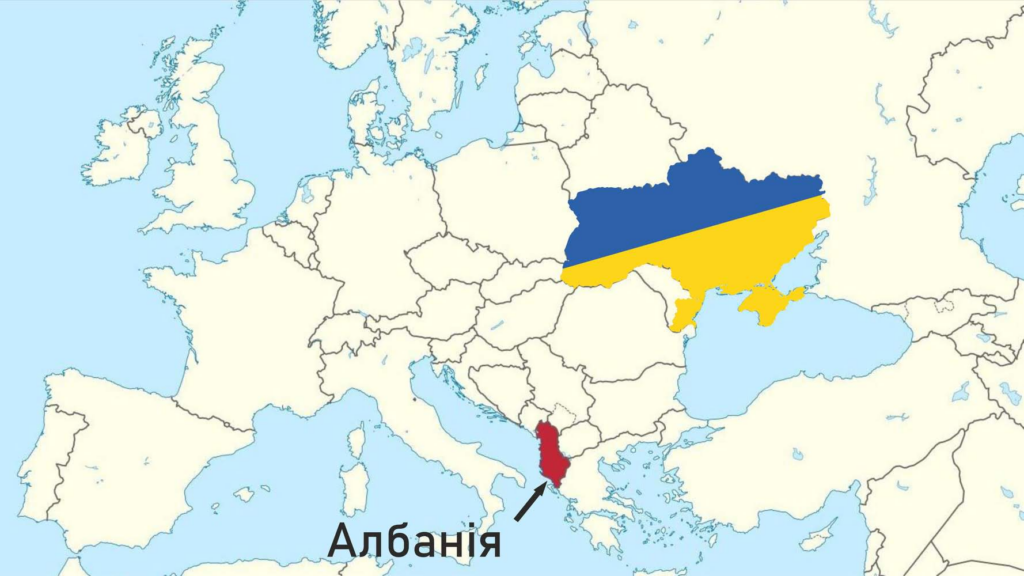
He also pointed out that Albania, despite its special status in Europe, pursues a fairly pragmatic foreign policy.
“Albania is, in fact, the only Muslim country in Europe, but at the same time, its policy in recent years has been very pragmatic. Therefore, I see no reason why it would suddenly become the initiator of a major military adventure,” Tamar explained.
North Korea and Missiles: A Real Military Threat
Much more serious, according to the IDF reserve officer, is the situation on the Korean Peninsula. North Korea launched about ten ballistic missiles toward the Sea of Japan. This was reported by the Japanese Ministry of Defense. According to their data, the launch took place at 1:24 p.m. local time from the west coast of North Korea. The missiles flew approximately 340 km and reached an altitude of about 80 km. Following the launch, Japan established a crisis response headquarters and began analyzing the situation.
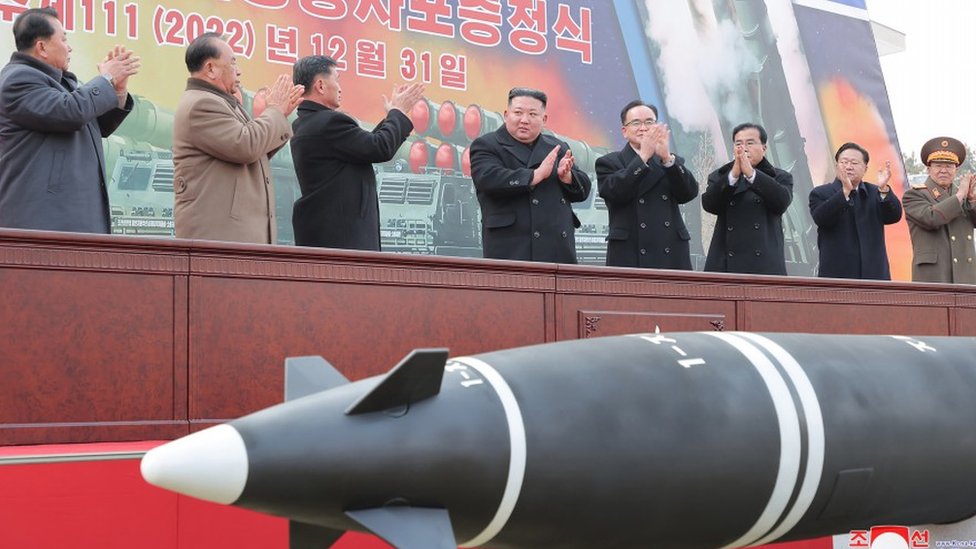
North Korea has a massive army, but its main strength lies not in modern technology, but in the sheer volume of its weaponry and the strategic positioning of its artillery.
“North Korea has a very large army, although it is largely technologically outdated. But one of their strongest assets is their artillery. It’s about twenty kilometers from Seoul to the border. In fact, even conventional barrel artillery can shell the city,” explained Grigory Tamar.
According to the officer, massive artillery positions are deployed along the DPRK border, which in the event of war could deliver a catastrophic strike against the South Korean capital.
“Entire fields of artillery batteries are concentrated along the border. And the Koreans understand perfectly well: if war breaks out, the first thing that will happen is that the metropolis of Seoul, home to tens of millions of people, will come under massive shelling,” said Tamar.
However, South Korea is actively building up its own defense capabilities and developing modern weapon systems.
“South Korea isn’t sitting idly by either. It was there that a missile with a warhead was developed, whose explosive power is comparable to a tactical nuclear charge. This is a response to North Korea’s nuclear capabilities,” the officer noted.
He emphasized that South Korea’s defense industry is now among the strongest in the world.
“South Korea has a very powerful modern army and produces top-tier military equipment. In terms of quality, it is on par with leading Western manufacturers—Germany, the U.S., or Israel,” Tamar said.
Japan is changing its military policy
Japan is becoming another important security factor in the region, as it is effectively revising its postwar military doctrine. Japanese Prime Minister Sanae Takaichi stated that Tokyo is considering possible steps to ensure the safety of ships linked to Japan in the Strait of Hormuz amid the U.S. and Israel’s war against Iran. At the same time, she noted that the United States has not yet made an official request for the deployment of Japanese ships, and the government is merely analyzing possible actions within the framework of existing laws, as the country’s constitution restricts the use of the Self-Defense Forces abroad.
“Japan has announced that it is significantly increasing its defense budget and beginning to transform its Self-Defense Forces into a full-fledged military. In reality, its defense industry has long been operating in wartime mode—especially since Russia attacked Ukraine,” Tamar noted.
In addition, Japan is increasingly forming security alliances in the region.
“Japan positions itself as one of the main democratic forces in the Far East and is rallying other democracies in the region—South Korea, Taiwan, and the Philippines—to contain the expansion of China and North Korea,” the officer explained.
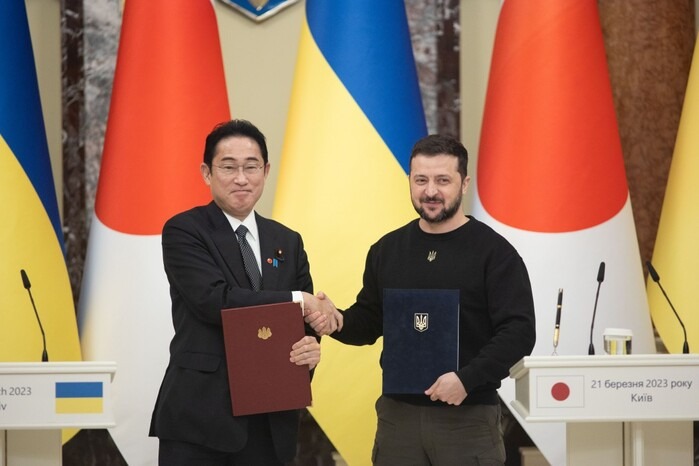
Moreover, the Japanese government plans to purchase Ukrainian-made strike drones to strengthen its defense capabilities, Kyodo News reports, citing sources. Ukrainian UAVs are known for their long flight range and resistance to electronic jamming. According to a representative of Japan’s Ministry of Defense, Ukraine is rapidly modernizing its drones based on combat experience, making them extremely effective. President Volodymyr Zelenskyy previously highlighted Ukraine’s successes in the mass production of drones for air defense and expressed hope for cooperation with Tokyo in this area.
Belarus as an Aggressor State
Belarus’s self-proclaimed president, Alexander Lukashenko, threatened to use the “Oreshnik” missile if, in his words, other states “meddle” with the country’s borders. According to Russian propaganda media, he stated that Minsk allegedly does not plan to strike the capitals of neighboring states but is ready to use weapons to “defend its territory” in the event of a threat from Ukraine, Poland, Lithuania, or Latvia. Tamar emphasized that Belarus’s role in the war has long been beyond doubt.
“It is quite obvious that Belarus is an aggressor state, just like Russia. Russian troops entered from its territory, and strikes were launched from its territory. Russian military units are stationed on its territory,” Tamar stated.
According to him, this is precisely why military facilities on Belarusian territory are legitimate targets in the war.
“Military targets on Belarusian territory are absolutely legitimate targets—there’s nothing to discuss here,” the officer emphasized.
Iran and Threats to Ukraine
Ibrahim Azizi, chairman of the Iranian Parliament’s National Security and Foreign Policy Committee, stated that Ukraine has allegedly become a “legitimate target” for Iran due to Israel’s assistance with drones. According to him, such support makes Kyiv a participant in the war. Meanwhile, U.S. President Donald Trump previously stated that the United States does not need Ukraine’s help to intercept Iranian drones in the Middle East.
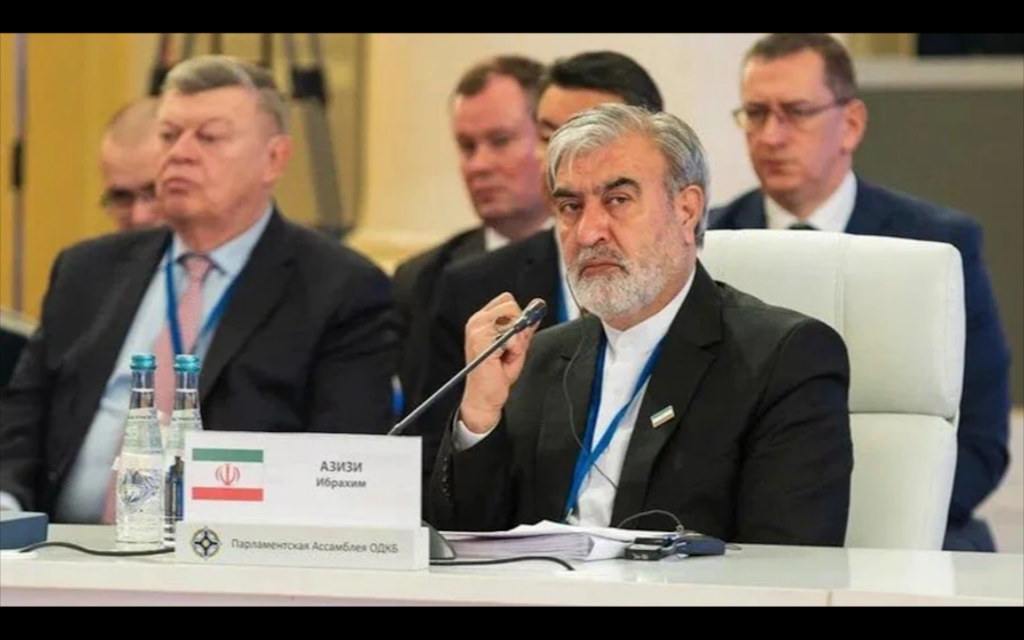
Separately, Tamar commented on statements by Iranian politicians threatening Ukraine over its contacts with Israel. In his view, such statements appear particularly cynical given Iran’s military cooperation with Russia.
“Iran has been supplying Russia with weapons for four years now, weapons that are destroying Ukrainian cities and killing thousands of people. Therefore, their threats against Ukraine look like outright hypocrisy,” Tamao emphasized.
At the same time, he noted that even if Iran attempted to attack Ukraine, its capabilities would be limited.
“Yes, Iran could theoretically launch a few missiles toward Ukraine. But compared to what Russia does every day, Ukrainians might not even notice it,” Tamau said.
Cooperation Between Ukraine and Israel
Despite criticism directed at Israel regarding insufficient support for Ukraine, cooperation between the two countries is actually much broader than it appears publicly.
“The aid that is openly discussed is far from everything Ukraine receives. Believe me, time will pass, and we will learn about many things that cannot be discussed today,” the officer concluded.
According to him, in recent months alone, Israel has transferred dozens of water purification and desalination units to Ukraine, and high-level diplomatic contacts between the countries take place regularly.
The global situation demonstrates that global security is currently under significant strain: from North Korea’s missile launches to threats from Iran and military rhetoric in the Balkans and Belarus. However, real military threats to Ukraine and other countries in the region are limited, and most of the high-profile statements serve as political signals and information maneuvers. Strengthening one’s own defense capabilities and international cooperation remain strategically important, allowing for an effective response to potential threats and the containment of escalation.