Not only borsch. Putin accused of trying to appropriate Immanuel Kant
24 April 2024 13:34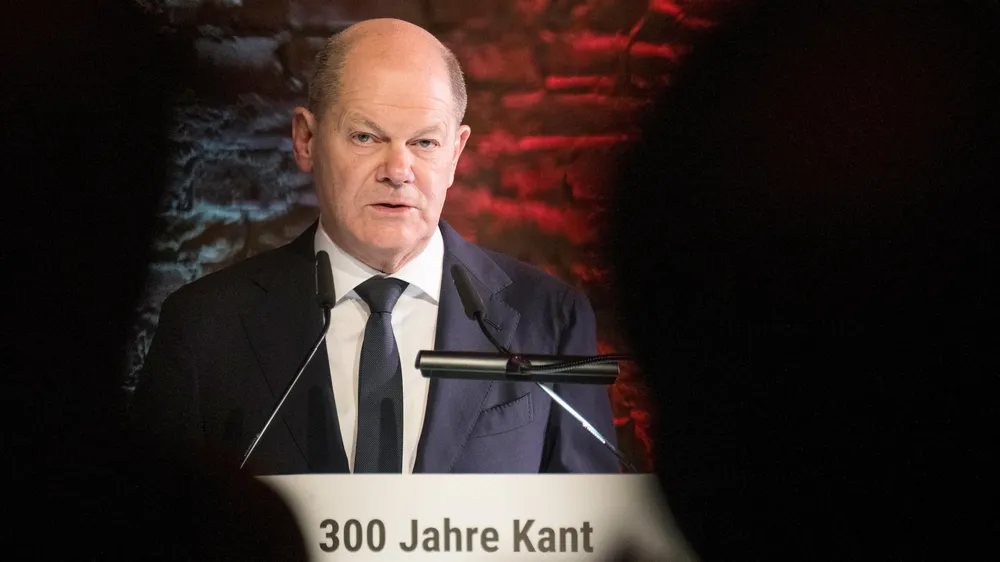
German Chancellor Olaf Scholz has accused Russian President Vladimir Putin of trying to appropriate the legacy of the great German philosopher Immanuel Kant. He said this during a speech at the ceremony of the Berlin-Brandenburg Academy of Sciences on the occasion of the 300th anniversary of Kant, Komersant ukrainskyi  with reference to Zeit.
The chancellor denied Putin the right to refer to the philosopher, because Putin’s war of aggression contradicts all of Kant’s fundamental statements, Scholz said.
“Putin has no right to invoke Kant. Nevertheless, the Putin regime remains committed to appropriating Kant and his work at almost any cost,”
– scholz said.
Putin likes to call Kant, whose hometown of Königsberg is now the Russian exclave of Kaliningrad, his favourite philosopher, but according to Scholz, Kant’s ideas on human rights and human dignity, as well as his thoughts on war and peace, cannot be reconciled with what the Russian president practices in his country and in Ukraine. The dignity and autonomy of the individual is nipped in the bud every day under Putin’s autocracy, Scholz said.
Russian attacks and devastation in Ukraine, according to Scholz,
“represent a desire to destroy that, because of its absolute excess, few of us in 21st century Europe could have imagined.”
Back in 2005, the Russian president said: “Kant was a categorical opponent of resolving interstate disputes through war. And we are trying to adhere to this part of his teachings… I believe that the vision presented by Kant should and can be realised by our generation.”
Now, Putin is using Kant to hide his aggressive policy. In 2024, Putin redefined the philosopher, saying: “Kant is a fundamental thinker. And his call to use our own reason is extremely timely. For Russia, this practically means that we are guided by our national interests.”
This is absurd, Scholz believes, as Kant explicitly spoke out against state interference in the affairs of other states. Scholz believes that the philosopher’s ideas are not suitable as a cover for aggressive war, violation of international law and despotism.
The Chancellor also emphasised the relevance of Kant’s work On Perpetual Peace. Although this text does not provide “practical guidance on how to resolve military conflicts in the 21st century,” it does contain sensible advice that is worth paying attention to, he said. “Everyone who is attacked is allowed to defend himself.” True peace always goes beyond a simple ceasefire and postponement of hostilities, Scholz said.
How Russia wanted to appropriate borsch
Appropriation is one of the traditional mechanisms of Russia’s imperial policy in the humanitarian sphere. In recent years, Ukraine and Russia have been engaged in real cultural, diplomatic, and propaganda wars for the right to borsch. On global platforms, Russia began to aggressively promote the idea that borsch is a Russian dish. When it became clear that Russia was taking the dish away from us, Ukraine submitted an application for borsch to be included in the UNESCO heritage on 31 March 2021. In response, Russia habitually accused Ukraine of Nazism, linking it to the banning of literature in the Third Reich.
“Even cookery books were banned. Why? Because you couldn’t share borsch. You couldn’t It had to belong to only one person, to one nation. But not so that it could be shared, and so that in every city or every region the hostess could cook it in her own way. They did not want to compromise. So this is xenophobia, Nazism, extremism of all kinds,”
– said Russian Foreign Ministry spokeswoman Masha Zakharova.
Ukraine managed to win this struggle – on 1 July 2022, UNESCO added “Ukrainian borsch” to the representative list of the intangible cultural heritage of humanity. However, misconceptions are still ubiquitous around the world. For example, Yevhen Klopotenko failed to open a restaurant dedicated to Ukrainian borsch in Japan, as borsch is considered a Russian dish in Japan.