New border crossing rules are already in effect: what has changed for carriers
24 November 2025 10:14
As of today, Ukraine has officially launched updated rules for the operation of the electronic queue for freight transport, eChezha. The reform, enshrined in Decree No. 1028 of June 20, 2025, is designed to streamline queues at the border, eliminate the chaos of multiple entries, and make traffic more predictable, "Komersant Ukrainian" reports
The system operates with new restrictions and liability mechanisms that are already affecting the way all carriers register and plan trips.
Why the rules had to be changed
Although eCherge was created to reduce congestion at checkpoints, in practice the system was overloaded with false or “extra” entries. Some drivers registered “in reserve” or did not arrive at the designated time.
This led to
- chaotic movement of the queue;
- inability to predict the time of border crossing;
- artificial increase in queues;
- delays for bona fide carriers.
In October alone, more than 25,000 cancellations were recorded, most of which were made by users themselves.
What has changed in the work of “eChezhda”
1. Limit on the extension of the record
Only one queue extension per truck is allowed within 60 days.
As before, the carrier can choose the extension interval:
- 4 hours
- 6 hours
- 8 hours
- 10 hours
This will avoid the endless time postponements that used to disrupt the schedule at the border.
2. Introduction of liability for violation of the rules
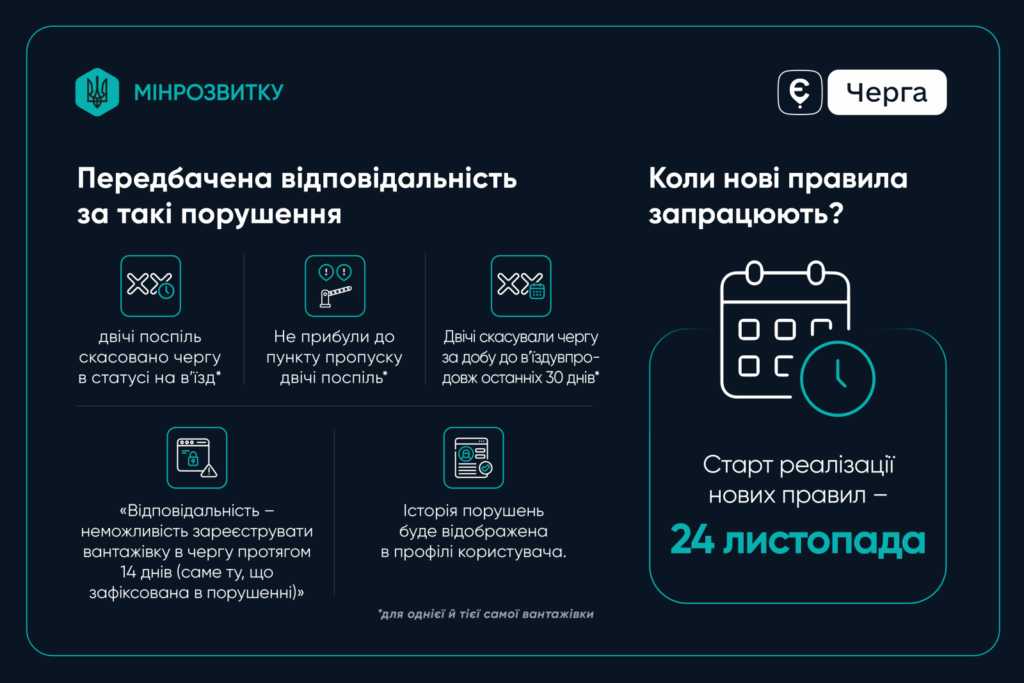
If the system detects repeated violations, a particular truck will be blocked from creating a new queue for 14 days.
This is the first systemic restriction aimed at disciplining market participants.
What violations result in a 14-day ban
The block is applied to a vehicle if:
- twice in a row, the queue in the status of “for entry to the checkpoint” has been canceled;
- the truck has not arrived at the checkpoint twice in a row;
- the queue has been canceled twice within 30 days.
In fact, we are talking about situations where a vehicle does not use a booked spot, despite the fact that other carriers are waiting for it.
The problem is becoming widespread: in October alone, the system recorded more than 25,000 cancellations, of which about 22,000 were made by users themselves.
Many of these drivers immediately created new entries, overloading the queue again.
What it means for carriers now
Now you need to:
- carefully plan the trip and time of arrival at the checkpoint;
- not to create unnecessary entries – it can cost a two-week blockade;
- remember that the queue is allowed to be extended only once;
- avoid canceling without a reason.
In fact, discipline becomes a condition for the safety and speed of border crossing.
The system has already proved its effectiveness: since its launch, more than 2.5 million border crossings have been made with its help. The government expects the new rules to make queues more manageable and predictable.