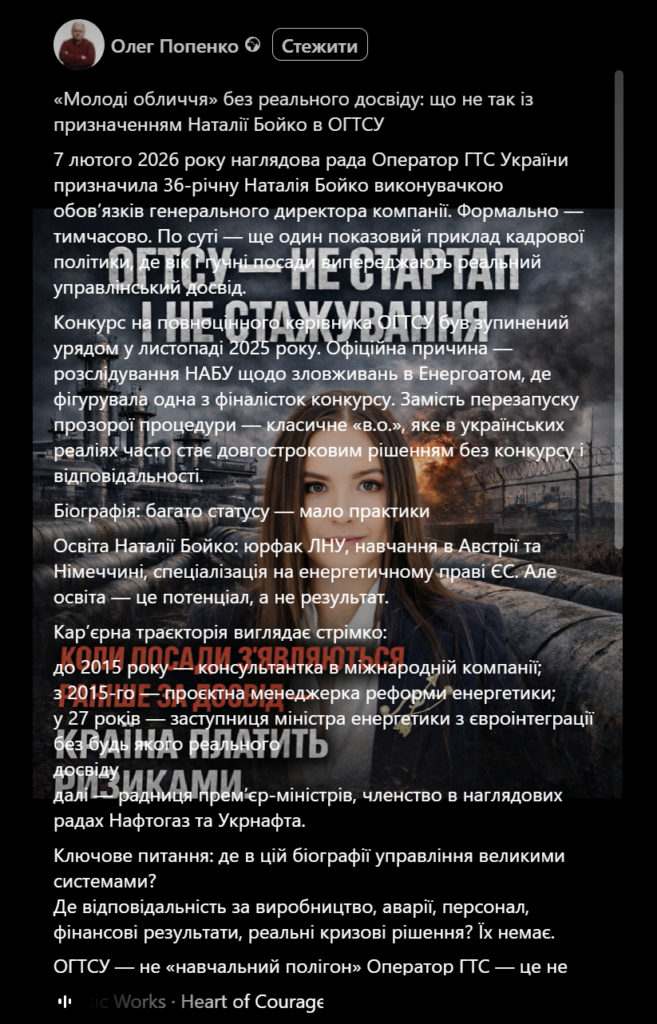
Ukraine’s gas transmission system operator under the leadership of “young faces”: what’s wrong with Natalia Boiko’s appointment
10 February 10:28
The supervisory board of Ukraine’s gas transmission system operator has appointed 36-year-old Natalia Boiko as acting CEO of the company. Formally, this is a temporary appointment. In reality, it is yet another personnel decision that has drawn sharp criticism from experts. Oleg Popenko, an expert on energy and housing and utilities, believes that this appointment is an example of a systemic problem where public status and a rapid career replace real management experience, according to "Komersant Ukrainian".
Earlier, by decision of the Supervisory Board, Deputy CEO Natalia Boiko was included in the OGTSU Directorate.
Natalia Boiko has over 15 years of professional experience in the energy sector. In particular, she held the position of deputy chair of the supervisory board of Naftogaz of Ukraine, as well as the positions of advisor to two Prime Ministers of Ukraine and deputy Minister of Energy for European Integration.
As of today, the Company’s Management Board consists of: Natalia Boiko, Vladislav Medvedev, Boris Lyubich, Kateryna Kovalenko, and Oleksandr Tymofeyev.
“Acting” instead of a competition — the old scheme
The competition for a full-fledged head of OGTSU was stopped by the government in November 2025. The official reason was the NABU investigation into abuses at Energoatom, where one of the finalists in the selection process was involved.
However, instead of restarting a transparent competition, the path of appointing an acting head was chosen.
“It has become the norm for us: the competition was stopped, and an ‘acting’ person was appointed. And then this person manages a strategic company for years without competition, KPIs, or personal responsibility,” emphasizes Oleg Popenko.
Biography: a rapid career without systems management
Natalia Boiko has a law degree (from Lviv National University), studied in Austria and Germany, and specializes in EU energy law. However, according to the expert, education does not equal management results.
Boiko’s career path looks fast:
- until 2015 — consultant for an international company;
- since 2015 — project manager for energy reform;
- at 27 — Deputy Minister of Energy for European Integration;
- then — advisor to prime ministers, work on the supervisory boards of Naftogaz of Ukraine and Ukrnafta.
“The key question is simple: where is the management of large systems? Where is the responsibility for accidents, personnel, financial results, crisis decisions? There is no such experience,” Popenko notes.
OGTSU is not a training ground
The expert emphasizes that the Ukrainian GTS Operator is not a “training ground.”
“This involves thousands of kilometers of critical infrastructure, billion-dollar contracts, gas supply security, and working in wartime conditions. What is needed here is not the right words, but decades of real management experience,” he emphasizes.
According to Popenko, the head of such a company must have practical experience in managing complex technical and financial systems, not just a political or advisory background.
A systemic problem, not a personal story
The expert stresses that the criticism is not directed against a specific person, but against the personnel model that has been replicated in the public sector for years.
“This is not the story of one person. It is a system where ‘young faces’ quickly get positions without being tested by reality, and ‘acting’ is used as a way to bypass competition,” says Popenko.
The result, he says, is predictable:
“Weak decisions, blurred responsibility, and the traditional question: ‘Who appointed them?'”
The price of experimentation is too high
Ukrainian energy in wartime is a matter of national survival, the expert emphasizes.
“Those who have actually been responsible for complex systems should be in charge, not those who ‘have never really worked a day in their lives’. Otherwise, all these ‘reforms’ and ‘European integration’ will remain just pretty words with very costly consequences,” concluded Oleg Popenko.