Negotiations without illusions: what the trilateral meeting between Ukraine, the US, and Russia in Abu Dhabi really means, and why peace is still on hold
24 January 12:18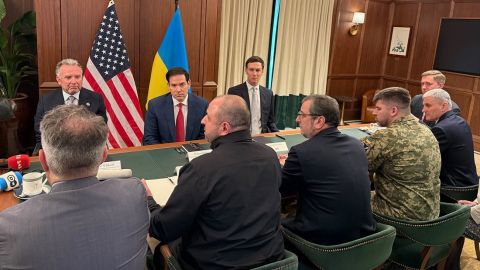 ANALYSIS FROM
Today, an event is taking place in Abu Dhabi that could determine the future configuration of international efforts to end Russia’s war against Ukraine. Representatives of Ukraine, the US, and Russia are meeting in the capital of the United Arab Emirates—the first direct trilateral talks since the start of the full-scale invasion.
Although public expectations are traditionally linked to the possibility of quick agreements or even a breakthrough, experts warn against excessive optimism. For example, according to political scientist Volodymyr Fesenko, the current talks are not a platform for signing either a peace agreement or treaties on security guarantees or economic cooperation. At the same time, the very fact of the meeting has important political significance — primarily as a signal to Washington and personally to Donald Trump about the Kremlin’s alleged readiness for dialogue.
Fesenko says that this is the first attempt at direct trilateral consultations in this format since the start of the full-scale war. In his commentary for "Komersant Ukrainian", the political scientist emphasizes that no breakthrough decisions should be expected, but the very fact of the meeting is of great political significance.
The trilateral format is a signal to Trump
According to the expert, the talks in Abu Dhabi may be an attempt by the Kremlin to demonstrate its readiness for dialogue with the new US administration.
“My version is this: Putin, in order to please Trump and show his constructiveness, will agree to direct negotiations in Abu Dhabi. This is the first time there have been direct negotiations in a trilateral format. There has never been anything like this before,” Fesenko notes.
He recalls that previously, the US had pursued a policy of “shuttle diplomacy,” communicating separately with Kyiv and Moscow, and that previous contacts with Russia had been more of a formality. The political scientist emphasizes that no agreements — neither on security guarantees nor on a large-scale investment agreement with the US — are expected in the near future.
“The Americans will not sign anything with us now. Nothing. They have a simple, rational, and tough tactic: they will sign security guarantees and an investment agreement only when it is clear that a peace agreement will be signed tomorrow,” he explains.
According to Fesenko, this refers to the so-called “Agreement on Ukraine’s Prosperity” — a large-scale investment agreement on post-war reconstruction, which Kyiv had hoped to sign earlier.
The most pressing issue remains Donbas. According to the expert, Russia insists on the unilateral withdrawal of Ukrainian troops, which is unacceptable to Kyiv. He notes that Ukraine has proposed either a ceasefire along the front line or a mutual withdrawal of troops, but Moscow rejects these options.
Energy truce — a possible first step
The expert calls the so-called energy truce one of the realistic topics of the negotiations in Abu Dhabi.
“This can be seen as the first stage of a ceasefire: first energy, then air and sea, and only lastly — combat operations on land,” says the political scientist.
He emphasizes that it is precisely the cessation of strikes on energy facilities that could be the most controllable and technically feasible scenario. Fesenko believes that in the event of agreements, control over their implementation will in fact be exercised by the US.
“The American side has satellite reconnaissance and early warning systems. If a ballistic or cruise missile is launched, it is known exactly where it came from,” he explains.
What to expect next
The political scientist does not predict quick results from the meeting, but considers it an important test.
“I do not expect quick and dramatic results from the talks in Abu Dhabi. But if they continue and real discussions on a ceasefire in the energy sector begin, that will already be almost a breakthrough,” Fesenko concludes.
At the same time, he emphasizes that if Russia makes concessions, there may be a partial reduction in sanctions, but President Volodymyr Zelensky has repeatedly stated that there will be no general lifting of sanctions.
Thus, the negotiations in Abu Dhabi demonstrate the main reality of the current stage of the war: the diplomatic process is formally beginning, but its content remains extremely controversial. The positions of the parties are not simply different — on key issues, they are directly opposite, primarily regarding Donbas and the terms of the ceasefire.
For the US, the current round is a tool for pressure and testing. Washington is not ready to make long-term commitments in the form of security guarantees or investment agreements until there is a real prospect of a peace agreement. This logic makes the American position pragmatic, but at the same time tough for Ukraine, as it effectively links security guarantees to the need to reach a compromise with Russia.
For Russia, participation in the trilateral talks is primarily a diplomatic demonstration. The Kremlin seeks to show its willingness to engage in dialogue without changing its basic demands. As experts point out, Moscow continues to insist on a scenario of unilateral concessions on the part of Ukraine, which makes the achievement of a comprehensive peace agreement unlikely in the short term.
Against this backdrop, a phased approach seems most realistic, starting with limited agreements, in particular on the cessation of attacks on energy infrastructure. Such a scenario does not mean the end of the war, but it could be an attempt to reduce the level of escalation and test the parties’ willingness to adhere to the agreements in practice. The US, which has the technical capabilities to monitor the implementation of the ceasefire, will play a key role in this process.
At the same time, even the successful implementation of an energy truce does not guarantee a transition to the next stages — the cessation of hostilities in the air, at sea, or on land. Without a change in Russia’s position on Donbas, any agreements will remain fragile and limited in time.
Thus, the meeting in Abu Dhabi should be seen not as a turning point, but as the beginning of a complex and lengthy negotiation process. Its outcome will depend not so much on diplomatic rhetoric as on the willingness of the parties to move from demonstrations to real compromises — primarily on the part of Russia. For now, the negotiations remain more of a political game than a mechanism for quickly achieving peace.