Under pressure from Trump, EU plans to cut off Russian gas sooner – Bloomberg
19 September 2025 09:29
The European Union is preparing to accelerate the phase-out of imports of Russian liquefied natural gas (LNG) after US President Donald Trump called on Europeans to fight Moscow’s energy trade more actively. This was reported by Bloomberg, citing its own sources, "Komersant Ukrainian" reports.
Thus, the European Commission is considering including in the new sanctions package a provision to stop imports of Russian LNG earlier than planned – the end of 2027. The new sanctions package may be presented as early as Friday.
RePowerEU
An alternative option is to amend the RePowerEU plan, which provides for complete energy independence from Russia. European Commission representative Anna-Kaisa Itkinen emphasized:
“Since the presentation of the RePowerEU plan in 2022, we have been saying that it is better to wean ourselves off Russian energy sooner rather than later.”
The Trump administration is actively pressuring European allies to accelerate the curtailment of Russian fuel imports and even impose 100% duties on India and China for purchases of Russian oil. However, many EU countries are not ready for such tough measures against Asian partners.
Therefore, the European Commission’s focus is shifting to Russian LNG. An important factor in the decision will be the expected overproduction of gas on the global market in the second half of next year, which will reduce the risks of shortages and price spikes in Europe.
Дивіться нас у YouTube: важливі теми – без цензури
Despite the sharp decline in Russian gas supplies following the full-scale invasion of Ukraine in 2022, Russian gas will still account for about 19% of total EU imports in 2024. The main supplies come through the Turkish gas pipeline and LNG shipments by sea.
Spain, Belgium, and France remain the largest importers of Russian LNG. These countries will be forced to look for alternative sources of supply with the accelerated curtailment of Russian imports.
The United States is ready to increase its LNG supplies to Europe, especially given the launch of new production facilities in the coming years. The commitment to purchase US LNG was a central part of the $750 billion EU-US deal.
Procedurally, a decision through the sanctions package will require the unanimous support of all EU countries, while changes to the RePowerEU plan can be approved by a qualified majority.
The key difference is that the measures under RePowerEU will be permanent, while the sanctions restrictions can be lifted if sanctions against Russia are lifted in the future. This makes the RePowerEU option a more reliable tool for finally severing energy ties with the aggressor.
Читайте нас у Telegram: головні новини коротко
The EU is faced with a choice
Currently, the European Union buys Russian energy so actively that it is quite possible to talk about financing the Russian military machine. For example, in August 2025 alone, the five largest EU importing countries paid Russia 979 million euros for gas, oil, and coal.
This EU funding of Russia fits perfectly with pro-Ukrainian rhetoric. To make it look less bloodthirsty, a price ceiling mechanism was invented and the price of Russian oil was set at $60 per barrel. This means that any EU state that buys Russian oil can only buy it at this price or lower. Thanks to this mechanism, the EU argues, Europe has Russian energy resources, but Russia’s profits from this are significantly limited.
on September 3, the European Union’s decision to reduce the price ceiling for Russian oil to 47.6 dollars per barrel came into effect.
The European Union traditionally assumes that such a measure will hit Russian oil revenues hard. Instead, according to the Center for Research on Energy and Clean Air (CREA), since the beginning of Russia’s full-scale invasion, the EU has bought 213 billion euros worth of energy from Russia. Of this amount, 105 billion euros were paid for oil.
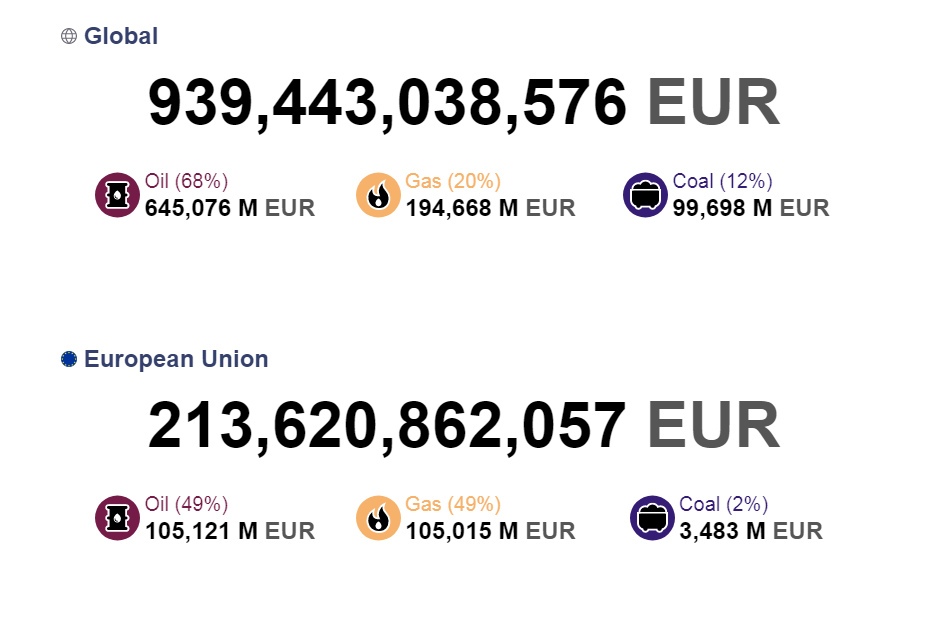
Thus, the EU has spent more money on Russian fossil fuels than on financial assistance to Ukraine.