Penguins, isolation, and polar night: how polar explorers live at the Akademik Vernadsky station
12 January 03:09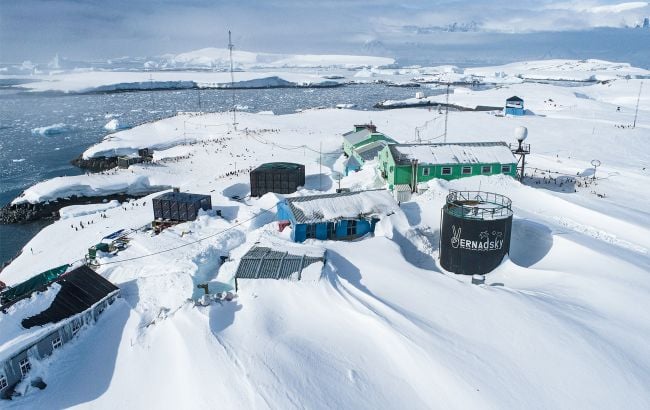
Almost nine months of complete isolation, winds of up to 40 meters per second, polar nights, and life without the usual weekends. This is the reality for Ukrainian polar explorers working at the Akademik Vernadsky Antarctic station.
In an interview with RBC-Ukraine, polar explorer and meteorologist-ozonometer Alexander Poluden described what life is like for Ukrainian polar explorers in Antarctica, what they do, and how they cope with polar nights and storms, reports "Komersant Ukrainian".
Life in isolation
According to Alexander, the team always consists of half experienced winterers and half newcomers. Currently, the expedition includes eight scientists and five people who are responsible for the station’s life support.
“We have three meteorologists and biologists, and two geophysicists. The command support team consists of a mechanic, a diesel engineer, a doctor, a cook, and a system administrator. There are four women among us. The icebreaker Noosphere brought us to the station on March 15. The team delivered everything necessary for the expedition. The changeover takes two weeks. An inventory is taken, employees hand over all their work, and provide instructions on any changes in observations, as our data is then used by the whole world,” says the polar explorer.
The food comes from South America; they eat Chilean potatoes, fruit, and grains, but they also have Ukrainian buckwheat. They only drink bottled water, which they bring with them.
“The water we desalinate at the station is used only for washing, cleaning, and showering. If necessary, special building materials can be delivered to us from Ukraine if they are difficult to find in Chile or Argentina, or if they are expensive,” adds Oleksandr.
For the next 8-9 months after their arrival, when everything around them is frozen, they are completely isolated. They saw the first people during this expedition at the end of October, when the National Geographic Resolution ship arrived.
The Noosphere came to the island for the second time in early December, bringing fresh vegetables, fruit, and a seasonal team of additional scientists and engineers to check that nothing had been damaged over the winter. The station experiences very strong winds, severe frosts, and a lot of icing. Technicians check everything and make repairs as needed.
Amidst snow, without sun or warmth
About 300 days a year, cyclones coming from the north prevail at the station. And only 60 days are anticyclonic, i.e., clear weather. Sunny days here occur only during the polar summer — in December, January, and February. In other months, there are 1-2 days per month.
Severe frosts are rare, with the lowest temperatures at the station recorded in 1958 at -43.3 degrees Celsius. The warmest year was 2022, with a high of 12.7 degrees Celsius. Almost 80 years ago, the average annual temperature was -5.5°C, and now it is between -1.8 and -2°C. This is global warming.
“Right now, we have a polar day, but starting on December 21, we will gradually move toward nighttime. Sunrises and sunsets are not typical here. Even in summer, when the sun hides behind the mainland mountain range, it still remains light outside. During the polar day, we have more work to do because we can carry out field tasks — go on expeditions to collect biological samples. Since the station is located 150 kilometers from the Arctic Circle, during the polar night we have about three hours of twilight per day, and the rest of the time it is dark,” says the Ukrainian polar explorer.
He added that this period is more difficult to endure: people become less active, tire more quickly, their sleep patterns are disrupted, and their bodies do not understand when to sleep because it is almost constantly dark outside.
Life without civilization
Among the threats at the station are strong winds and snow. Wind gusts here can reach 30-40 meters per second. Icing and snowfalls tear cables and wires. The station is sometimes buried up to the very top, and all this snow has to be cleared, otherwise it compacts.
“Before leaving for Antarctica, we are told about all the risks, and experienced winterers share their experiences. We try to take everything into account so that there are no surprises. People are selected for the station so that they can potentially replace each other in performing certain tasks,” explains an expedition member.
There are three diesel generators at the station, one of which is always on standby. All instruments at the station are duplicated so that there are no interruptions in observations. If necessary, readings can be taken again to check for errors.
We don’t have weekends as such, only the cook has Sunday off. The rest take turns cooking on that day. In addition to their main duties, each participant is assigned a specific area near the station, which they must monitor and clear of snow throughout the year.
“We clean the station every day, and on Fridays we do a general cleaning. Only the cook and the night watchman are exempt from this work. After that, as the expedition leader, I give the team some gifts, such as a can of beer or a chocolate bar. There are day and night shifts, during which we have to check all the buildings where the station’s life support equipment, pumps, diesel generators, and desalinators are located every hour. We need to monitor temperatures, pressures, and various indicators,” says the polar explorer about everyday life.
The station sorts its waste. There are containers for paper, plastic, and food waste. There is a special machine that compresses everything, and after the expedition is over, the waste is taken off the island. The same goes for used oil; everything is thought out to the smallest detail.
Holidays and entertainment “at the edge” of the world
The “initiation” into polar explorers takes place at Midwinter, a midwinter holiday that falls on June 21. Newcomers dive into the icy ocean water wearing only swimming trunks and a tie.
“When the team is selected, we immediately think about what gifts to bring with us, because we celebrate birthdays and all holidays here. This year, on St. Nicholas Day, the girls knitted a large sock, and we pulled notes out of it to see who should prepare a gift for whom. And then, figuratively speaking, the organizers distributed them under the pillows. So you wake up in the morning and there’s a surprise waiting for you. This year I got socks with dragons on them,” says Oleksandr.
The station adheres to Ukrainian traditions. On Christmas, there was kutia, varenyky with cabbage and potatoes, salads, and other traditional dishes. The girls sang carols. On New Year’s Eve, we had an artificial Christmas tree and champagne. First, we celebrated 2026 according to Ukrainian time—we have a 5-hour time difference, and dinner was at 7 p.m. Then we celebrated according to local time.
“We dressed up in our best clothes, drank a glass of champagne, and, of course, wished for peace in Ukraine. During the holidays, we took in Norwegians who live in tents on a neighboring island during a short expedition to study penguins. We also had Mexicans staying with us for a couple of weeks who were part of the first Ukrainian-Mexican expedition. Earlier this year, a Ukrainian yacht with tourists docked at our place,” adds the polar explorer.
He admits that he copes well with prolonged isolation, and his family is understanding about his expeditions.
“We have internet here, we can call home, communicate with management, and conduct open online lessons in schools and universities. Each expedition member has their own office, workplace, equipment, consumables, and living space. The station has a gym, a sauna, a recreation room, and a library. We have many different board games. If there is time, you can watch movies. We have skis and snowshoes, so you can go to the mountains or go out to sea on motorboats. So, whoever wants to can do whatever they want in their free time,” says Oleksandr.
He added that the station’s residents are following what is happening in Ukraine. They know that Zelensky flew to Trump for peace talks.
“Each of us here has an alarm on our phone, and we are all subscribed to our city’s Telegram channels. We are in constant contact with our families. Thirty-one polar explorers are currently serving in the Armed Forces of Ukraine. We even help our ‘combat penguins’ from the station. We organize various gatherings to meet their needs. We participate in auctions, hold open lessons for donations — we try to raise as much money as possible to buy cars, generators, Starlink, and drones. We are grateful to the people who donate, and, of course, we donate ourselves,” said Oleksandr Poluden.