After US sanctions against Russia: three scenarios for the Ukrainian fuel market
24 October 2025 17:45 ANALYSIS FROM
After the US imposed sanctions on the Russian oil market, Ukrainian society began to debate whether the restrictions would affect the price and availability of fuel in the country.
The discussion about the risks to the Ukrainian fuel market was sparked by media reports that suggested that the Trump administration’s sanctions against Russian oil could disrupt refineries in Hungary and Slovakia, where some of the fuel is supplied to Ukraine.
Some experts explained this by saying that Russia’s Lukoil and Rosneft supply raw materials to the Hungarian and Slovak refineries. These, in turn, supply fuel to Ukraine. If the latter have problems, the end consumer – Ukrainians – will feel the shortage due to a decrease in fuel production.
Is this forecast viable and what trends will dominate the oil and gasoline market in Ukraine in the near future?
The analyst claims that the supply chain to Ukraine should not be affected by possible US sanctions:
I refute that. Neither Rosneft nor Lukoil supplies oil to Hungary and Slovakia, as these companies are under sanctions imposed by Ukraine. Therefore, their oil cannot be transported through our territory,” Ryabtsev explained.
When asked if this meant that there could be no impact on fuel supplies to Ukraine, Ryabtsev replied: “Yes, they can’t.”
How the supply chain is organized and where the potential risk points are
Two elements of the logistics puzzle are critical for the Ukrainian market.
1. Production at refineries in neighboring countries. Statements about which
2. Access to alternative raw materials and redistribution of flows. Even with a decline in output at individual refineries, markets usually react by reconfiguring logistics: larger imports of petroleum products from other destinations, substitution with mixed batches, and spot purchases. It is this compensatory effect that the media emphasize in their publications when they write that “the end consumer will not feel any discomfort.”
Gennadiy Ryabtsev’s position, on the contrary, is based on the legal “untangling” of Ukrainian sanctions and raw material supplies: if Rosneft and Lukoil are already restricted by the Ukrainian sanctions regime, their oil should not be a critical element of the raw material basket of refineries focused on the Ukrainian market.
So, we can see that there are two risk models at play. The first is technological and logistical. The second one is in the legal area.
What will the end consumer of fuel in Ukraine see?
Energy expert Gennadiy Ryabtsev emphasizes that the current price of fuel at gas stations is too high and “has been maintained for several months, regardless of the external situation.”
“Leading operators do not respond to changes in the external environment in any way… because there is no control by government agencies in this market,” the expert says.
The analyst also criticizes the lack of active investigations by the Antimonopoly Committee and checks on compliance with technical regulations.
“If we translate this into the language of economics, the mood and behavior of domestic fuel networks in Ukraine are now more important than external shocks. If operators still have room for price inertia and a “price comfort zone,” then short-term sanctions news may not be reflected on the scoreboard, especially if competition for traffic and average checks remains.
Possible “fuel” scenarios for Ukraine: from painless to stressful
Currently, economic experts are talking about three predictive scenarios. Among them:
1. Base case scenario. Supplies from neighboring refineries remain stable, logistics adapt, and the market covers demand without visible disruptions. Retail prices vary within the current corridor, with the key factors being the behavior of networks and the exchange rate.
2. Narrow-mouth scenario. If some refineries do reduce output and limit export slots, Ukraine will have to increase the share of alternative destinations. This will increase logistics costs and may widen the spread between wholesale and retail purchases. However, given Kuyun’s comment, the impact on the consumer still looks limited.
3. Stress scenario. A combination of factors – sanctions, refinery maintenance windows, and the high season – could squeeze supply in the short term. In this case, rapid portfolio maneuvering with imports is critical to prevent a cascading price increase.
Read also: 57 regions of Russia face gasoline shortages
The situation on the fuel market: what to expect for business and regulators
For gas station chains and traders, the main task is to diversify channels and be ready to buy additional volumes on the spot. For regulators, it is to monitor wholesale purchases and retail for extra-economic price inertia. Ryabtsev’s remark about inflated prices and the AMCU’s passivity raises the old question of transparency in price formation and the need for proactive compliance in the market.
From the consumer’s point of view, the inflationary effect is possible not because of a shortage, but because of the pricing policy of operators. Therefore, it is more correct to talk about the risk of incomplete transfer of favorable external conditions to retail prices, if such conditions develop.
In summary, this means that no systemic fuel shortage should be expected in the short term. The really significant risks to the consumer’s wallet lie in the price discipline of market participants and careful supervision of their practices. If regulators strengthen monitoring and compliance checks, and operators continue to diversify their supply flexibly, potential US sanctions against Russian oil will remain a second-order factor for Ukrainian retailers, rather than a source of shock.
Watch us on YouTube: important topics – without censorship
US fuel sanctions against Russia: what you need to know
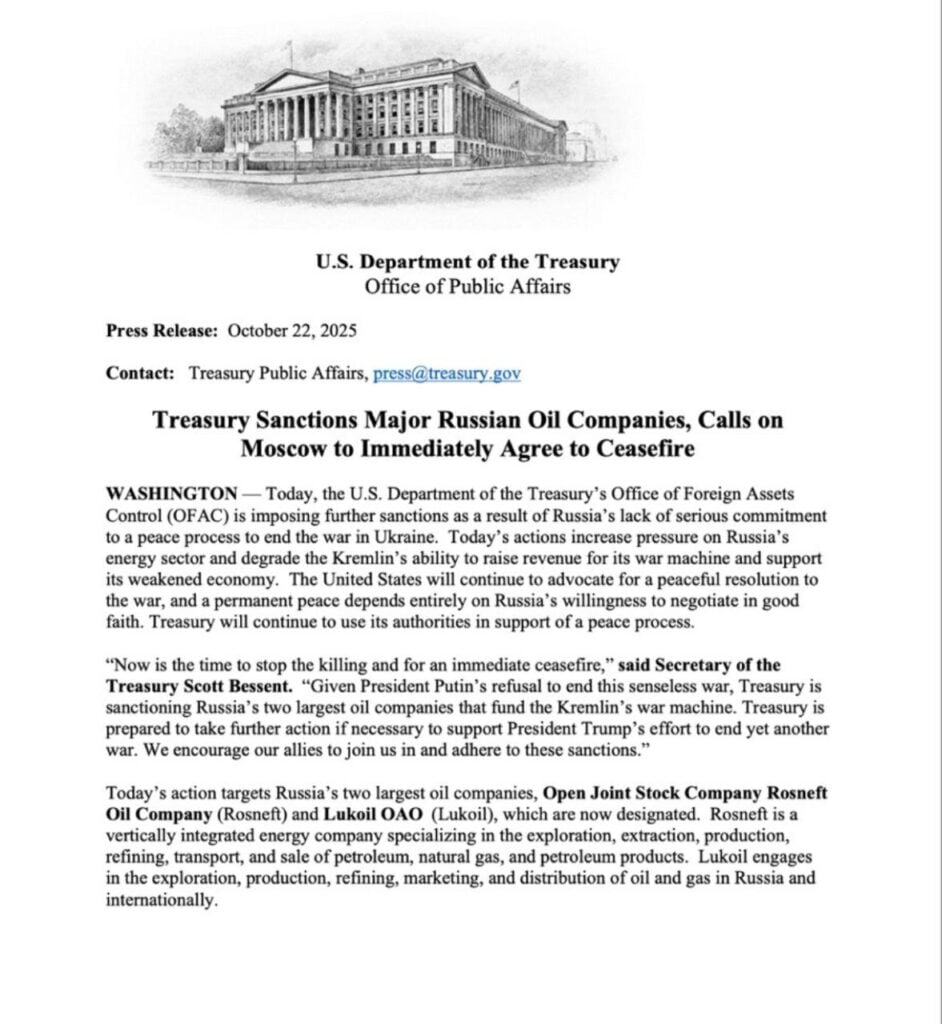
on October 22, the US Treasury Department imposed sanctions on the largest Russian oil companies and called on Moscow to immediately agree to a ceasefire in Ukraine.
Additional sanctions by official Washington increase pressure on Russia’s energy sector and limit the Kremlin’s ability to generate revenue to finance its military machine and support its weakened economy.
Given Putin’s refusal to end this senseless war, the Treasury Department is sanctioning two of Russia’s largest oil companies that fuel the Kremlin’s war machine. We stand ready to take further action if necessary to support President Trump’s efforts to end the war. We call on our allies to join us in strengthening these sanctions,” said U.S. Treasury Secretary Scott Bessent.
He clarified that the new sanctions are aimed at the two largest Russian oil companies – Rosneft and Lukoil.
“Rosneft is a vertically integrated company engaged in the production, refining, transportation and sale of oil and gas in Russia and worldwide. “Lukoil, in turn, produces, processes, markets and exports oil and gas.
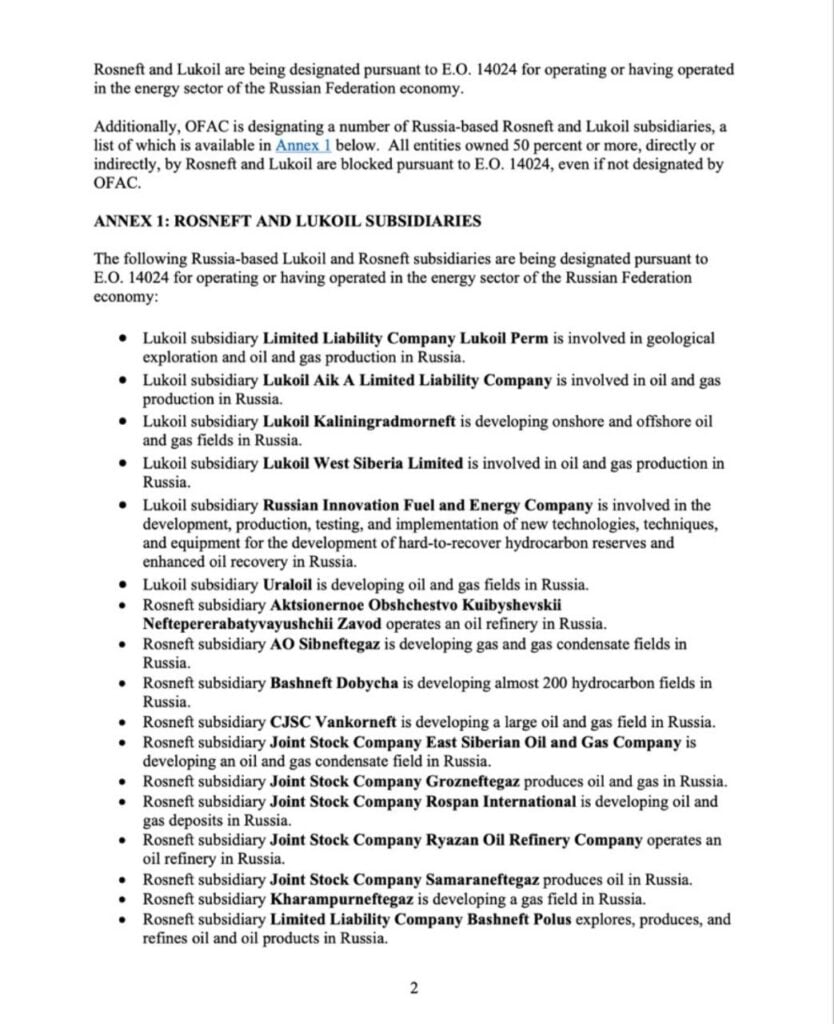
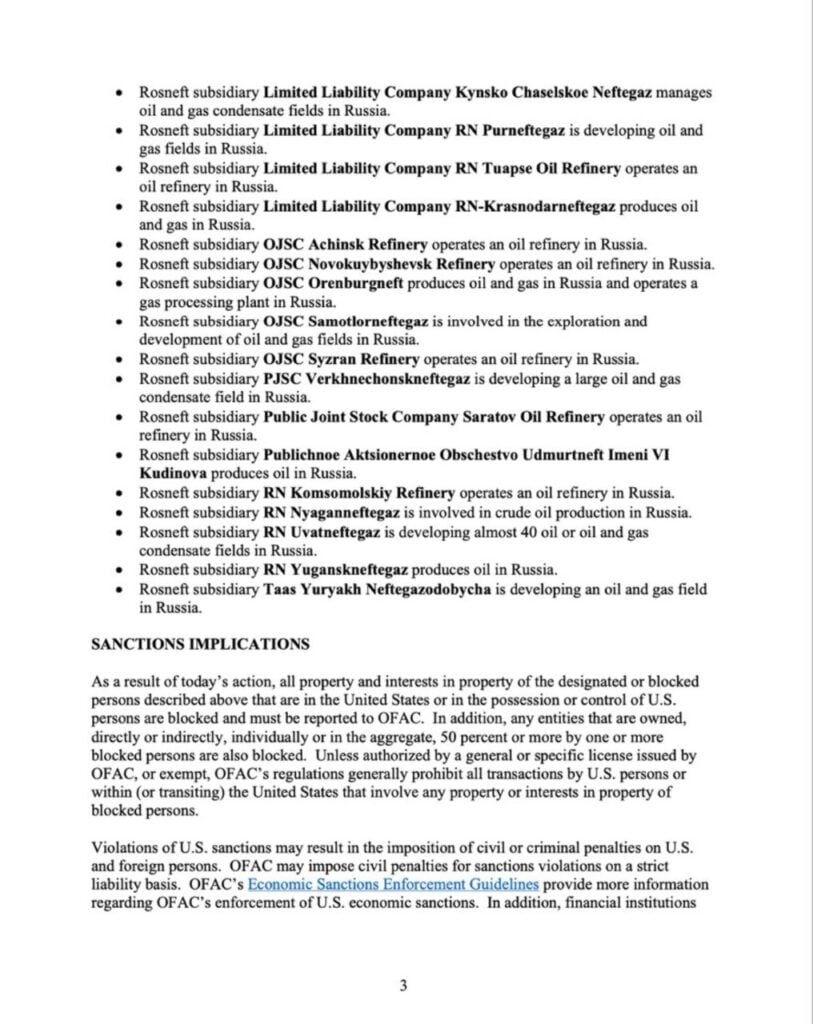
Not only the above-mentioned companies, but also their subsidiaries are subject to the restrictions. Among them:
- Lukoil-Perm LLC – geological exploration and production of oil and gas in the Russian Federation.
- Lukoil-Aik LLC – oil and gas production.
- LLC Lukoil-Kaliningradmorneft – development of onshore and offshore fields.
- LLC LUKOIL-West Siberia – oil production in the Tyumen region of the Russian Federation.
- RITEK LLC – development of new production technologies.
- JSC Kuibyshev Oil Refinery – oil refinery.
- Sibneftegaz JSC – development of gas condensate fields.
- LLC Bashneft-Dobycha – operation of approximately 200 oil fields.
- JSC Vankorneft – development of a large oil and gas field in the Krasnoyarsk region of the Russian Federation.
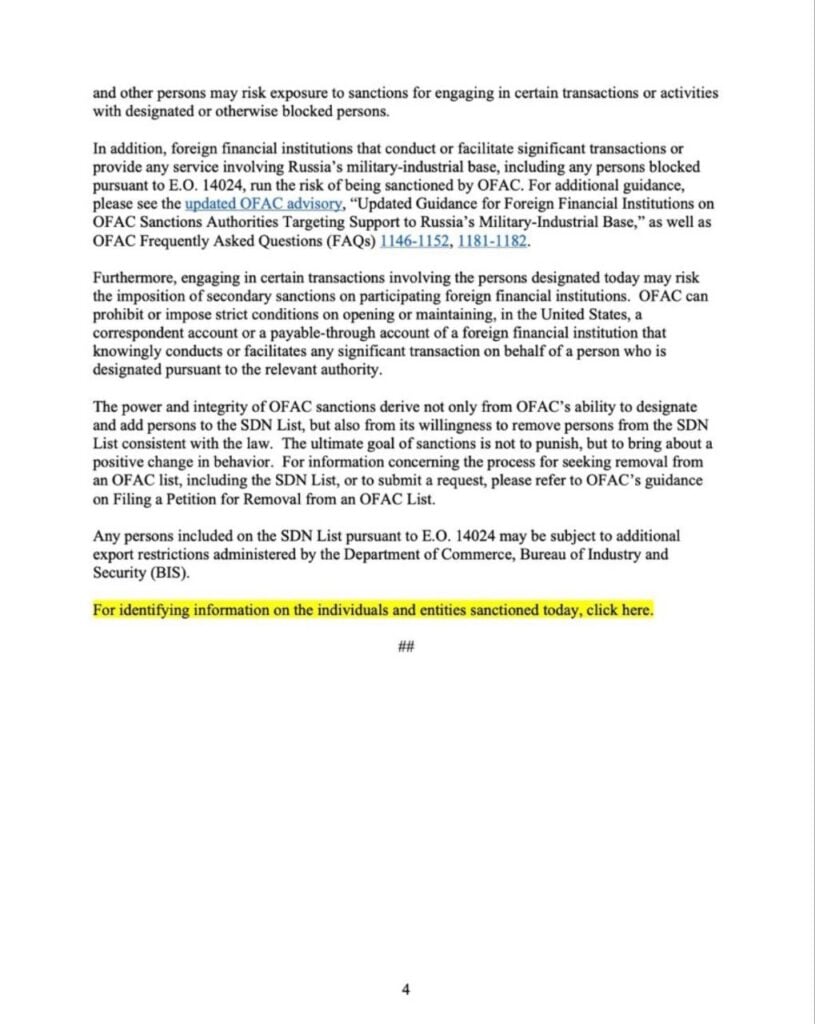
All assets and interests owned by the persons listed above that are located in the United States or controlled by U.S. persons are blocked. Any transactions involving these assets are prohibited (unless a special license has been obtained from OFAC). Violations of the sanctions may result in civil or criminal liability.
And financial institutions abroad that facilitate significant transactions in favor of blocked persons may be subject to secondary U.S. sanctions.
Read us on Telegram: important topics – without censorship