After the ban on scrap exports, domestic supplies of this secondary raw material to metallurgical plants fell by almost a third.
17 February 21:04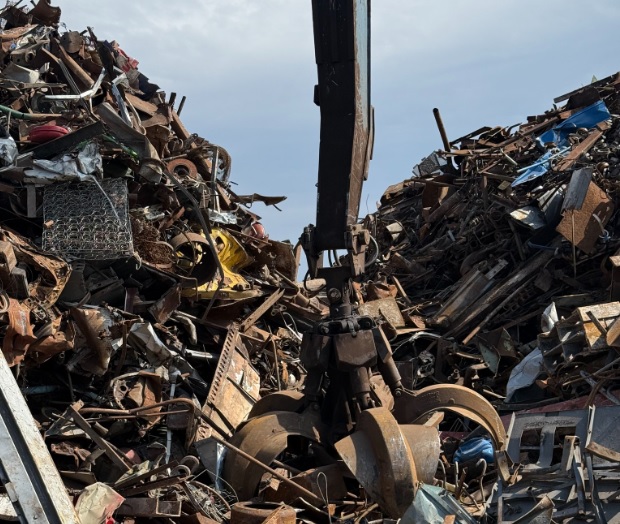
In January 2026, compared to January 2025, domestic scrap supplies to metallurgical plants decreased by 26.7% — from 126.2 thousand tons to 92.5 thousand tons. Procurement fell by 18.5% — from 149 thousand tons to 97.1 thousand tons. Steel production during the same period decreased by 16.4% — from 611,000 tons to 511,000 tons. This is evidenced by data from the Ukrainian Association of Secondary Metals (UASM), according to
According to the Association’s estimates, in the first month of the scrap export ban, more than 20% of companies in the industry partially suspended their operations, and another 12% completely stopped their activities. Experts predict that by April-May, about 4,000 workers in the scrap metal industry will lose their jobs. UAVtormet President Volodymyr Bubley noted that today the domestic price of ferrous metal scrap is almost half the export price and in some cases has already fallen below cost — €160–180 per tonne compared to €330–350 in EU countries. According to him, due to the huge surplus of scrap metal, collectors are forced to lower the purchase price to around 5,000 hryvnia per ton. Until December last year, it was 7,000–9,000 hryvnia. In other words, in just one month of 2026, domestic scrap prices fell by almost 40–60%. Under such conditions, procurement no longer covers logistics, energy, salaries, and taxes. At the same time, as emphasized by the Ukrainian Association of Scrap Metal Producers, the problem is not only the price. After the loss of two powerful giants, Azovstal and Ilyich Steel, and given the difficult situation in the energy sector, some metallurgical enterprises are not operating at full capacity. Since the start of the full-scale invasion, scrap consumption has fallen by almost three times — from 3,323,400 tons in 2021 to 1,300,000 tons in 2025. Domestic demand for scrap is declining. In January, against the backdrop of a reduction in supply volumes by almost 35,000 tons, the rate of surplus accumulation reached a record high of about 30,000 tons per month. In contrast, in 2023–2025, monthly growth did not exceed 10–12 thousand tons.
“Currently, metallurgical plants are only able to process 60-80% of all available scrap, and this does not include military (conversion) scrap, the confirmed volume of which has already exceeded 1.4 million tons,” emphasizes Volodymyr Bubley.
The second problem faced by the industry after the export ban, according to the expert, is that the sites are completely full.
“There is physically nowhere to store the scrap metal. But we continue to be told about the importance of preserving ‘strategic raw materials’ in the country. Strategic for whom, if no one consumes it?” he emphasizes.
The expert notes that hundreds of small collection points across the country are already feeling the crisis. For many people, selling metal was perhaps the only opportunity to earn money. Previously, they paid 6.5 hryvnia per kilogram, but now they pay 4 hryvnia.
“People come and ask why it’s so cheap. But collectors can’t pay more because there’s no market. Against this backdrop, there are arguments that the export ban is supposedly “keeping the hryvnia stable.” That’s absurd. The hryvnia exchange rate doesn’t depend on whether people are allowed to sell scrap metal,” says the president of UAVtormet.
The consequences of the scrap export ban extend beyond the industry itself. The state is losing tens of millions of euros in foreign exchange earnings. The plans of large state-owned companies are under threat. According to the expert, last year Ukrzaliznytsia planned to sell 125,000 tons of scrap, but actually sold only 8,000 tons. In 2026, the company says it intends to sell 250,000 tons, but with zero quotas, these plans may remain on paper. Experts estimate that potential losses could reach up to UAH 2.5 billion per year.
“The war is going on. People have no electricity or heat, and metallurgists are trying their best in all media outlets to convince society that the government did the right thing by destroying an entire industry. I am told that the export ban is a ‘state position’. But let’s be honest: all large metallurgical plants in Ukraine are privately owned. So whose interests does the state position serve? The state or specific owners?” he notes.
The expert also emphasized that from January 1, 2026, Ukrainian steel exports to the EU will be fully subject to the Carbon Border Adjustment Mechanism (CBAM). This means that importers of Ukrainian steel products into the EU will be required to pay a carbon tax (up to €90 per ton) based on the amount of CO₂ emissions embedded in the products. Today, the industry complains about the “unfair” carbon tax, pressure from the EU, and the war as a universal explanation for all problems. However, according to Volodymyr Bubley, behind this rhetoric, something else is becoming increasingly clear: CBAM only reflects the consequences of many years of inaction on the part of the metallurgists themselves.
“Scrap is the simplest and most accessible tool for reducing the carbon footprint in metallurgy. The transition to electric arc furnaces using scrap allows CO₂ emissions to be reduced several times over. This is well known in both the EU and Ukraine. But instead of investing in electric metallurgy, the industry has for years continued to rely on blast furnace-converter production — the same “old-fashioned” steel smelting that generates one of the highest carbon footprints in industry,” explained the head of UAVtormet.
According to him, the export ban has not catalyzed the modernization of the metallurgical industry, but instead is destroying another industry — scrap metal procurement.
“The export ban did not trigger the modernization of metallurgy, did not reduce the carbon footprint, and did not prepare the industry for the new EU rules. Instead, it is destroying the scrap metal procurement sector, cutting jobs, and depriving the state of foreign exchange earnings. If this is called a ‘strategic decision’, then the strategy should not be to block the market, but to invest and modernise. Otherwise, we will lose the industry, people and competitiveness,” concludes Volodymyr Bubley.
Let us recall, as