“Privatization of defense” during the war: shareholder alleges corruption scheme involving Smetanin and Kamyshin
4 February 13:52
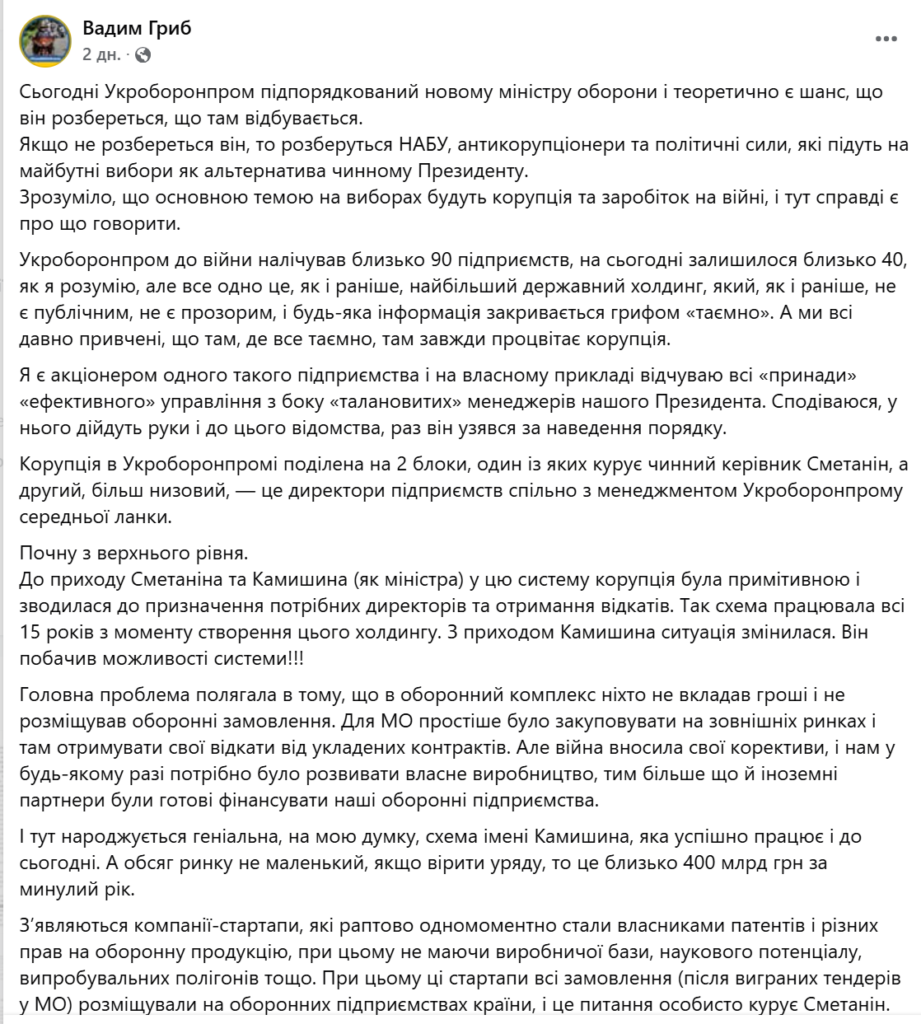
Following personnel changes in the defense sector, the state-owned concern Ukroboronprom has found itself at the center of new public accusations. Businessman and shareholder of one of the defense complex enterprises, Vadym Hryb, has stated the existence of a systemic corruption model, which, according to him, operates at the “upper” and “lower” levels of the holding’s management, reports "Komersant Ukrainian".
According to the author of the statement, after Ukroboronprom was placed under the authority of the new defense minister, there was a chance for a real audit of the processes. However, if this does not happen, anti-corruption authorities and political forces may take up the issue ahead of the upcoming elections.
“Today, Ukroboronprom is subordinate to the new defense minister, and theoretically there is a chance that he will figure out what is going on there. If he does not figure it out, then NABU, anti-corruption activists, and political forces that will run in the upcoming elections will figure it out,” Grib wrote.
“The largest holding company that remains closed”
According to the businessman, despite the reduction in the number of enterprises within the concern — from approximately 90 to about 40 — Ukroboronprom remains the largest state-owned holding company, but it has not become either public or transparent.
“Ukroboronprom, as before, is not public, is not transparent, and any information is classified as ‘secret’. And we have all long been accustomed to the fact that where everything is secret, corruption always flourishes,” he notes.
Gryb emphasizes that his assessment is based not only on public data, but also on his own experience as a shareholder in one of the defense industry enterprises.
Two levels of corruption: management and plant directors
Grib claims that corruption in the defense holding company is divided into two levels. The first, according to him, is associated with the current management, and the second with the directors of enterprises and middle management.
“Corruption in Ukroboronprom is divided into two blocks: one is overseen by the current head, Smetanin, and the other, more grassroots, is the directors of the enterprises together with middle management,” he said.
How the old scheme worked — and what has changed with the arrival of new managers
According to the businessman, for about 15 years since the holding company was created, the corruption model was relatively simple.
“Before Smetanin and Kamyshin arrived, corruption in this system was primitive and boiled down to appointing the right directors and receiving kickbacks. That’s how the scheme worked for all 15 years,” he notes.
However, with the start of full-scale war and personnel changes, according to Gryb, the model has transformed.
“With the arrival of Kamyshin, the situation changed. He saw the possibilities of the system,” the author writes.
The “startup scheme”: how, according to Gryb, the model works
The author identifies the key problem as the change in the model of financing defense production after the arrival of former Minister of Strategic Industries Alexander Kamyshin.
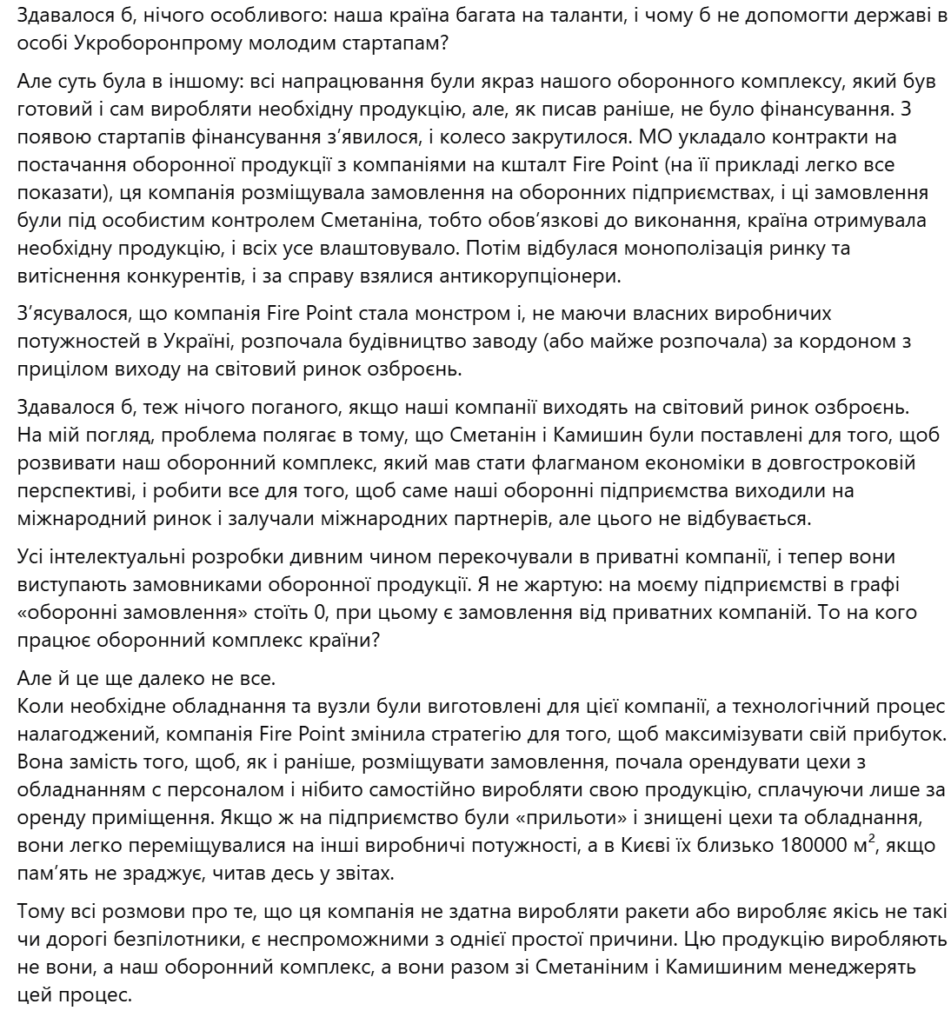
“Before the war, no one invested money in the defense complex. It was easier for the Ministry of Defense to purchase abroad. But the war made its own adjustments, and, in my opinion, a ‘brilliant’ scheme appeared,” writes Grib.
According to him, private start-up companies appeared on the market, which obtained patents and rights to defense products without having their own production facilities.
“Start-up companies are appearing that have suddenly become owners of patents and rights to defense products, without having a production base, scientific potential, or testing grounds,” he notes.
After winning tenders, these companies, according to him, did not actually manufacture the products themselves, but placed orders with state-owned defense companies.
“All the developments were made by our defense complex. But now the Ministry of Defense is signing contracts with startups, and they are placing production at state-owned enterprises,” he says.
The example of Fire Point and the issue of monopolization
The article cites Fire Point as an example. According to the author, after initially cooperating with state-owned factories, it began to monopolize the market, driving out competitors.
“Fire Point became a monster and, without its own production facilities in Ukraine, began building a plant abroad with an eye on entering the global arms market,” he writes.
According to Gryb, the key problem is not entering international markets as such, but the fact that state-owned defense enterprises are not receiving the same development.
“It would seem that there is nothing wrong with our companies entering the global arms market. In my opinion, the problem is that Smetanin and Kamyshin were appointed to develop our defense complex, which was supposed to become the flagship of the economy in the long term, and to do everything possible to ensure that our defense enterprises entered the international market and attracted international partners, but this is not happening,” he said.
Private orders instead of state orders
Grib also draws attention to the situation where defense enterprises are actually working not for the state, but for private structures.
“All intellectual developments have strangely migrated to private companies, and now they are the customers for defense products. I’m not joking: at my company, the “defense orders” column is zero, while there are orders from private companies. So who is the country’s defense complex working for?” he notes.
In his opinion, under this model, state assets lose their development prospects, while private entities reap the benefits.
According to him, after establishing technological processes, private companies began to rent workshops along with personnel, formally acting as manufacturers of products.
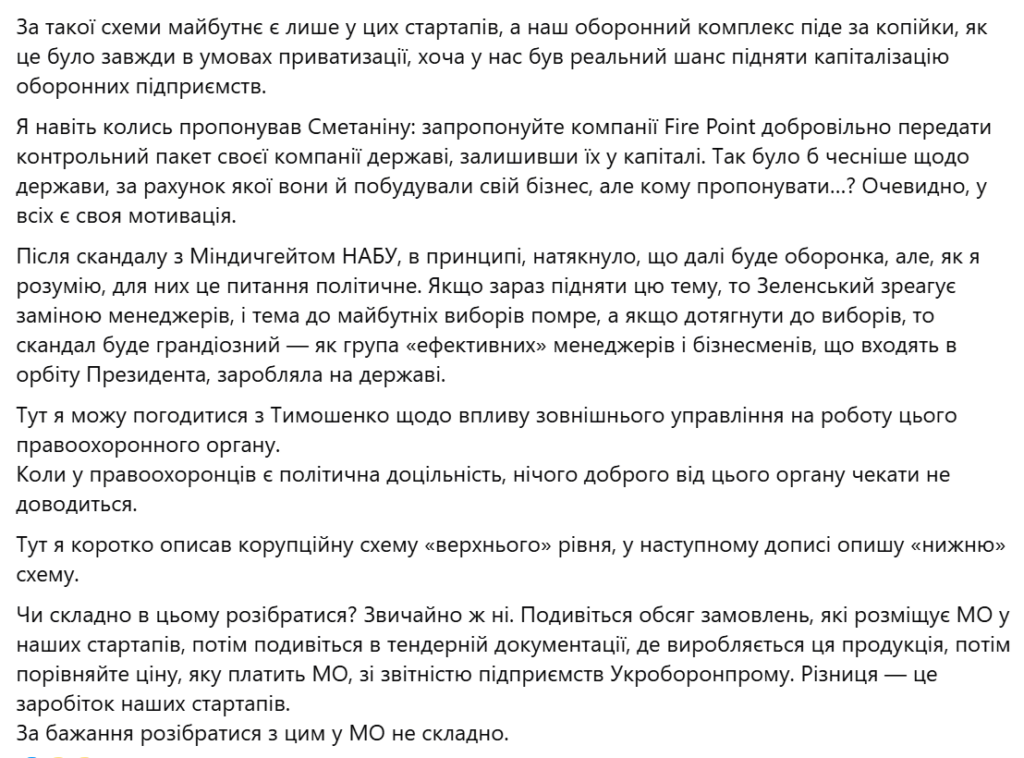
“Therefore, all talk that this company is not capable of producing missiles or produces some kind of inferior or expensive drones is invalid for one simple reason. These products are not manufactured by them, but by our defense industry, and they, together with Smetanin and Kamyshin, manage this process. Under this scheme, only these startups have a future, and our defense complex will go for pennies, as has always been the case under privatization, even though we had a real chance to increase the capitalization of defense enterprises,” adds Grib.
According to him, he “even once suggested to Smetanin: offer Fire Point to voluntarily transfer the controlling stake in their company to the state, leaving them in the capital.”
“It would have been fairer to the state, on whose account they built their business, but who to offer it to…? Obviously, everyone has their own motivation,” notes Hryb.
The role of anti-corruption agencies and the political factor
The article also mentions the National Anti-Corruption Bureau of Ukraine. Hryb believes that the investigation of the defense sector may be postponed for political reasons.
“If this issue is raised now, Zelensky will respond by replacing managers, and the issue will die down before the elections. But if it drags on until the elections, the scandal will be huge,” he writes.
He also agrees with Yulia Tymoshenko’s assessment of the influence of political expediency on the work of law enforcement agencies.
“It’s not hard to figure out”
In conclusion, Vadym Hryb emphasizes that verifying the facts presented does not require overly complex investigations.
“Look at the volume of orders placed by the Ministry of Defense with startups, then see where these products are actually manufactured, and compare the price of the contracts with the reports of Ukroboronprom enterprises. The difference is the earnings of private companies,” he concluded.
According to him, if there is political will in the Ministry of Defense, it is entirely possible to resolve this issue.
Editor’s note: The editorial board reserves the right for all persons and entities mentioned in the author’s article to express their own opinions.
If comments or explanations are provided to the editorial office, these positions will be highlighted and published.