Putin and his demands: the role of the “belt of fortresses” in Donetsk region in the war against Russia
13 August 2025 09:54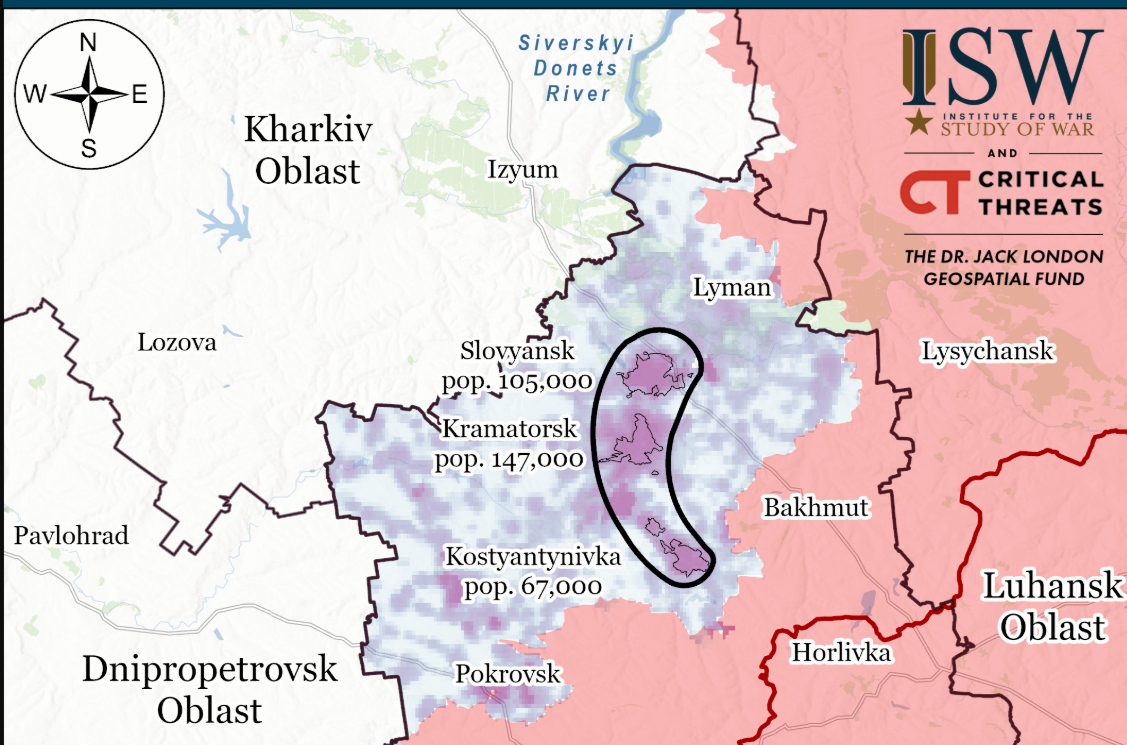
Kremlin officials are demanding that Ukraine cede strategically important unoccupied territory in the Donetsk region to Russia and freeze the front line in other areas as part of a ceasefire agreement. This will force Ukraine to abandon its main defense line, the so-called “belt of fortresses” created in 2014. This is reported by "Komersant Ukrainian" with reference to a report by the American Institute for the Study of War (ISW).
The transfer of the rest of Donetsk region as a precondition for a ceasefire, without any commitment to a final peaceful settlement, would force Ukraine to abandon its “belt of fortresses” – the main fortified defense line in Donetsk region since 2014 – without any guarantee that hostilities will not resume.
Putin’s proposal reportedly calls for Ukraine to surrender this critical defensive position, which Russian forces currently do not have the ability to quickly surround or break through, for virtually nothing.

What is the “belt of fortresses” and why it cannot be given away
the “Belt of Fortresses” is a defensive line of four large cities and several settlements located along the H-20 highway Slaviansk – Kostiantynivka. Its length is approximately 50 km, and before the war, the population of these settlements numbered more than 380,000 people.
Sloviansk and Kramatorsk are important logistical hubs, while Druzhkivka, Oleksiyevo-Druzhkivka, and Kostiantynivka are the southern segment of the defense line that Kyiv began to create after liberating these towns in April 2014.

Russia’s inability to take Sloviansk in 2022 and its current difficulties in encircling the belt underscore the effectiveness of Ukrainian efforts. Currently, Russian forces are still trying to bypass the belt from the southwest, and the attempt to capture it is likely to take several years.
The loss of this frontier – and its strategic advantage in the region – would create a foothold for Russia to launch repeated attacks.

What are the consequences for Ukraine?
The transfer of parts of the Donetsk region to Ukraine’s control will put Russian troops directly on the border of the region, which is a much less favorable defense position for Ukraine. This will force Ukraine to urgently build large-scale fortifications on the borders with Kharkiv and Dnipro regions, where the terrain – mostly open fields – is poorly suited for defense. Natural borders, such as Oskil and the Siverskyi Donets, are too far to the east to be used.

If Russia occupies the borders of Donetsk region, it will gain a foothold for a future offensive against Kharkiv or Dnipropetrovs’k region. The transfer of the western part of Donetsk Oblast would move the front line 82 kilometers to the west (roughly the distance from midtown Manhattan to Trenton).

For example, the transfer of the Lyman would create conditions for attacks on Ukrainian positions in eastern Kharkiv region along the Oskol River. Russia could use Sloviansk and the E-40 highway to attack Izyum from the south, being only 20 kilometers from this key city.

In the southwest, the Russians already hold small positions along the border with Dnipropetrovska oblast, but handing over the rest of Donetsk oblast would allow them to avoid costly battles for Pokrovsk and Myrnohrad, as well as bypassing the western defense line of Dobropillia-Bilozerske-Novodonetsk-Oleksandrivka.
What Putin wants
This proposal emphasizes his tough demands for Ukraine’s surrender and lack of interest in negotiations. Back in June 2024, Putin demanded “the elimination of the causes of the war” – demilitarization, “denazification,” neutral status, and the actual replacement of the current government in Kyiv with a pro-Russian one. He insists on the transfer of the entire Donbas and “Novorossia” (occupied and non-occupied parts of Donetsk, Luhansk, Kherson, and Zaporizhzhia regions) as a precondition for any negotiations.
On the American side, there is confusion in the versions ranging from Putin’s alleged offer to withdraw troops from Zaporizhzhia and Kherson regions in exchange for the rest of Donetsk to the option of only freezing the front line there. Sometimes there was also mention of a “withdrawal” from Sumy and Kharkiv regions.
The only constant condition in all versions is the requirement that Ukraine leave the rest of Donetsk region, which gives Russia advantages and Ukraine significant strategic losses.
Situation at the front
At the same time, Russian troops made a tactical breakthrough near Dobropillia, advancing 10-17 km, which increased pressure on Ukrainian defense and provoked political tensions before the Trump-Putin summit in Alaska.
Ukrainian troops have already deployed reserves, including the Azov special forces unit, to stabilize the front and prevent a breakthrough.