Fines records and search for failure to appear: what is happening in the TP system
26 June 2025 14:40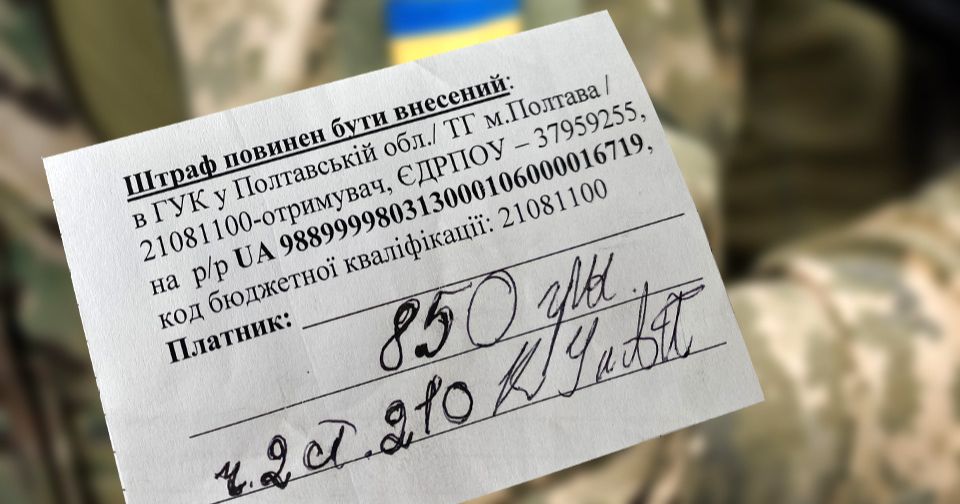
Every month, the Military Commissariats issue more and more administrative protocols for violating the rules of military registration. According to Opendatabot, 28,212 proceedings have been opened since the beginning of the year. An average of 4.7 thousand new proceedings were opened every month. April 2025 was a record-breaking month with 5,682 fines. And only one in five proceedings was closed this year. The phenomenon of this phenomenon was investigated by "Komersant Ukrainian".
According to statistics, the number of fines has increased by 11.2 thousand since April. In Chernihiv region, a record of 8 proceedings for violating the rules of military registration per person was recorded: 5 in April and 3 in early June. Currently, in 9 regions of Ukraine, the Military Criminal Court has opened more than 1,000 proceedings.
Kyiv is the leader in terms of the number of fines imposed by the MCC – 3,835 proceedings since the beginning of the year. It is followed by Dnipropetrovska (2,984), Sumy (2,464), Odesa (2,438) and Kharkiv (2,151) regions. In total, nine regions already have more than a thousand cases. In Kyiv itself, Podilskyi TCC has become the most active, with 1,100 proceedings in the first half of the year alone.
What TCCs are fined for:
- Failure to appear when summoned to clarify data or undergo a preliminary vetting.
- Failure to update personal data in the MCC in a timely manner.
- Failure to comply with the rules of military registration.
- Failure to register at the place of work or study.
- Failure to appear for the VLC.
- Failure to provide information about a change of residence.
- Loss or damage of a military registration document.
- Failure to update military registration data in a timely manner.
Why the fine is doubled
The amount of the fine has remained unchanged – from UAH 17,000 to 25,000, but it is important to know that after the opening of enforcement proceedings, according to the law on enforcement proceedings, a double fine is charged.
And it will not disappear in a year, or two, or five, and even after the enforcement proceedings are closed, this fine of UAH 50,000 will still remain, says attorney Roman Simutin.
The thing is that the employees of the military commissariat usually do not notify the person liable for military service of the fine, and if it does not appear in the apps by chance, you may not even know about it. And when the case gets to the executive service, the fine is automatically doubled according to the Code of Administrative Offenses.
“The law signed by the president on a 50% discount on fines from the TCC is currently ineffective. Not everyone receives an administrative protocol from the TCC in person to go and pay UAH 8,500 right away. It so happens that the protocols are issued in absentia, and persons liable for military service may not know about them. And this happens repeatedly. It’s a good thing that the TCCs have not yet received a plan for the number of protocols, because then there will be real chaos – they will be stamped for everyone. And there are already cases when current military personnel receive protocols for failure to appear at the MCC, and the executive service blocks their payroll cards for non-payment of the fine,” says lawyer Valentyn Serkov.
If you are fined – appeal
Lawyers advise not to hesitate and appeal against the fine in court, because in 90% of cases the court takes the side of the person liable for military service. This is because the employees of the TCC often write out decisions with errors or do not give the stub of the decision to the person. After all, if a person pays the fine, he or she automatically admits guilt.
“By paying a fine, a citizen actually pleads guilty to an administrative offense. And, as I have already said, bringing to administrative responsibility for violation of the legislation on mobilization is the basis for putting a person on the wanted list, regardless of whether he or she has paid the fine. Payment of the fine does not exclude the person from the wanted list in the Oberig information system and the Ministry of Internal Affairs database, nor does it relieve them of the obligation to appear at the TCC under new summonses. Do not assume that if you pay the fine, the TCC will not bother you anymore. This will not be the case. If you pay the fine, you will still be on the wanted list,” emphasizes attorney Simutin.
And, according to the lawyer, removal from the wanted list is possible only if the court appeals and reverses the TCC resolution that became the basis for the wanted list.
And one more thing: the number of violations (and, according to statistics, there is a man who has already been issued 8 administrative protocols) is not a basis for turning administrative liability into criminal liability. For example, failure to clarify data, failure to appear when summoned to clarify data, or to undergo a medical examination are violations that entail only administrative liability. However, failure to appear on a “combat” summons issued after the military qualification examination and the recognition of a person as fit for service may be grounds for criminal liability from the very first time.
Online payment of fines from the Ministry of Defense
The Ministry of Defense has announced that at the end of June, the Reserve will launch online payment of fines to the MCC. Deputy Defense Minister for Digitalization Kateryna Chernohorenko said that this feature will be one of the digital achievements of the year.
Fines will be paid online in a few clicks in the “Reserve” application. This innovation will significantly simplify the process for citizens, avoiding the need to visit the TCC to receive a bill and pay a fine. The app will display the fact of violation of the military registration rules and will also offer a 50% discount if the fine is paid voluntarily. In the future, it is also planned to add the possibility of concluding a contract with the Armed Forces online through Reserve.
Benefits:
- Reducing the bureaucratic burden on the TCC.
- Simplification of the procedure for paying fines for citizens.
- Increased transparency and convenience of interaction with military authorities.
Author: Alla Dunina