Locusts on the contact line: how insects undermine food security in Ukraine
22 July 2025 12:21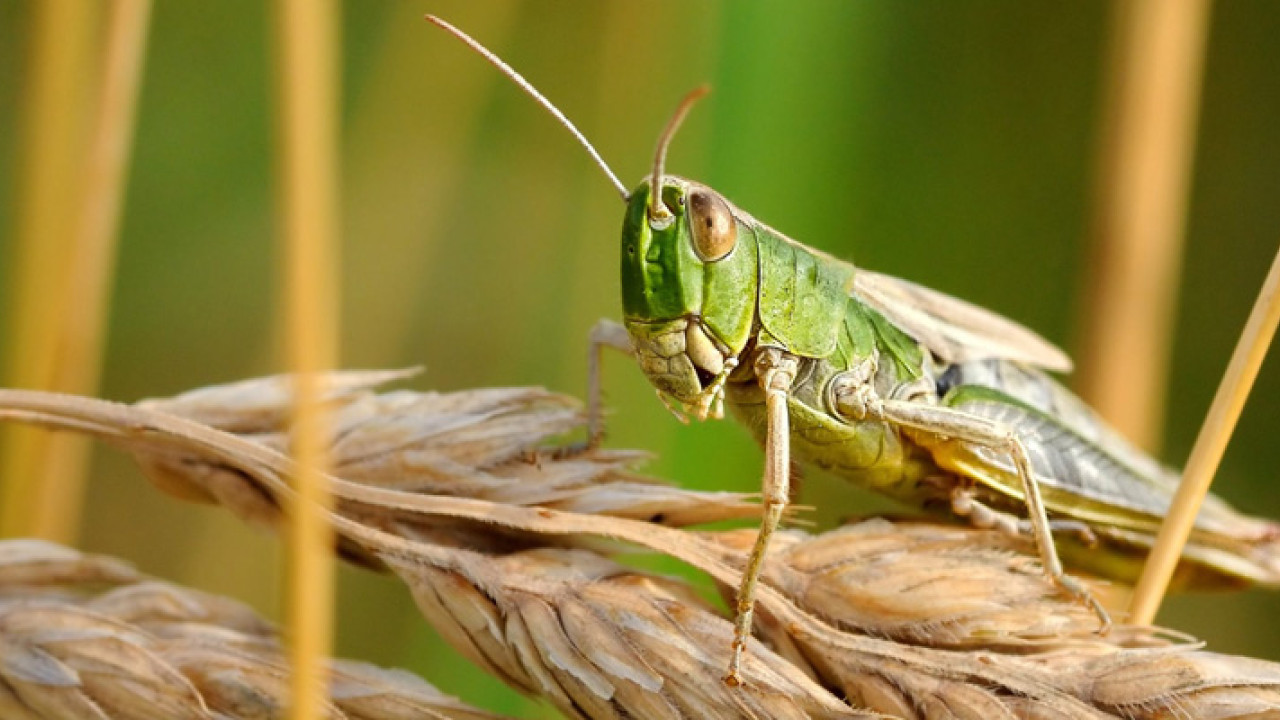
 ANALYSIS
In July 2025, Ukraine faced one of the largest locust infestations in recent decades. The spread has already covered several regions, including Zaporizhzhia, Dnipro, Kherson, and partially Odesa,
The largest concentrations of insects were recorded in the Kushugum community of Zaporizhzhia region, where locusts literally “cover” fields and household plots. Similar cases have been reported in Zaporizhzhia, Malokaterinivka, Zaporizhzhia Oblast, and a number of rural communities in the region.
The locust invasion is a serious economic threat that requires immediate interagency coordination. In the context of the war, Ukraine has received a new challenge that could affect the country’s food security.
Farmers are sounding the alarm: locusts are destroying the stems, leaves and flower parts of plants, causing irreparable crop losses. According to farmers, the losses range from 25% to 100%, depending on the crop and the location of the infestation. Sunflower, wheat, barley, vegetables, and melons are particularly at risk.
Russian aggression and locusts: a new front for Ukrainian farmers
According to experts, the invasion became possible as a result of an environmental disaster caused by the explosion of the Kakhovka hydroelectric power plant. The drainage of the Dnipro riverbed has created ideal conditions for locusts to breed, which are massively populating the reeds near the front line.
According to Vadym Tchaikovsky, deputy head of the State Service of Ukraine for Food Safety and Consumer Protection, who spoke to
“These are the results of Russian strikes, Russian aggression. The environmental catastrophe caused by the explosions and the blowing up of the Kakhovka hydroelectric power plant has had consequences,”
– Tchaikovsky said, emphasizing the double blow to Ukraine: both military and environmental.
The official also noted that similar outbreaks had occurred before, but then local services successfully overcame them due to greater mobility, the absence of hostilities, and open access to pest-infested areas. For example, insect outbreaks were eradicated in Odesa and Kherson regions through prompt and preventive field treatment.
“Locust invasions do happen from time to time. Then a special protection regime is introduced. All relevant services, administrations, and agricultural producers are involved in the fight against pests,”
– emphasized the Deputy Head of the State Service of Ukraine for Food Safety and Consumer Protection.
Читайте нас у Telegram: головні новини коротко
Locusts are attacking fields, melons and gardens: how the authorities are responding
The authorities, together with local farmers, are localizing the spread of pests and taking measures to preserve the harvest. In particular, the affected communities
- carry out large-scale insecticide treatment of fields;
- introduce a special protection regime.
- local commissions are being set up to coordinate the work with the SES, the DIA and the State Service of Ukraine for Food Safety and Consumer Protection.
Nevertheless, in the areas of active hostilities, the treatment of territories remains unattainable, and locusts continue to destroy vegetation, reproduce and develop new territories.
Thus, agrarians of have recorded new locust centers within the village of Vyshetarasivka, Nikopol district, Dnipro region, in the floodplains of the Kakhovka reservoir.
Experts warn that if the pests are not localized and eliminated in the near future, the locusts may spread to the central regions of Ukraine.
What losses will Ukraine suffer from the insect invasion?
● Direct losses for farmers: locusts affect winter and spring crops, reducing yields and profitability.
additional budgetary costs for local authorities and agricultural producers: purchase of pesticides, machinery, and monitoring of territories.
What the government is doing in response:
● Conducting surveys of potential locust distribution areas;
● introduces zones of special plant protection regime and preventive treatments;
● informs farmers and the public about methods of locust detection, its spread, and the safe use of plant protection products.
Summary
In July 2025, Ukraine faced a new environmental and agricultural threat – a massive locust invasion that spread across several southern and central regions. This invasion not only destroys crops and undermines food security, but is also directly related to the consequences of Russian aggression, in particular the explosion of the Kakhovka hydroelectric power plant. In times of war, effective pest control is difficult, requiring consolidated action by the authorities, farmers and specialized services to minimize economic losses and prevent the locusts from spreading to new territories.
Читайте нас у Telegram: головні новини коротко