“The system turned a blind eye to my father’s death”: a student from Novi Sad on the causes, course and prospects of protests in Serbia
30 May 2025 09:39 INTERVIEW
Serbia is currently at the epicenter of events that could determine the future of not only the country but the entire Balkan region. For more than six months, large-scale student protests have been going on here, which have received wide support from civil society. According to opinion polls, the majority of Serbs approve of both the protesters’ demands and the protests themselves.
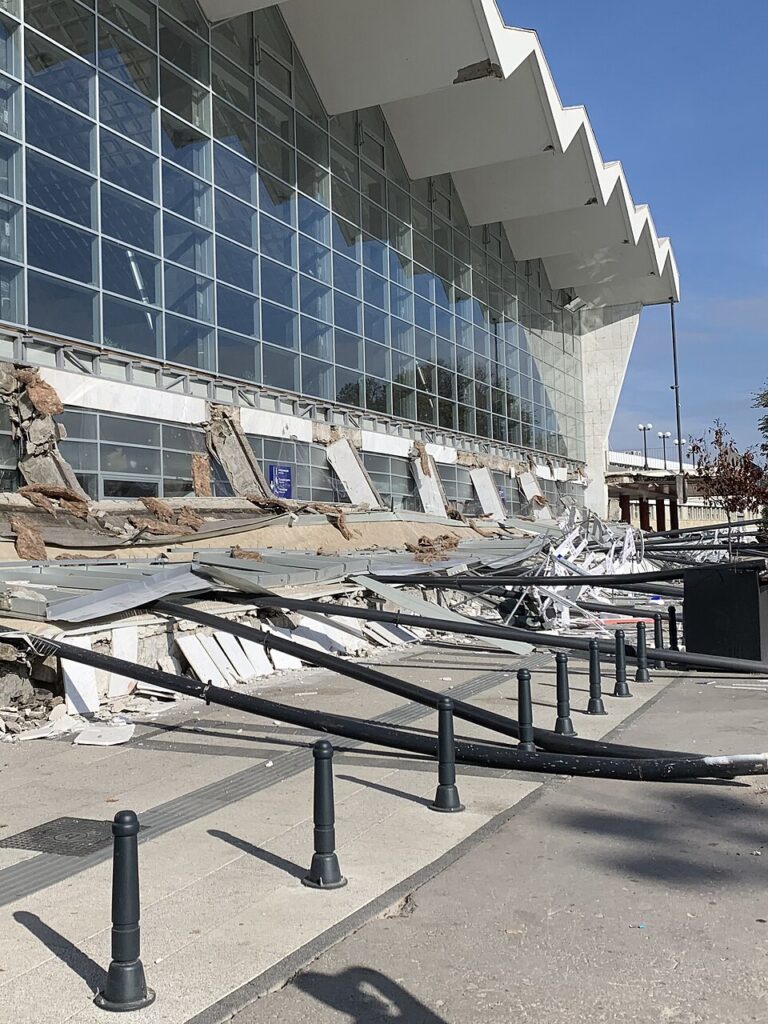
It all started with a tragedy. on November 1, 2024, a concrete shed at the railway station in Novi Sad collapsed, killing 16 people, including children. This sparked mass protests across Serbia that have not subsided to this day. The public accused the authorities of corruption and negligence during the reconstruction of the station. As is often the case, discontent and demands grew and gave rise to a whole political movement aimed at radical changes in society and the state.
In Ukraine, Serbia is traditionally perceived as a pro-Russian state, and for good reason. The president and the head of the Serbian Orthodox Church regularly visit Moscow, maintaining close ties with the Kremlin. This position is largely explained by Serbia’s historical experience, including the consequences of the Balkan wars of the 1990s, which shaped Belgrade’s modern foreign policy.
At the same time, recent events indicate a possible change in public sentiment.
In this difficult situation, it is crucial for Ukrainians to understand what is really going on behind the scenes of the Serbian protests and whether the country is capable of reconsidering its geopolitical priorities in favor of European integration
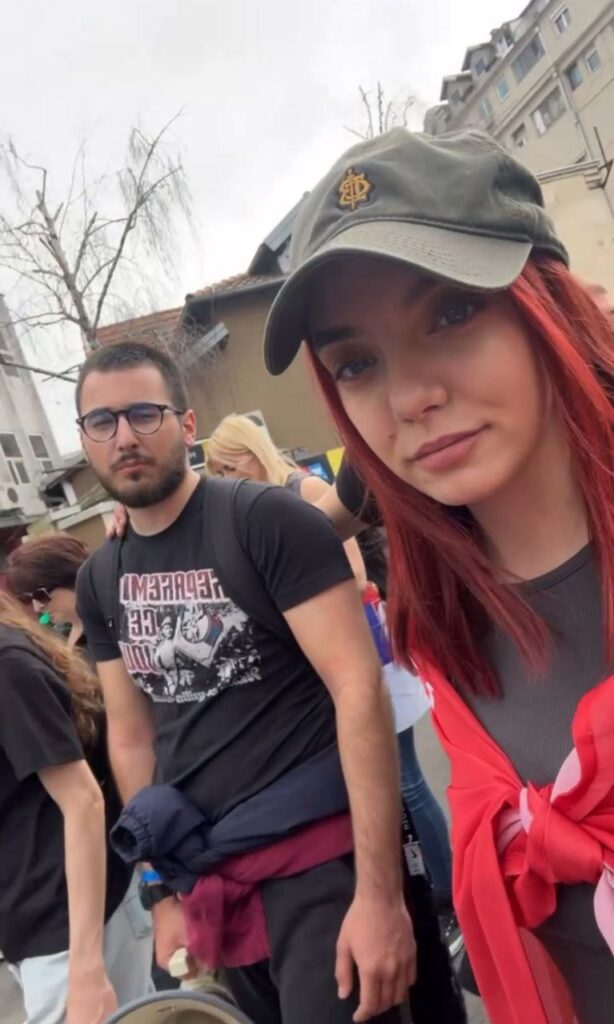
We will look for answers to these questions in an interview with a student activist from Novi Sad. Milica Popovic is actively involved in the protests and will tell us about the events from the inside.
Please tell us a little about yourself. Why did you decide to take part in the protests?
My name is Milica Popovic, I live in Novyi Sad and study at the Faculty of Sports and Physical Education. I also work as a personal trainer – I love movement, working with people, and I believe in a healthy lifestyle, but also in a healthy society.
I have been watching what is happening in our country for a long time: crimes go unpunished, corruption is rampant at every level, and there is a complete loss of justice. Those who harm society walk free, while those who try to live honestly face constant obstacles.
Unfortunately, I personally experienced this injustice: my father died because of a medical error, and the system turned a blind eye. Since then, I have had a deep compassion for the victims of this system – I feel their tragedies as my own. That is why I can no longer remain silent.
Together with my friends, I strongly condemn the situation in Serbia. I joined the protests because I want my future family, my children, to grow up in a normal Serbia – in a country where healthcare and education work, where nature is protected, where there is no room for corruption, and where true values are respected. Not in a society where the mafia is a role model and truth and justice are a sign of weakness.
We are fighting because we believe that this country can – and should – become better.
What challenges has Serbia faced under President Vucic and his government?
Serbia is going through a deep political, institutional and moral crisis. The entire system of government is riddled with corruption, nepotism and fear, and institutions have become empty forms that no longer serve the people.
Public funds are spent non-transparently, through sham tenders and backroom deals. Incompetent party cadres are appointed to key positions, not specialists. Competence is not valued, only obedience.
The judiciary is not independent, the media is under pressure, and the opposition is systematically disrespected. People are losing faith in institutions because they see that there is no justice – criminals and people connected with politics go unpunished, while ordinary citizens are held accountable for trivial matters.
Education and healthcare are collapsing, and young people are leaving the country in droves because they see no future. Instead of investing in knowledge, development and people, everything is spent on centralizing power and control. Police and prosecutors are silent even when basic human rights are violated.
All of this creates an atmosphere of powerlessness, blackmail and fear, which is why these protests are not just a political struggle, but a struggle for dignity and justice.
“The Novyi Sad tragedy has become a symbol of everything that is wrong”
Why did the tragedy at the Novyi Sad train station cause such long-lasting protests? Is it a protest against the current government or a demand to punish the criminals involved in the poor repair of the station?
The tragedy, which killed 16 people, deeply affected citizens because it exposed the irresponsibility of the system and the authorities. People realized that this could happen to anyone – and all because of incompetence, corruption, and complete negligence of the authorities.
Protests became widespread because this tragedy was seen not as an isolated incident, but as a consequence of years of institutional decay, when institutions no longer protect citizens but serve the interests of the authorities. None of the responsible parties were brought to justice, and the authorities remained silent – as they had been countless times before. The railway station became a symbol of everything that was wrong – it was the drop that overflowed the cup, unleashing the public discontent that had been accumulating for years.
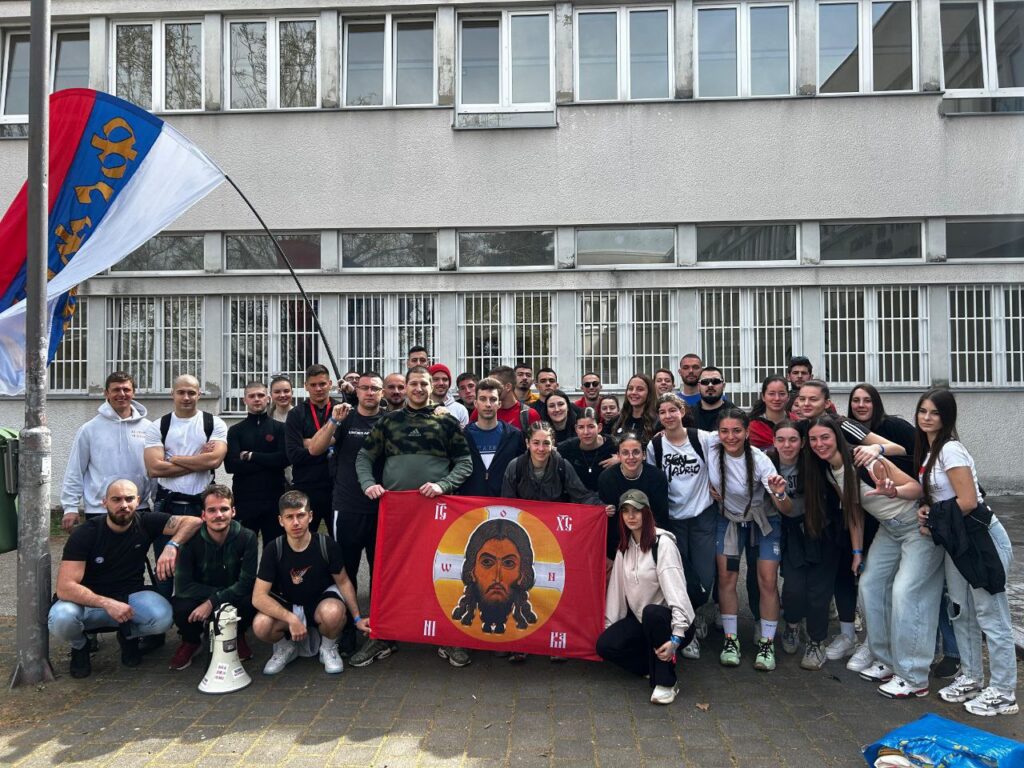
According to polls, 80% of Serbian citizens support the demands of the student protests, and 64% directly support the protests themselves. Why did students, and not the political opposition, lead the protests?
As a student, I believe that we have taken the initiative in the protests because we bring fresh, young and educated energy, unencumbered by political pressure or compromise. We are a new voice in society – honest and authentic, without the baggage of past failures or compromises. The political opposition has been systematically discredited for years and is under constant pressure from the regime-controlled media, which portrays it negatively, leaving the opposition with little chance to stand up to the government on its own. In contrast, we, the students, have never played political games, have never been actively involved in politics, and are not subject to foreign influence. That is why people see us as real agents of change and hope for a better future in Serbia. This honesty and new energy have allowed us to become the main drivers of these protests and give us a real chance to achieve meaningful change in society.
“Our demands are the expectations of a democratic society”
What demands did the students put forward to the authorities? Why is there no call for the resignation of the president, dissolution of the parliament, or a demand to ban them from participating in new elections?
Student demands should not be demands – they should be guaranteed by the proper functioning of the system. However, a wave of student protests erupted after a violent incident in which students from the Faculty of Dramatic Arts (FDM) in Belgrade were physically attacked as they peacefully blocked traffic for 15 minutes to honor the victims of the Novi Sad tragedy. The attackers, who were initially unidentified, turned out to be members of the ruling Serbian Progressive Party.
In response, the students of the FSM initiated a blockade of the faculty, which was soon joined by other faculties of the University of Belgrade, and later by the universities in Novi Sad, Niš, Kragujevac, and Novi Pazar. The students made four initial demands:
- Public disclosure of all documentation related to the reconstruction of the Novi Sad train station. To date, the full documentation remains unavailable.
- Official investigation and prosecution of those responsible for the attacks on students and professors, especially if they are public officials.
- Drop all charges against students arrested or prosecuted during peaceful protests.
- Increase the national budget for higher education by 20%.
During one of the largest student demonstrations in Serbia’s recent history on March 15, panic broke out during a 15-minute minute of silence due to an unidentified loudspeaker. This led to the fifth demand, a thorough investigation into the incident and the technology used, which disrupted a peaceful protest and caused fear and disorientation. Later, the prosecutor’s office warned that anyone disseminating information about the device could face legal consequences, and no official medical records were released despite numerous health complaints. Many protesters reported symptoms such as dizziness, nausea, and ringing in the ears.
A sixth demand was added when the Serbian president entered a hospital ward where high-risk burn victims from North Macedonia were being treated, accompanied by a full media team. Medical students condemned the violation of sterile protocol and institutional ethics. The president publicly stated that he “made the mistake himself,” dismissing criticism and legal concerns.
Students across the country insist that these are not political demands, but basic expectations in a democratic society.
When it became clear that the government would not respond to their demands – offering neither justice, transparency, nor accountability – students realized that the problem was much larger than individual incidents.
What began as a protest against violence and silence has turned into a demand for structural change: the dissolution of the People’s Assembly [the state’s parliament – ed.
This is not just a student protest. It is a growing civic movement based on the belief that Serbia deserves institutions that serve its people, not the government.
Elections are not the end, but the beginning of reconstruction.
Читайте нас у Telegram: головні новини коротко
“There is a clear pattern of violence against protesters”
In Ukraine, during the 2014 protests, the criminal regime of Yanukovych wanted to use legal restrictions as a basis for a violent victory over the protest. Are the authorities in Serbia ready to go for the power scenario and use force to disperse the protest and establish a dictatorship?
Based on recent events, it can be concluded that the Serbian authorities are using various forms of force and intimidation to suppress student protests, even if they are completely peaceful and democratically legitimate.
Since the collapse of the canopy at the Novi Sad railway station on November 1, 2024, which was the initial impetus for the protests, numerous attacks on students and citizens have been recorded, often without a proper response from the relevant institutions.
Among the most significant incidents:
- Novi Sad, January 28, 2025 – A group of masked individuals attacked students in front of the offices of the government’s Serbian Progressive Party. One student suffered a broken jaw, and a student of the Faculty of Philosophy sustained minor injuries. Four attackers were arrested. After the incident, Prime Minister Milos Vucevic and Mayor Milan Djurić resigned.
- Belgrade, January 13, 2025 – Students were attacked with glass bottles during an overnight blockade of the Faculty of Law. One student was pushed down a flight of stairs. Six students were injured and one attacker was arrested.
- Belgrade, January 16, 2025 – A driver deliberately hit a female student and rode with her on the hood of the car for several dozen meters. She was seriously injured. The driver was arrested.
- Belgrade, January 24, 2025 – On Yuri Gagarin Street in New Belgrade, a car crashed into a student and several other people. The student fell from the car to the curb and hit her head. Immediately after the incident, she was charged with attempted murder, but two weeks later it was reclassified as a violation of public order.
- Novy Pazar, February 19, 2025 – A driver crashed into a group of demonstrators at high speed during a road blockade. One student was slightly injured.
- Nis, March 30, 2025 – The dean of the Faculty of Philosophy , Natalia Jovanovic, was attacked with a knife and her arm was cut. She had previously been threatened. The president downplayed the incident, saying: “It was just a small knife – like cutting the liver.”
- Chachak, January 16, 2025 – A religious education teacher who publicly supported the teachers’ strike received threats and pressure after meeting with the mayor, leading to increased protests and public support.
- Novyi Sad, March 27, 2025 – About ten thugs attacked students of the Faculty of Sports and Physical Education. One student suffered a broken jaw and needed stitches. This incident deeply affected many people.
- Novy Sad, April 28, 2025 – During a peaceful protest in front of the Faculty of Sports and Physical Education, police and gendarmerie used excessive force. A professor of the Faculty of Philosophy was thrown to the ground, a professor was hit with a baton, and many protesters were beaten and teargassed.
- Belgrade, March 15, 2025 – During a large protest, a sound cannon was used, causing injury and suffering. My roommate experienced nausea and ringing in her ears for several days, even though she was not near the center of the protest.
These are just a few of the many incidents that occur on an almost daily basis. There is a clear pattern of systematic pressure and violence against citizens expressing legitimate grievances. While the regime does not use overt dictatorial force, there is selective use of violence, institutional abuse and attempts at intimidation.
There are well-founded concerns that repression could escalate further if protests intensify. Nevertheless, citizens and students are showing great courage and determination in their struggle for truth, justice and dignity.
“The emphasis is on peaceful resistance and attracting international support”
The student protests have been going on for quite some time, since the fall. on March 15 this year, about a million people gathered in Belgrade to protest. But its results disappointed many. Do people feel tired of protests that don’t help meet the demands of students?
Yes, perhaps people feel a certain amount of fatigue, which is understandable given how long this has been going on. But even so, the support we are receiving is still enormous and comes from all sides. We are doing our best to find a way to move things forward as quickly as possible.
We are fully aware that the government refuses to cooperate, and that this deliberate delay is aimed at exhausting people, making them give up so that nothing changes. But fatigue cannot be a reason to stop. The point is to keep up the pressure – the more the better.
Our goal has never been for the protests to remain centered only in Belgrade. That’s why students are cycling and walking from city to city, from village to village – to talk to every grandparent, to explain what’s really going on, because we know that the regime-controlled media distorts the truth. People need to understand why we are protesting and why the faculties are being blocked, and not be held captive by false narratives promoted by propaganda.
The fact that our demands have not yet been met does not mean that they will not be. With enough pressure, change is possible. If the system worked properly, these demands would not even exist. We have to realize that this is a long and hard fight against a system that has been corrupt for over a decade. But this does not mean that we will stop.
Are students and citizens ready to defend themselves and confront the authorities in the event of a violent scenario?
The movement is characterized by its commitment to non-violence. Students have organized peaceful demonstrations, such as the 1,300-kilometer bike ride to Strasbourg, to raise awareness. While there is a strong determination to stand firm against oppression, the emphasis remains on peaceful resistance and attracting international support to deter any forceful actions by the authorities.
53% of citizens are ready to support the student list during the elections. Can organized students win the elections without experience in participating and defending the results?
While there are challenges, including concerns about election transparency and potential manipulation, the significant public support for the student movement points to a viable path to electoral success. Building alliances with civil society organizations and engaging international observers could help ensure a fair electoral process. The grassroots nature of the movement and broad support create a solid foundation for political participation.
Do students want Serbia to become a member of the European Union?
This question shows an expectation of an immediate position on complex issues that really need thoughtful public dialogue, democratic processes and, where appropriate, referendums to reflect the will of the majority of citizens.
“We believe in justice and always stand with the victims”
Serbia has been selling Ukraine shells. Recently, it sent financial aid. Do Serbian students support Ukraine? Should the world support Ukraine in its defense against Russian aggression?
On behalf of the students, I can say that we strongly condemn all forms of violence, aggression and war used for political purposes. Our country has suffered significant hardships and losses, including innocent lives, and we continue to heal from these wounds. We believe in justice and stand by the victims, never justifying violence or oppression.
Do you think that Serbs and Ukrainians should develop our bilateral relations? Or maybe they should wait until the war in Ukraine is over, because Serbs do not want to worsen their ties with Russia?
I believe that Serbs and Ukrainians should start developing their bilateral relations now, without delay.
Yes, it’s true that Serbia has traditionally had strong emotional and historical ties with Russia – we share the Orthodox faith, a similar culture and long-standing ties. No one denies this. But at the same time, many of us condemn the war in Ukraine because ordinary people-civilians-are suffering, and all because of the political games of the big powers, which is deeply wrong.
I don’t think Serbia should be forced to “choose a side” by blindly following someone. We are not against Ukraine. On the contrary, understanding and solidarity with people who are suffering should exist, regardless of what political relations exist. We do not support aggression. We do not support violence.
Also, the Balkans should not be squeezed into one geopolitical bloc or another just for the sake of it. The point is that we should choose our own path – and on this path, why shouldn’t we have normal, even strong relations with Ukraine? We could cooperate in many areas: culture, education, energy, science… And more and more people in Serbia realize this, despite the official policy.
Would you like to visit Ukraine? Which famous Ukrainians do you know?
I really want to visit Ukraine. It seems to be a country with a rich history, interesting culture and beautiful cities. I would like to see Kyiv and Lviv, taste traditional food and meet the locals.
Among the famous Ukrainians, I know Jamala, who won the Eurovision Song Contest in 2016. Of course, I know Andriy Shevchenko and the Klitschko brothers. I also know Kazimir Malevich, who was an important figure in avant-garde art.
Author: Yuriy Lutsky