Prices could rise by 10%, and restaurants could close: a business owner explained the consequences of the rate hike
26 March 14:54
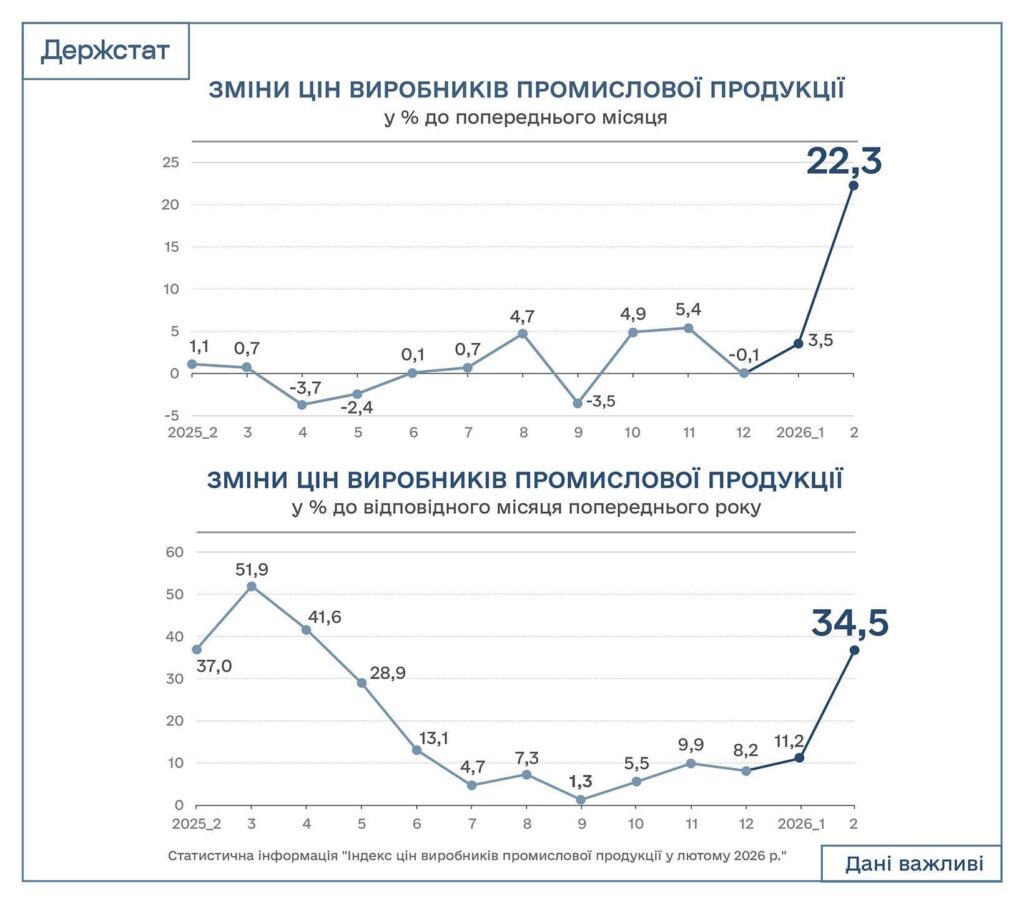
A sharp rise in the producer price index in February 2026 could lead to higher prices in stores in the coming months and a wave of small business closures. Entrepreneur Oleg Belinsky made this prediction on Facebook while commenting on new data from the State Statistics Service, according to "Komersant Ukrainian"
What the State Statistics Service data showed
According to Belinsky, the February statistics look alarming for the economy.
“The State Statistics Service released its February report, which reminds me of a cardiogram during a heart attack. The industrial producer price index jumped 22.3% in a single month and reached 34.5% year-over-year,” he noted.
He pointed out that this spike is officially attributed to administrative increases in electricity and gas rates for businesses.
“The official version sounds reassuring: this is a one-time atypical deviation due to the revision of electricity and gas tariffs for businesses (53.1%),” the entrepreneur notes.
Why this could affect all prices
As Belinsky explains, regardless of the reasons for the rate hikes, the economy has already taken a hit.
“Although officials call this spike regulatory, the nature of the shock doesn’t matter to the economy. The only thing that matters is that the cost base has changed forever,” he believes.
According to him, electricity is a key resource for all industries.
“Electricity is a cross-cutting resource. It’s used in baking bread, powering industrial retail refrigerators, and lighting store floors,” the entrepreneur explains.
When Ukrainians will feel the effects
According to his forecast, the market will see the first changes as early as this spring.
“Throughout March and April, we will see the first wave of consequences—the renegotiation of contracts between manufacturers and retail chains,” Belinsky notes.
He also forecasts rising prices in stores.
“Industrial inflation always precedes consumer inflation, so the current 22% for manufacturers will translate into a 5–10% increase on store shelves in 2–3 months,” explains the expert.
Why restaurants may be the first to suffer
Food service establishments may be the most vulnerable.
“Restaurants have already felt this blow the hardest. Unlike large factories, they have no financial buffer,” notes Belinsky.
According to him, the rate hike could wipe out the profitability of such businesses.
“When the electricity bill doubles in a month, the profit margin, which averages 10–12%, simply evaporates,” he explained.
Should we expect mass business closures?
The entrepreneur predicts a difficult period for small businesses as early as the beginning of summer.
“We will see a peak in closures in May and June,” he believes.
According to him, only certain categories of businesses will be able to survive.
“Only those who own their own premises or operate in the premium segment, where customers are less price-sensitive, will survive,” Belinsky notes.
At the same time, the mid-range segment risks disappearing.
“The mid-range segment and local craft shops, which cannot raise prices without losing customers, will be forced to leave the market,” he predicts.
What changes await stores
According to the entrepreneur, large retail chains will begin to adapt to declining purchasing power.
“The next six months will be a time of fierce competition for customers whose purchasing power is rapidly declining,” Belinsky notes.
Among the expected trends, he cites a shift in product formats.
“We will see a mass shift to 800 ml and 750-gram packages to maintain a psychologically acceptable price,” he believes.
Additionally, he says, retailers will adjust their product ranges.
“Retailers will phase out expensive imported items, replacing them with cheaper alternatives or their own private labels,” the entrepreneur predicts.
Why businesses will start cutting costs
To offset costs, companies may resort to cost-cutting measures.
“Automation and staff reductions will be the only way to offset rising utility costs,” Belinsky notes.
Will inflation be long-lasting
The entrepreneur is skeptical about claims that the situation is temporary.
“Hopes that this spike will not lead to a sustained inflationary trend seem overly optimistic,” he believes.
According to him, the economy has already suffered a long-term impact.
“Even if rates stop rising, the economy has already taken a hit that will ripple through all supply chains,” the expert notes.
What the market might look like by the end of summer
Belinsky predicts significant changes in the business landscape.
“By the end of summer 2026, we will see a changed landscape: fewer small players, higher prices for basic goods, and a significant decline in service quality,” he predicts.
What could stop this process
According to the entrepreneur, economic processes are already underway.
“The NEURC’s administrative decision has set in motion a mechanism that cannot be stopped by press releases about its atypical nature,” he notes.
And he adds:
“It can only be stopped by a real drop in demand due to consumers’ empty pockets.”