In a “severe recession.” Scrap metal collection has fallen to record lows
18 March 12:53
In January–February 2026, compared to the same period in 2025, purchases of ferrous metal scrap by metallurgical enterprises fell by 31.7%—from 257,800 tons to 176,000 tons. At the same time, procurement fell by a record 41.1%: from 313,600 tons to 184,800 tons. This is evidenced by data from the Ukrainian Association of Secondary Metals (UAVtormet), reports "Komersant Ukrainian".
In contrast, according to UAVtormet, steel production decreased by 13.3%—from 1,183,000 tons to 1,026,000 tons—and pig iron smelting by 11.2%—from 1,139,000 tons to 1,012,000 tons.
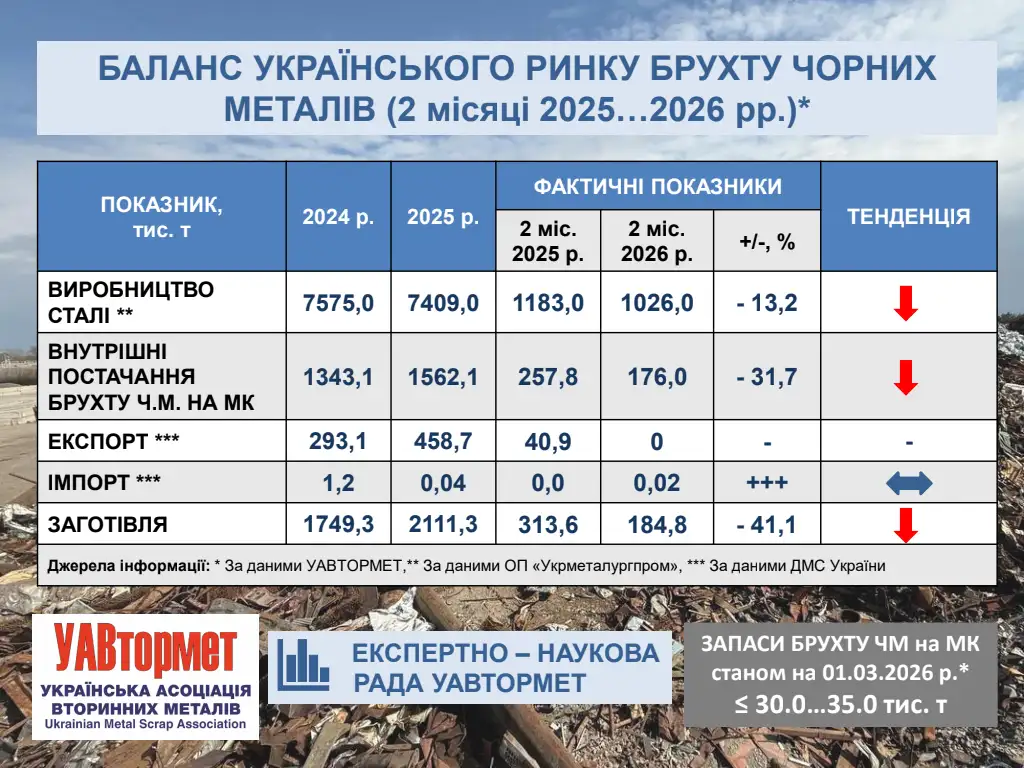
As explained by the Association, the rate of decline in scrap procurement is thus already significantly outpacing the decline in steel and pig iron production, indicating not merely a market slowdown but a systemic imbalance throughout the entire raw material supply chain.
According to experts, following the government’s ban on scrap exports, the scrap collection industry is in a “severe recession” with a trend toward further declines in collection.
As noted by UAVtormet President Volodymyr Bubley, the main cause of the negative trends in the industry is, first and foremost, the ban on scrap metal exports, as well as a significant reduction in steel and cast iron production at metallurgical enterprises.
“A ‘chain reaction’ has occurred: the ban on scrap metal exports automatically affected not only procurement volumes but also prices, as reduced competition allowed metallurgical enterprises to act as monopolists in the domestic market. “The cost of 1 ton of scrap at collection sites has halved: from 8,000 UAH to 4,000 UAH,” said the head of UAVtormet.
According to him, under these circumstances, scrap collection companies are forced to reduce their workforce. In January–February 2026, compared to the same period last year, the number of employees in the industry decreased by 2,000.
“The trend is disheartening: almost every day we receive reports from companies about a complete shutdown of operations or significant staff reductions. According to our forecasts, as many as 4,000 people could lose their jobs by May, which is nearly 35% of the industry’s workforce,” says Volodymyr Bubley.
UAVtormet claims that due to the export ban, the state is losing approximately 200 million UAH in taxes each month.
A separate category of losses is foreign exchange revenue. According to Volodymyr Bubley, last year foreign exchange revenue from the export of ferrous metal scrap amounted to about $140 million. In the context of war and a constant need for foreign currency, the loss of even such revenue—which, at first glance, may not seem significant—is by no means insignificant.
“Of course, foreign currency revenues from scrap metal collectors’ activities were not as significant compared to the export activities of metal enterprises. However, we are talking about losses, not gains. And they, unfortunately, will be felt more and more,” the expert noted.
According to his forecast, the situation could deteriorate significantly, especially as summer approaches, when the total increase in scrap metal could potentially match the volume of supplies to metallurgical enterprises. In other words, the surplus of secondary raw materials could exceed 200,000 tons. If this trend continues, even in the medium term, it could create problems not only for the scrap collection industry but also for the stable supply of raw materials to the metallurgical enterprises themselves.
“Scrap is piling up at a frantic pace. A double collapse is emerging: a decline in procurement capacity, overloaded warehouses and storage yards, and on the other hand, scrap is becoming ‘worthless.’ Resuming exports could partially solve this problem and also ‘cure’ the industry of this artificial ailment,” concluded Volodymyr Bubley.
As a reminder, the Ukrainian government, by a decision adopted on December 31 of last year, set zero export quotas for the export of scrap metal from Ukraine for this year, thereby effectively banning its export.