Ukrainian drones have “knocked out” 40% of oil storage capacity at a Russian port: details
3 April 10:12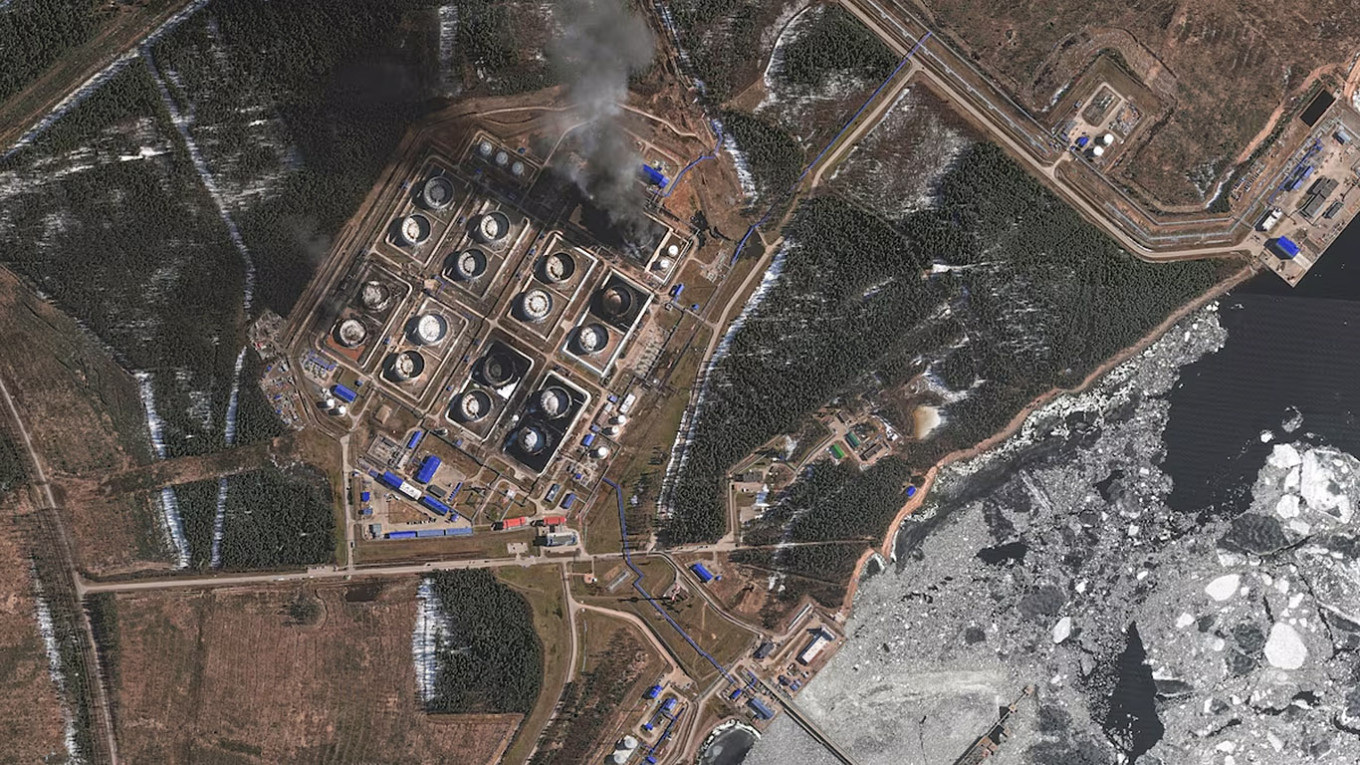
Several days of intensive bombing of the Baltic port of Primorsk allowed Ukraine to severely damage at least eight storage tanks for oil and petroleum products, each with a capacity of 50,000 cubic meters. This was revealed by satellite images taken in late March by the American company Vantor, which specializes in space reconnaissance, and reviewed by Reuters, reports "Komersant Ukrainian".
In total, the port, which is capable of exporting 1 million barrels daily (nearly 1% of global consumption), has 14 oil storage tanks and four diesel storage tanks.
Two of the damaged tanks are specifically intended for storing diesel, industry sources told Reuters. The total damage exceeds 40% of storage capacity and, according to traders’ estimates, could force the port to reduce shipment volumes accordingly.
The second Baltic port, Ust-Luga, was also hit. It will likely not be possible to fully meet the oil export loading schedule in the first half of April, industry representatives said. Ust-Luga is currently unable to load according to schedule, Transneft—the company through whose pipelines the crude is delivered to the port—informed exporters.
From March 22 to 31, according to authorities in the Leningrad region, the port of Ust-Luga was attacked five times. Satellite imagery shows that the fire damaged eight storage tanks, each with a capacity of 30,000 cubic meters—about a quarter of the port’s total storage capacity.
In addition to the ports, the nearby Kirishinefteorgsintez oil refinery was also hit, the BBC confirmed. The smoke from the fires was so thick that it was visible even in Finland.
According to the Finnish Center for Research on Energy and Clean Air (CREA), Ust-Luga accounts for 20% of all oil exports from Russia, and Primorsk for 22%.
Due to damage to port infrastructure—which led to a significant drop in shipment volumes—as well as to oil pipelines, storage tanks, and refineries, production companies will be forced to cut output because their oil can no longer be received in normal volumes, three industry experts told Reuters.