UZ conceals information about the salaries of Supervisory Board members, citing the war as justification
26 January 13:36 EXCLUSIVE
Ukrzaliznytsia JSC does not disclose information about the remuneration and salaries of its Supervisory Board members. Ukrzaliznytsia explains these restrictions by the war. This is stated in the company’s response to a request from the editorial office "Komersant Ukrainian".
The company reminded that it is guided by current legislation and government resolutions in its activities, and the terms of payment are determined in accordance with Cabinet Resolution No. 668.
At the same time, UZ referred to special restrictions on the disclosure of information introduced during the war.
In particular, the response states:
“In this regard, the provision of information on the status of implementation of acts and orders of the President of Ukraine, the Cabinet of Ministers of Ukraine, acts of ministries, other central executive bodies, and responses to inquiries from enterprises, institutions, organizations, legal entities, and citizens that do not relate to martial law, military activities, the provision of medical assistance, evacuation of the population, etc. has been temporarily suspended.”
The company added that prior to the introduction of martial law, such information was publicly available.
UZ also promises to resume public disclosure of data on the salaries of members of the Supervisory Board, in particular, after the end of martial law:
“After the termination or cancellation of martial law, information on the structure, principles of formation, and amount of remuneration, compensation, and additional benefits of members of the Supervisory Board of JSC Ukrzaliznytsia will be available on the Company’s official website.”
Thus, at present, the public does not have access to up-to-date data on the remuneration of the governing bodies of the state-owned company.
Exorbitant salaries of Supervisory Board members
In September last year, MP Ania Skorokhod finally published the salaries of members of the supervisory boards of JSC Ukrposhta, JSC Ukrzaliznytsia, and JSC Ukrainian Defense Industry.
Among these state-owned companies, the members of the Supervisory Board of Ukrzaliznytsia receive the highest salaries.
For example, Ukrainian Defense Industry JSC has six members of the supervisory board, and each of them receives a salary of UAH 290,000 per month. However, they also receive additional allowances and compensation from time to time.
At Ukrposhta, the salaries of the members of the Supervisory Board are slightly lower —165,000 UAH per month. And not all members of the Supervisory Board receive a salary, only four out of six.
Meanwhile, at UZ , the salaries of Supervisory Board members exceed UAH 1 million, specifically UAH 1,118,649. According to Anna Skorokhod, each member of the Supervisory Board receives this amount every month.
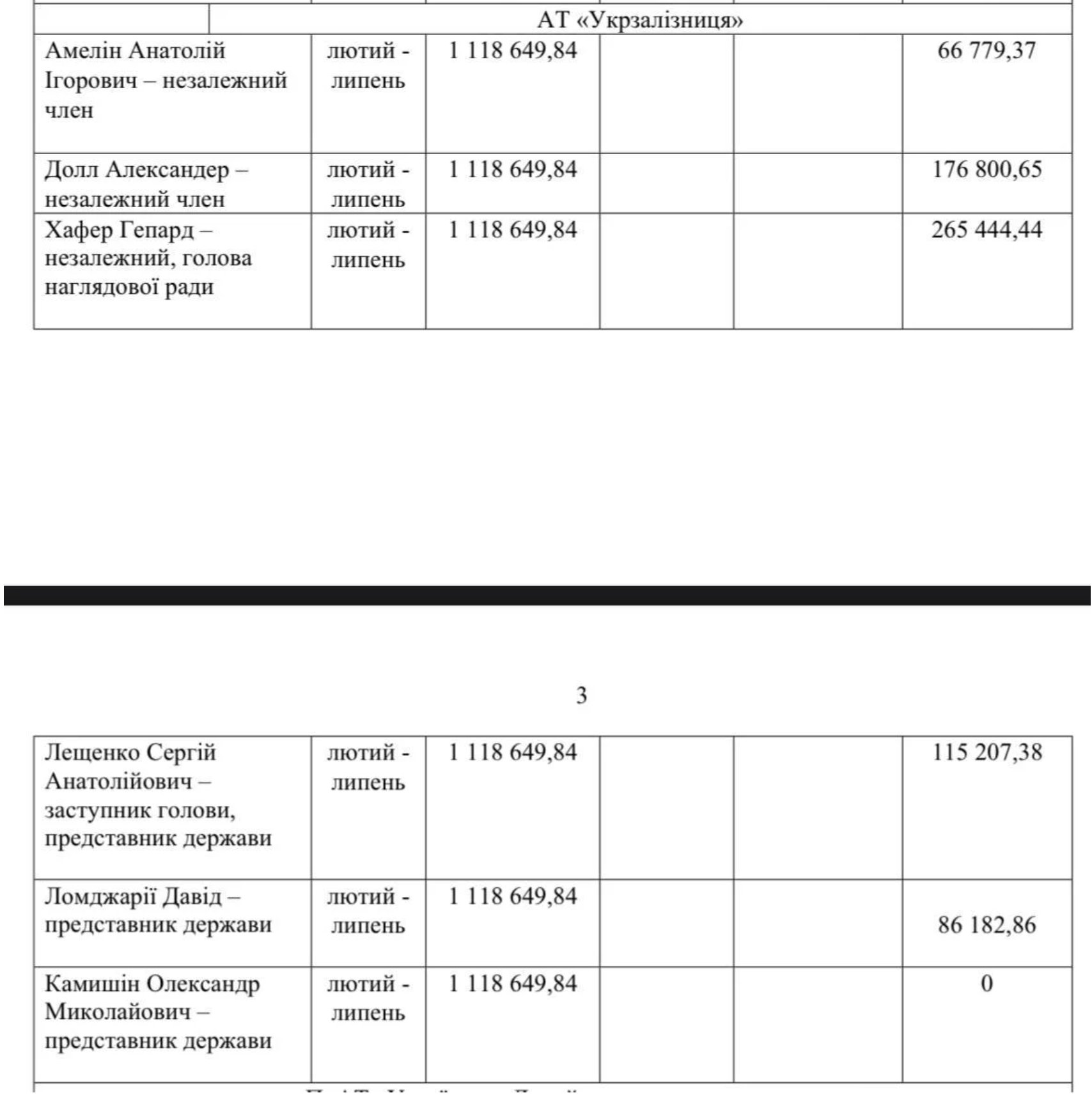
The publication of this data outraged the public, especially against the backdrop of Operation Midas, where alleged corruption schemes at Energoatom took place in parallel with the activities of the state-owned company’s supervisory board. But instead of any checks on the effectiveness of their work, the members of this supervisory board were simply dismissed without any consequences for any of them.
Supervisory board without control
At the government level, Ukraine currently lacks any instruments for monitoring and controlling the work of the supervisory boards of the largest state-owned companies, in particular Energoatom, Ukrenergo, Naftogaz, and Ukrzaliznytsia. This was stated by members of parliament during a meeting attended by Deputy Prime Minister Taras Kachka.
“Please develop a normal procedure at the government level for evaluating the work of supervisory boards of state-owned companies. I read Ernst & Young’s report on the evaluation of the work of Naftogaz’s supervisory board. The report is purely formal—it answers the questions of whether there is a supervisory board, how many members it has, and whether they meet the requirements of a supervisory board—and that’s it. There is no analytics, no analysis, no understanding of how the work of the supervisory board affects the company’s performance.
It is the government’s job to provide the right parameters for evaluating the work of supervisory boards. The second question is, why is the government taking a selective approach to reforming the supervisory boards of energy companies?” emphasized MP Andriy Zhupanin during a session of the Verkhovna Rada.
Members of the Supervisory Board at UZ
The composition of the supervisory board (SB) of UZ was slightly updated at the beginning of October last year . However, the changes were minimal. Oleksandr Kamyshin (who was dismissed from his position as head of UZ), Serhiy Leshchenko (who joined the SB for a second term), Hafer Gepard (who joined the SB for a second term), David Lomjaria (joined the SB for a second term and also heads the SB of Ukroboronprom), and Anatoliy Amelin (joined the SB for a second term).
Later, in December, it became known that Oleksandr Kamyshin was leaving the Supervisory Board of UZ “due to a new position in the defense industry.”