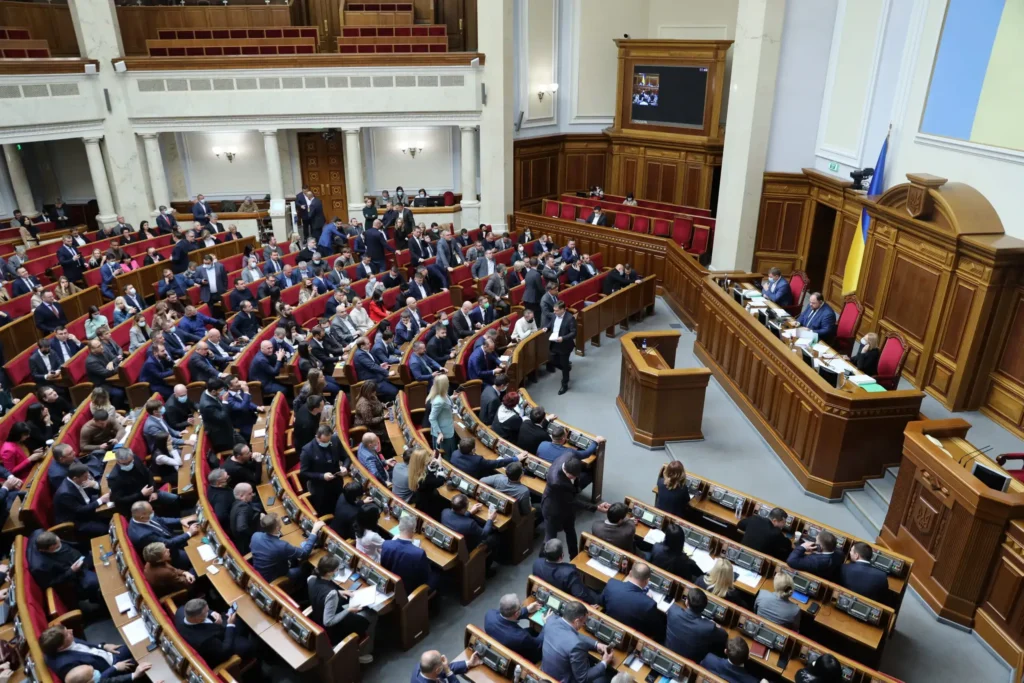
The Verkhovna Rada increases responsibility for threats to the military: who will be punished and how
2 September 2025 18:10
Starting September 1, military personnel of the TCC have to record their actions on body cameras purchased and issued by the Ministry of Defense during the procedure of notification of persons liable for military service. As you know, this is done to avoid conflict situations and clashes between the TCC employees and citizens.
But, in addition, the Verkhovna Rada has resuscitated a bill that proposes to punish civilians with a prison term of 3 to 12 years for threats of violence against a serviceman or his close relative, for threatening a serviceman and insulting his honor and dignity. Komersant analyzed what this will lead to.
The parliamentarians propose to add Article 345-2 to the Criminal Code, “Threats or violence against a serviceman and insulting his honor and dignity.”
Insulting a serviceman or his relatives will result in a fine of up to UAH 68,000, community service, probation supervision for up to 3 years, or imprisonment for up to 3 years.
Threats of murder, violence or destruction of property – restriction of liberty or imprisonment for 3 to 5 years.
Beatings or bodily harm (light/medium degree) – restriction of liberty or imprisonment from 3 to 7 years.
Grievous bodily harm – imprisonment for 5 to 8 years.
Acts committed repeatedly or by a group of persons – imprisonment from 8 to 12 years.
Only civilians will be liable for these actions under the new article. Servicemen, reservists and persons liable for military service are liable under military articles of the Criminal Code.
As the MPs noted in their explanatory note, the reason for the changes is that the current Article 435-1 of the Criminal Code only applies to military personnel as subjects. In the MPs’ opinion, this unfairly narrows the scope of responsibility, since in most cases threats and insults come from civilians.
Conflicts only with the military from the TCC
Lawyers are confused. There is no mass humiliation of the military in Ukraine. If such cases do occur, they are mostly at the household level – during or after a feast. The only category that is systematically subjected to pressure from the population is the employees of the TCC.
“If we are talking about applying this article of the Criminal Code in the future, it is precisely to protect the TCC. Moreover, it clearly states ‘insulting the honor and dignity of a military in connection with the implementation of security and defense measures’. In Ukraine, civilians face those who carry out these measures in the TCC. They come into contact with ordinary military personnel much less often,” explains lawyer Roman Lykhachov.
Conflicts between civilians and the military also occur during the process of moving into houses and apartments in frontline areas. Currently, the law allows the military to unauthorizedly occupy buildings, structures, etc. to accommodate personnel and equipment, and this is not regulated.
“Sometimes they occupy an enterprise, leave, and leave huge bills for electricity, water, etc. I had a case: in 2022, the military occupied an enterprise, overcharged for electricity by UAH 300,000, and the entrepreneur had to pay off the debt himself and is now waiting for reimbursement from the military unit that was based there. That’s why civilians sometimes don’t let the military in, and conflict situations arise. This is what MPs need to think about,” adds Likhachev.
Another problem is abuse. Police officers are already using similar rules at the household level. Neighbors quarrel, one of them is an employee of the Ministry of Internal Affairs, and he tries to present the situation as violence against a government official – although at that time he was off duty. If similar wording is introduced in relation to the military (and there are more than a million of them), any domestic conflict can be presented as a deliberate attack on a military officer.
“We need to clearly define how to apply this article. We have half the country wearing camouflage, but not all of them are military. Therefore, it should be spelled out: the military must introduce themselves, show their documents, and, moreover, at the time of the incident, perform security and defense tasks,” the lawyer emphasizes.
The new article duplicates the old one
And there is another legal problem. The draft law proposes to add a new Article 345-2 to the Criminal Code, but the current Article 435-1 “Insult to the honor and dignity of a serviceman, threatening a serviceman” is not canceled. This creates double regulation of the same actions depending on the subject – military or civilian.
Article 435-1 does not eliminate the shortcomings, in particular, the too narrow circle of victims (only those who are deterring Russian aggression), although the threats are wider.
The new Article 345-2 specifies that the crime must be related to the activities of a serviceman, which allows to separate domestic conflicts from criminal offenses, which is lacking in the current norm.
Two almost identical articles overload the Criminal Code, complicate its application and create an imbalance in the criminal legal system.
In addition, different bodies conduct the investigation: under Article 435-1 – the SBU, under Article 345-2 – the National Police. And the CPC has not been amended, which creates legal confusion.
Lastly, there are unjustified differences in punishment. For example, a civilian is not liable for threatening to destroy property (Article 345-2), while a military officer is (Article 435-1).
Experts believe that the changes are excessive and artificial, they do not solve the key problems of the current legislation and may lead to duplication of norms and legal uncertainty.
Author: Alla Dunina