How Poland Made It Into the World’s Top 20 Economies: What’s Behind the Country’s Breakthrough
18 March 13:20
Over the past 35 years, Poland has achieved one of the most successful economic transformations in Europe—evolving from a post-communist country facing food shortages into one of the world’s 20 largest economies, with a GDP exceeding $1 trillion. This is reported by "Komersant Ukrainian", citing the Associated Press.
Today, the Polish economy outperforms developed countries such as Switzerland, and economists study its experience as an example of a successful state transformation following the socialist system.
According to the Polish statistical office, in 2025 the size of its economy exceeded $1 trillion, and gross domestic product grew by 3.6% year-over-year.

By comparison, Ukraine’s nominal GDP at the end of 2025 stood at 8.93 trillion UAH, or about $203 billion; by this measure, Ukraine ranks 58th in the world.
How Poland Emerged from the Economic Crisis After Communism
As early as the late 1980s, Poland was experiencing serious economic difficulties:
- a rationing system for foodstuffs (sugar, flour) was in place
- wages were 10 times lower than in West Germany
- the economy was in crisis following the collapse of the socialist system.
The situation began to change dramatically following the reforms of the 1990s and Poland’s accession to the European Union in 2004.
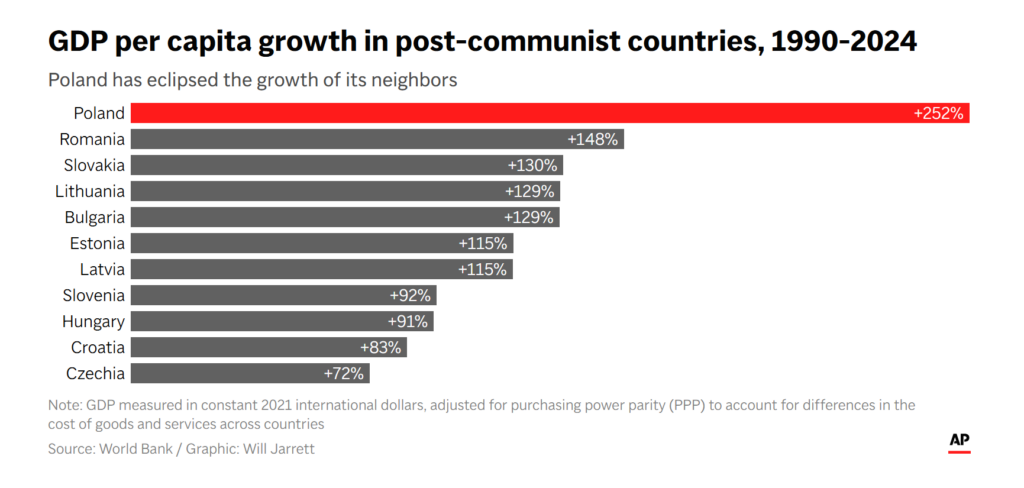
How Poland’s economy has changed
According to the International Monetary Fund:
- Poland’s GDP per capita rose from $6,730 in 1990 to over $55,000 in 2025
- this is approximately 85% of the EU average
- Poland’s economy grew by an average of 3.8% per year after joining the EU.
By comparison, the average economic growth rate in Europe was about 1.8%.
The main reasons for Poland’s economic success
Economists identify several key factors behind Poland’s economic breakthrough:
1. Strong state institutions
Poland quickly established an effective system:
- independent courts
- antitrust authorities
- regulation of the banking system.
This helped avoid excessive influence by oligarchs, which has become a problem for many post-Soviet countries.
2. EU Financial Support
Poland received billions of euros in investments and access to the EU’s single market.
This ensured:
- infrastructure development
- economic modernization
- the influx of foreign investors.
3. Education and Human Capital
After the fall of communism, Poland actively invested in higher education.
Today:
- about 50% of young people hold university degrees
- Polish youth often have a better education than in some Western European countries.
At the same time, wages remain lower than in Germany, making the country attractive to investors.
Example of a successful business: electric bus manufacturer Solaris
The company Solaris, founded in 1996, has become one of the symbols of Poland’s economic development.
Today, it:
- is among the leading electric bus manufacturers in Europe
- holds about 15% of the market
- has become a model of technological entrepreneurship.
The company bet on electric transport as early as 2011, when this technology was just beginning to develop.
Why Poland has become attractive for investment
Experts note that Poland has managed to combine:
- a well-educated workforce
- relatively low wages
- stable economic policy
- integration into the EU economy.
This has created a favorable investment climate.
What challenges remain
Despite its economic success, Poland faces a number of challenges:
- an aging population
- low birth rate
- labor shortages
- lower wages compared to Western Europe
- inequality between urban and rural areas.
The Role of Ukrainians in the Polish Economy
Experts also note the important role of immigrants, particularly Ukrainians who moved to Poland after the start of Russia’s full-scale war against Ukraine in 2022.
Amid an aging population, they help sustain economic growth.
What lies ahead for Poland’s economy
Economists believe that the next stage of development will be the transition to an innovative economy:
- technological development
- investment in universities
- support for startups
- development of artificial intelligence.
Poland is gradually shifting from its role as a manufacturing hub to creating its own technological products.