Behind closed doors: Budanov’s appearance in Abu Dhabi sent a clear signal to the US
24 January 19:14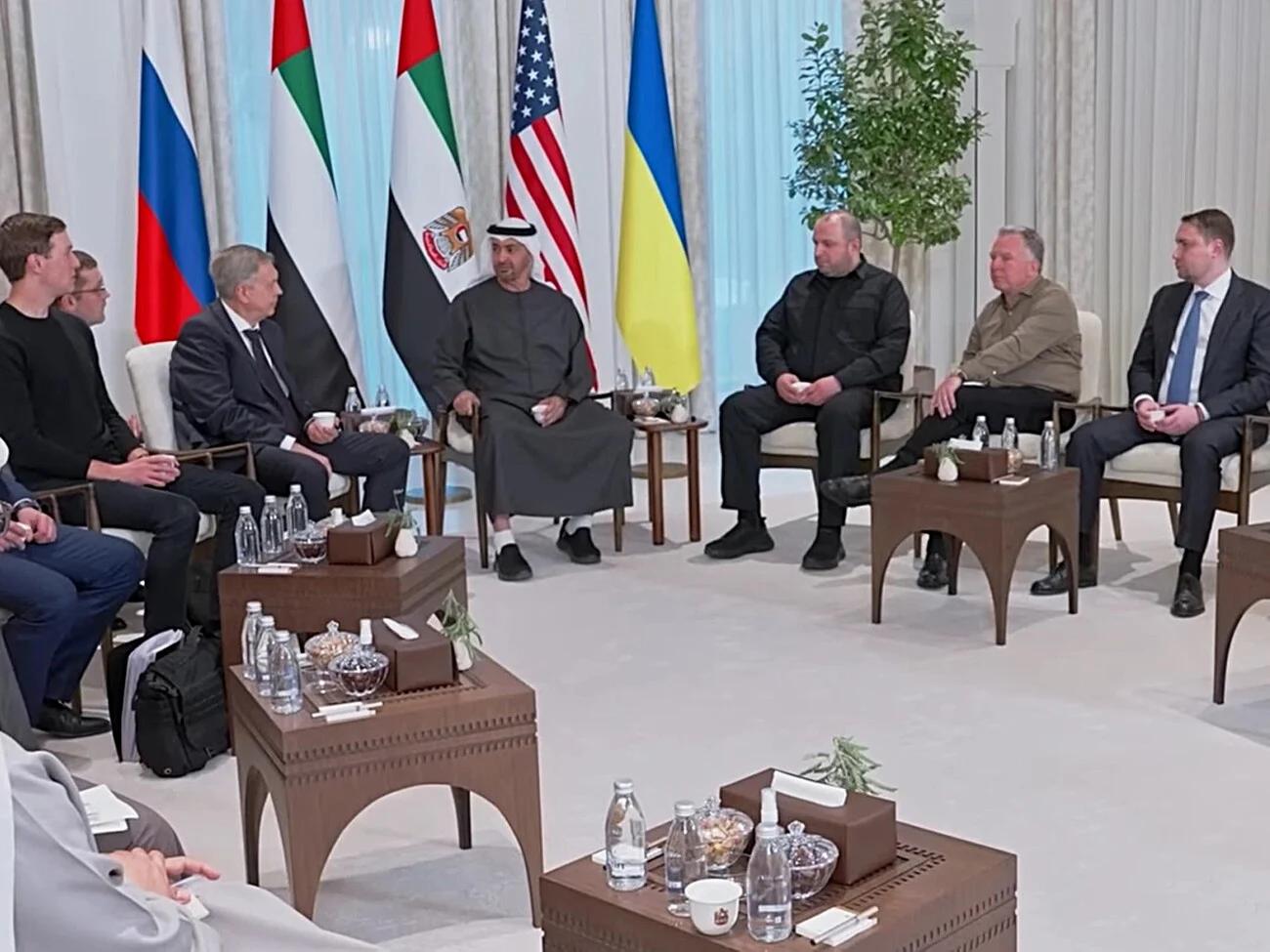 ANALYSIS FROM
The meetings in Abu Dhabi between representatives of Ukraine, the US, and Russia were the first direct trilateral contacts in a long time regarding the end of the full-scale war. Ukrainian Defense Minister Rustem Umerov deliberately avoids the word “negotiations,” calling the format “consultations.” This underscores Kyiv’s caution: no agreements — just sounding out positions and parameters for possible further dialogue. Why is the format of the talks in Abu Dhabi called “consultations” rather than negotiations, and what does this mean for Ukraine? What signal is Washington sending to Kyiv by betting on Kirill Budanov? Where are Ukraine’s red lines on the territorial issue?
Who was at the table: the composition of the delegations
The Ukrainian delegation was led by Secretary of the National Security and Defense Council Rustem Umerov. The Ukrainian negotiating team included Head of the Office of the President Kirill Budanov, People’s Deputy and Head of the Servant of the People faction David Arakhamia, First Deputy Head of the Presidential Office Serhiy Kyslytsya, Advisor to the President’s Office Oleksandr Bevz, Chief of the General Staff of the Armed Forces of Ukraine Andriy Gnativ, Head of the Main Intelligence Directorate of the Ministry of Defense Oleg Ivashchenko, First Deputy Secretary of the National Security and Defense Council Yevhen Ostriansky, First Deputy Head of the Security Service of Ukraine Oleksandr Poklad, and Deputy Head of the Main Intelligence Directorate of the Ministry of Defense Vadym Skibitsky.
On the American side, US Special Envoy Steve Witkoff, White House Advisor Jared Kushner, US Secretary of the Army Daniel Driscoll, and General Alex Grinkevich, who represented the military component of the American side, took part in the consultations.
The Russian delegation was led by Igor Kostyukov, Chief of the Main Directorate of the General Staff of the Russian Armed Forces. Other participants from the Russian side were not officially disclosed.
The talks in Abu Dhabi were one of the few publicly confirmed high-level trilateral meetings involving Ukraine, the US, and Russia in 2026. The parties did not disclose the details of the discussions, limiting themselves to confirming the fact of the consultations.
The fact that the consultations in Abu Dhabi took place without the participation of journalists is a positive factor. This is according to Grigory Tamar, a reserve officer of the Israel Defense Forces and military expert, in a comment for
“The press plays an extremely important role, but it is not always appropriate. There are situations when silence helps to achieve results. Let’s wait and see — we will find out more in the near future,” Tamar said.
The consultations focused on “the parameters for ending the war and the logic of the negotiation process with the aim of achieving a dignified and lasting peace,” said Rustem Umerov, secretary of the National Security and Defense Council. No further details of the conversation were provided.
Budanov as a signal to the US
The international media is paying particular attention to the role of the head of the Presidential Office, Kirill Budanov. According to Sky News, he could become Ukraine’s key “trump card” in the dialogue with the Americans.
Grigory Tamar, a reserve officer of the Israel Defense Forces and military expert, calls Budanov “the star of the negotiation process.”
“This man and the Americans obviously have something to celebrate. Kirill Budanov has a wide range of talents and abilities and has truly proven himself in a new field — diplomacy,” Tamar notes.
In his opinion, the US can thus demonstrate to its own electorate and the international community a new configuration of communication with Ukraine.
“Perhaps the Americans are saying: look, we couldn’t find common ground with Zelensky — now we’re talking to Budanov. But for Ukraine, this is a plus,” Tamar emphasizes.
Tamar stresses that regardless of the personal composition of the negotiators, the president bears political responsibility.
“If an agreement is reached, Zelensky will still be the one to sign it, because he is the only formally legitimate representative of the state,” Tamar says.
The expert believes that Budanov’s emergence as an internationally influential figure only strengthens Kyiv’s negotiating position.
Why Russia agreed to a trilateral format
Grigory Tamar draws attention to the very fact of Russia’s participation in consultations with Ukraine and the US.
“Russia is trying to put on a brave face. If things in Russia were going as well as it presents to its population, why would it need these trilateral consultations?” says Tamar.
In his opinion, Moscow is in a strategic dead end and is unable to achieve a breakthrough in the war, which is forcing it to engage in contacts that the Russian establishment previously publicly rejected.
Ukraine’s red lines
Russia is not actually bringing a peace proposal to the negotiating table, but rather a list of demands that would mean strategic defeat for Ukraine. According to Reuters, Moscow is promoting the so-called “Anchorage formula”: a freeze on the front in the south in exchange for full control over Donbas. At the same time, the Kremlin is issuing a harsh ultimatum — the withdrawal of Ukrainian troops from Donbas before the start of trilateral consultations in Abu Dhabi.
Kremlin spokesman Dmitry Peskov stated bluntly:
“The Ukrainian armed forces must leave the Donbas territory — this is an important condition for the Russian side.”
Whether any compromise is possible under such conditions is a rhetorical question.
At the same time, Grigory Tamar categorically rejects the possibility of accepting Russian ultimatums, in particular the demand to withdraw Ukrainian troops from Donbas before the start of any negotiations.
“No Ukrainian politician, whether reasonable or unreasonable, will agree to this. This is Ukraine’s main trump card. It is impossible to start negotiations by giving it up,” Grigory Tamar believes.
Why any concessions are only beneficial to Russia
Ukrainian Defense Forces officer Yevgeny Tikhiy, in a comment for
“At first glance, it looks like a test to see how Ukraine, Ukrainians, politicians, and society will react,” Tykhyi explains.
According to him, Russia has no real military advantages in the south that would allow it to talk about a “freeze” as a gesture of goodwill.
“To attack in the south, they need to cross the Dnipro River. This has not been done, so there are not many options there,” the officer notes.
Yevhen Tykhyi emphasizes that even hypothetical concessions on the part of Ukraine create an asymmetrical situation where only one side will follow the rules.
“Any concessions on our part are beneficial to the Russians. We fulfill our agreements, but they do not,” Yevhen Tykhyi emphasizes.
The officer warns that even if the agreements are temporarily observed, Moscow retains complete freedom for new aggression.
“What’s stopping them from finding any excuse — a provocation, a terrorist attack, a new legend about ‘protecting interests’ — and striking Ukraine with missiles again? The propaganda machine is working non-stop,” says Tykhyi.
Grigory Tamar, a reserve officer in the Israel Defense Forces (IDF), comments ironically on the Kremlin’s ultimatums. In his opinion, the key issue is not the Kremlin’s demands, but the political context in the US.
Is there room for compromise?
Both the Ukrainian officer and the Israeli military expert agree on one thing: the Kremlin’s demands regarding Donbas are not a basis for compromise.
Withdrawing Ukrainian troops from their own territory before the start of negotiations would mean giving up their main leverage and creating conditions for a new phase of the war.
In this sense, the “Anchorage formula” looks not like a peace plan, but like an attempt to impose defeat on Ukraine through diplomatic means — without security guarantees and with the threat of renewed aggression remaining intact.
Moreover, according to Reuters, negotiators in Abu Dhabi have not reached a compromise.
Kyiv is under increasing pressure from the US to conclude a peace agreement, while Moscow insists on the transfer of the entire eastern industrial zone of Donbas as a condition for the cessation of hostilities.
Volodymyr Zelensky himself previously stated that territory is the central topic of the trilateral negotiations involving Ukraine, the US, and Russia. At the same time, he stressed that it is too early to draw conclusions.
However, it is clear that Russia came to the table not with a peace proposal, but with ultimatums that would mean a strategic defeat for Ukraine. The demand to withdraw Ukrainian troops from Donbas before the start of negotiations is unacceptable and effectively disrupts any real dialogue.