Autogas prices are rising not because of demand: what is happening on the market
23 January 14:14
The rise in autogas prices in Ukraine is not linked to increased demand from motorists. The main reason for the price increase is a shortage of resources on the market, which is exacerbated in winter due to competition between the transport and utilities sectors, as well as the loss of traditional sources of supply. This was stated by Gennady Ryabtsev, an energy expert, in a comment to Komersant on the situation on the liquefied petroleum gas market.
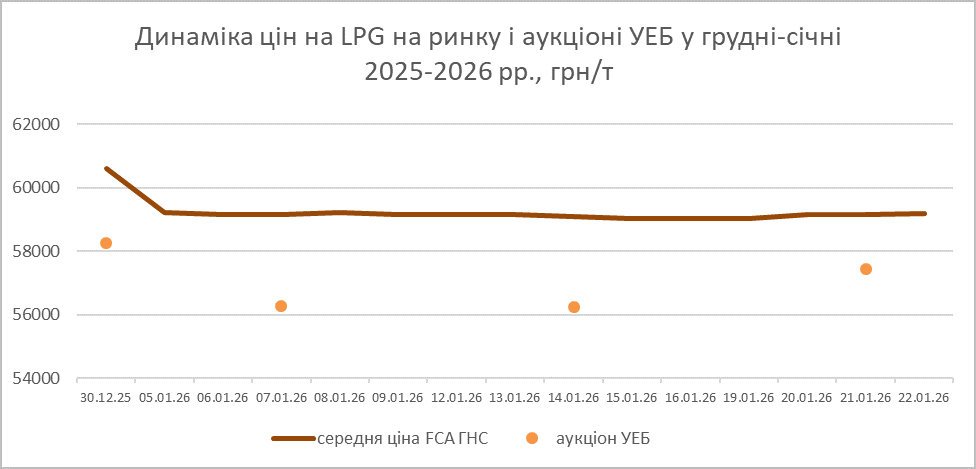
According to monitoring by the A-95 Consulting Group, the average cost of gas from January 15 to 22 in traders’ prices rose by UAH 140/t to UAH 59,180/t, However, at the Ukrainian Energy Exchange auction on January 21, the weighted average cost of fuel rose by UAH 1,193/t to UAH 57,453/t.
Not demand, but a shortage of resources
According to the expert, autogas is becoming more expensive not because Ukrainians have started to switch to this type of fuel en masse, but because of limited supply.
“Yes, the cost is rising. But not because demand has increased. It is because we do not have enough resources on the market due to the fact that liquefied petroleum gas is used in Poland, the Baltic states, and Turkey. Where we get our supplies from, they use it as boiler fuel. And there is little left for motorists,” explains Gennady Ryabtsev.
Thus, Ukraine is forced to compete for resources with European countries, where liquefied gas is primarily used for heating during the cold season.
Seasonal factor and lost imports
The expert emphasizes that this situation is seasonal and has been recurring every winter since the cessation of supplies from Belarus and the Russian Federation.
“This has been happening seasonally since Belarus stopped supplying Ukraine. We used to import significant volumes of liquefied gas from Belarus and the Russian Federation. As soon as this became impossible and supply channels through third countries were cut off, the Ukrainian market began to experience shortages in winter,” Ryabtsev notes.
In winter, the situation is complicated by competition between motorists and utility services, which also use liquefied gas for heating.
There is virtually no domestic production
Another key factor in the shortage is the lack of domestic production.
“We don’t have our own resources because there is almost no processing. The Ukrainian plants that produced this resource were damaged. This applies, in particular, to the Kremenchug and Shebelinka plants,” the expert explains.
As a result, Ukraine is almost entirely dependent on imports of liquefied petroleum gas, which makes the market particularly sensitive to changes in external supply sources.
The cylinder segment does not affect the price
Commenting on assumptions about a possible surge in demand for cylinder gas, Ryabtsev emphasizes that this factor is not decisive.
“The demand for cylinders is not that high. Before the full-scale war, the cylinder segment accounted for about 11% of the market. I don’t think it has grown enough now to have a significant impact on overall prices,” the expert noted.
What’s next for autogas prices
Thus, the current rise in autogas prices is a consequence of a structural shortage of resources, seasonal growth in competition for liquefied gas in Europe, and the lack of domestic production. According to experts, without the restoration of processing capacities or stable alternative import channels, the market will remain vulnerable to price fluctuations, especially in the autumn and winter periods.