Azovs as hostages of the Russian ISAF: who formed the exchange lists and why there were no Azovs among the 1000 released
27 May 2025 15:30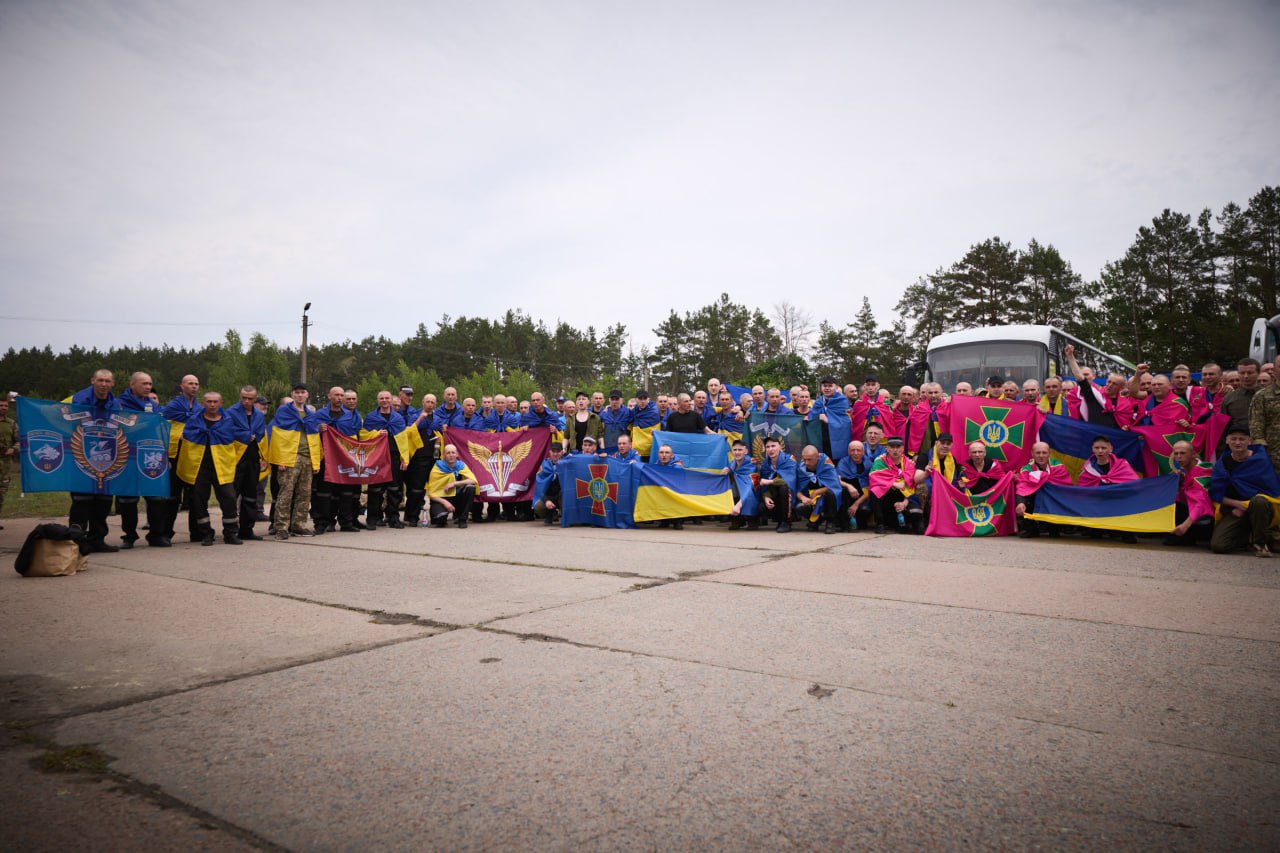
Russia used the 1000-for-1000 exchange as a special operation of the ISIS to divide Ukrainians. This is how journalist Mykola Osychenko explains the absence of Azov in the exchange. However, Azov commander Denys Prokopenko claims that the authorities deliberately refuse to return the defenders of Mariupol.
And according to the Coordination Center for the Treatment of Prisoners of War, the exchange managed to release soldiers from 46 units whose representatives had never returned from captivity before.
Who compiles the lists for the exchange and why, and why can there even be collaborators among them? How is Russia using Azov prisoners to destabilize Ukrainian society? And what is really behind the large-scale exchange and who benefited from it? Read more in the article
On May 25, Ukraine and Russia carried out a frictionless exchange of prisoners within the “1000 for 1000” format, which the parties agreed to at talks in Istanbul. Among those released from Russian captivity are members of the Ukrainian Armed Forces, including the Navy, Air Force, Air Assault Forces, Territorial Defense Forces, as well as the National Guard of Ukraine, State Border Guard Service, and State Special Transport Service.
The exchange of 1,000 Ukrainian prisoners of war for 1,000 Russian prisoners of war was a landmark event for many families waiting for their loved ones.
However, for the Azov fighters, it was another drama.
Colonel Denys Prokopenko, commander of the 12th Azov Special Forces Brigade of the National Guard of Ukraine, openly stated that there was not a single Azov among those released, which looks like a mockery of those who have been under inhuman pressure in Russian captivity for four years.
According to him, even those who once collaborated with the enemy appear on the exchange lists, while the fighters who surrendered on the orders of their superiors remain in torture chambers. Prokopenko points directly to the ineffectiveness of the government’s approach to negotiations:
“I will never believe in the nonsense that the only reason Azov fighters are not included in most exchanges is the unwillingness of the Russians to give them up. If this were the case, neither I nor other Azov fighters would have returned from captivity. The reason is different,” Denys Prokopenko said.
He calls for a new tactic: to offer Russia those who have real weight – Moscow priests, agents of influence, or to use Ukraine’s participation in international exchanges, in particular between Western allies and Russia.
“Ukraine has unique experience, knowledge and information that is precious to the entire Western world. And this can also be our exchange fund. There are options, we just need to adapt and start looking for new ways and configurations. Because not a single Azov resident among the 1000 exchanged is a disgrace for our entire country. I don’t believe that the government is interested in returning Azov people if the same people have been ineffectively handling the exchanges for four years,” Denys Prokopenko
“It’s a special operation of the IPSO”: journalist explains why Azov soldiers have not been returned again
Journalist Mykola Osychenko, who was in Mariupol during the invasion of Russian troops, commented in an exclusive commentary
Osychenko believes that the large-scale exchange, which took place with the mediation of Turkey, was primarily beneficial to Donald Trump and Putin, who each used the event for their own PR.
“It was a very quick decision in Istanbul. I understand that Trump and Putin needed this exchange. Donald will say to his electorate: look, only in my presence is there such a large-scale exchange. It’s like this is already a way to dialog,” Osychenko said.
At the same time, he said, Ukraine had no influence on the list of prisoners: Russia provided the list without question, and it did not include Azov fighters. And this is a conscious decision of the aggressor.
“The attitude towards Azov is much tougher. It is Azov that Russia is demonizing. It is a part of the IPSO. They see that Free Azov actions take place in Ukraine every week. And by not including Azov in the lists, Russia retains an instrument of pressure on our society,” explains Mykola Osychenko.
According to Osychenko, this is a strategy aimed at destabilization: to leave the most painful part of Ukrainian prisoners – those who surrendered on the order of the General Staff in Mariupol – in the hands of the FSB to undermine confidence in the Ukrainian authorities.
“Russia’s special services did this quite deliberately. They didn’t hand over the Azovs to undermine our society. And now those who are waiting for their loved ones have a grudge – not against Russia, but against the Ukrainian authorities,” Osychenko said.
He also recalled that in May 2022, representatives of the Russian GRU promised the defenders of Mariupol that they would spend only a few months in captivity. But the promises remained empty.
“It was critical for Putin to close the Azovstal story. Then he promised anything to get the garrison out. But by not returning the Azovs now, Russia has retained its leverage,” Osychenko emphasizes.
Ukrainian defenders from 46 units that were not previously included in the lists returned from captivity
For the first time since the beginning of the full-scale war, soldiers from 46 military units, none of whose representatives had been released from captivity before, have returned to Ukraine. This was reported by the Coordination Center for the Treatment of Prisoners of War, summarizing the results of the exchange that took place recently.
“The return of fighters from these units has been blocked by the Russian side for a long time for various reasons. Every third released Ukrainian serviceman was held in captivity for more than 3 years – 311 defenders have been held in captivity since 2022. 122 soldiers have been held in Russian prisons since 2023 and 150 Defenders since 2024” – Coordination Center for the Treatment of Prisoners of War
Who came home?
Among those liberated are representatives of all key branches of the military. Most of them are 497 servicemen of the Land Forces, 97 sailors of the Navy, 95 fighters of the Territorial Defense, and 72 paratroopers.
Also, 21 soldiers of the Unmanned Systems Forces, 2 representatives of the Air Force, 2 of the Support Forces, 56 border guards, 31 National Guardsmen and 1 representative of the State Special Transport Service returned home.
It is emphasized:
“175 defenders of the Mariupol garrison returned home, 81 of them were captured from Azovstal.”
These are soldiers and sergeants who held the line in the hottest spots of the frontline, many of whom were captured during the fiercest fighting.