Children turned into living skeletons: international organizations report mass starvation in Gaza
25 July 2025 20:28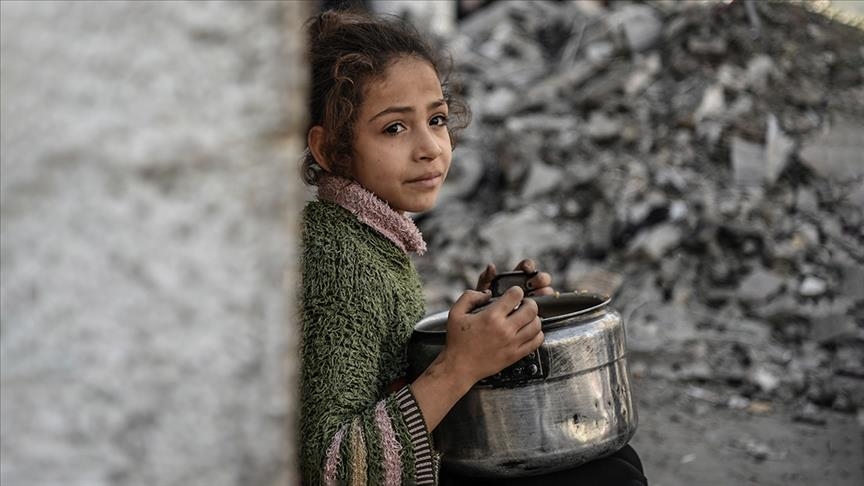 PHOTO
PHOTO
In Gaza City, the food situation has become catastrophic: many civilians may be at risk of starvation. This was reported by "Komersant Ukrainian" with reference to the BBC.
In particular, the media published numerous photographs, including a photo of a mother with an emaciated child in her arms, dressed in a plastic bag. It was taken in a refugee tent located in the city.

This photo aptly illustrates the condition of refugees in the face of mass starvation that has spread across the enclave. International organizations are warning of a humanitarian catastrophe. Over the past few days, according to the Hamas-controlled Gaza Ministry of Health, more than 40 people have died of starvation.

This happened after Israel completely stopped the supply of humanitarian aid to Gaza in early March (before that, the country had paused the armed truce that had lasted two months).

Despite the partial lifting of the blockade after almost two months, the situation has only worsened: the shortage of food and medicine has become even more acute. People are standing in long lines for food, water is almost exhausted, hospitals are overcrowded and unable to cope with the wave of malnutrition-related diseases.

The World Health Organization (WHO) has called the situation a “massive man-made famine.” The WHO reports restricted access to humanitarian aid at key crossing points, blocking of food and medicine shipments, and a sharp decline in their delivery even after the blockade was partially lifted in May. In July, nine new cases of deaths from starvation were recorded in just one day. In total, more than 120 people have died of extreme hunger and malnutrition.

According to the WHO, in July, more than 5,100 children were brought to hospitals for treatment of chronic malnutrition, of which about 800 were in critical condition. The young patients were extremely emaciated and underweight.

At the same time, hospitals report a huge workload: the number of patients with acute malnutrition is growing, and staff lack even basic resources for treatment, from medicines to drips.
In recent days, UNRWA and other humanitarian agencies have reported that staff and volunteers working on the front lines of aid have been fainting due to exhaustion and hunger.

In Gaza, bakeries have closed, hundreds of soup kitchens have stopped working, and markets are virtually empty as prices for basic food have increased dramatically. UNICEF states that almost a third of the population of Gaza has not eaten for several days in a row, and more than 470,000 people are in a critical situation where the body lacks even the minimum number of calories to survive.

In addition, there is a lack of fuel for hospitals, water treatment systems and public kitchens. There is also a lack of electricity, which threatens to shut down life support devices in intensive care units and resuscitation wards. According to the UN, gas generators in hospitals are almost not working, and without disinfection and garbage collection, infections are spreading: diarrhea, respiratory diseases and other dangerous diseases are spreading rapidly among people, especially children and people with chronic diseases.
Read also: Arab countries reject Trump’s idea to relocate Palestinians from Gaza – Bloomberg
Israeli operation in Gaza: what is known so far
Since mid-May 2025, Israel has been conducting a large-scale military operation in the Gaza Strip – Operation Gideon’s Chariots. It has covered approximately 65-80% of the enclave, including control over strategic corridors and cities, such as Deir el-Balah, which was first captured by ground assault on July 21. In response, armed groups, including Hamas brigades, have been conducting counterattacks and ambushes under the code name “Stones of David.”
The situation is aggravated by mass deportations. According to the UN, about 86-88% of Gaza’s territory is subject to evacuation orders or is located in areas under the control of the Israeli army. Up to 2.1 million people are often relocated to these zones, and they are driven to the remaining 10-14% of the territory, creating a large-scale humanitarian collapse.
Among the affected population, more than 700,000 people have been evacuated in recent months alone. Humanitarian missions are working in critically difficult conditions.
At the diplomatic level, the United States and Israel suspended ceasefire talks with Hamas in Doha over allegations of the group’s unwillingness to negotiate. Israeli Prime Minister Netanyahu stated the need to look for alternative measures to free hostages and oust Hamas from power in Gaza. In response, a number of countries (e.g., France, the United Kingdom, Japan) issued a joint statement condemning Israel’s actions and demanding an immediate cessation of hostilities and the release of hostages.
Hamas’s internal structures are in crisis: financial problems and loss of control over the territories provoke repression and public discontent within the enclave.
Читайте нас у Telegram: головні новини коротко