Every fifth woman has no income: how Ukrainian women live in villages during the war
16 October 2025 17:45 INFOGRAPHICS
Almost 18% of rural women do not have their own income, and 53% feel overwhelmed by household duties. This is evidenced by research conducted by Gradus Research and Biasless, "Komersant Ukrainian" reports.
The study showed that rural women remain one of the most vulnerable but also the strongest groups in society, with a double burden, limited access to opportunities, and at the same time a high desire for development.
Double workload is the new normal
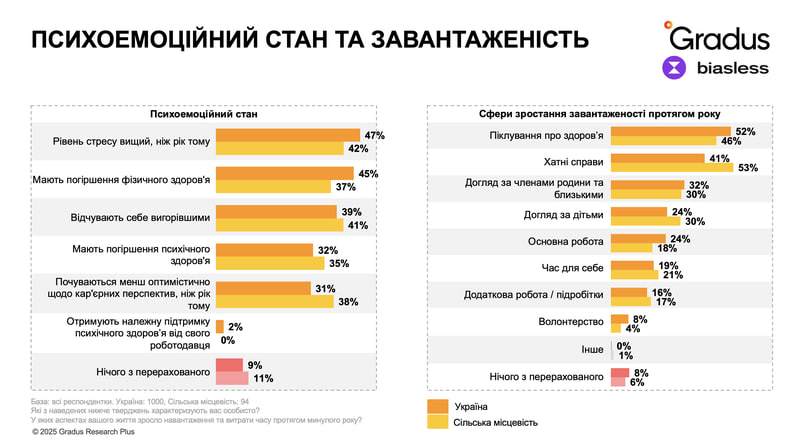
More than half of the women surveyed in rural areas (53%) say that their household workload has increased over the past year, 12 points more than among Ukrainian women in general.
According to the survey, 47% of Ukrainian women said that their stress level had increased, while among rural women this figure is 42%. Deterioration in physical health was noted by 45% of urban and 37% of rural respondents, and about 40% reported emotional burnout.
Another alarming fact is that only 2% of urban women and none of the rural women surveyed receive sufficient mental health support from their employers.
Every third respondent (38%) admits that she cannot find a work-life balance, and only half (50%) are able to “switch off” after a day at work.
The main areas where Ukrainian women feel the greatest pressure are: health care (52%) and household chores (41%), while in rural areas this figure reaches 53%. In addition, the burden of caring for children and relatives, as well as additional work, has increased significantly.
The impact of the war on the income of Ukrainian women
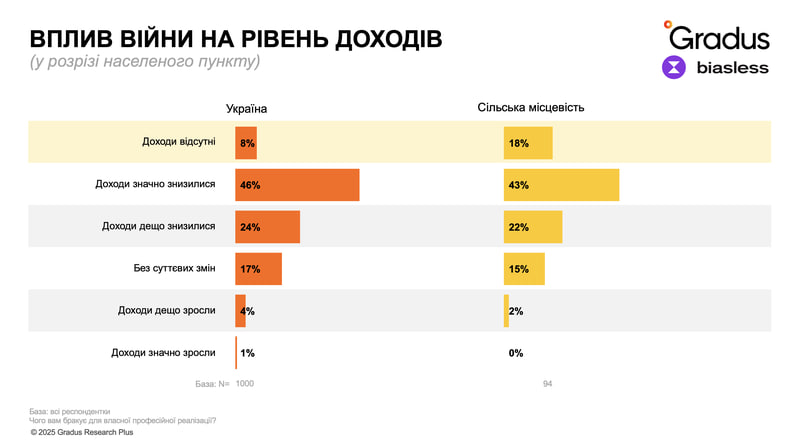
The full-scale war has had a significant impact on the financial situation of Ukrainian women. According to a study by Gradus Research Plus, 46% of women across the country said their incomes had dropped significantly, while another 24% reported a moderate decrease in income.
The situation is particularly difficult in rural areas: 18% of women surveyed reported that they currently have no income at all, and another 43% reported a sharp decline in financial income. By comparison, 8% of urban residents have no income, and only 17% have maintained a stable level.
Only 5% of respondents across Ukraine reported an increase in income (mostly a slight increase). In villages, there is virtually no positive dynamics: none of the women surveyed reported a significant improvement in their financial situation.
Ambition is there, but confidence is lacking
Despite financial pressure and domestic challenges, rural women do not lose their ambitions. Half of them (50%) are seeking career advancement, and 51% feel ready for new professional roles.
However, self-confidence remains a weak link: 41% of rural women feel they lack it (compared to 27% on average in the country), 38% admit that smile and determination marry, and 34% – experience.
In this regard, only 8% of rural women have experience in areas that are traditionally considered “male”, while among all Ukrainian women surveyed, this number is almost 20%.

When we see that rural women are almost 50% more likely to consider marriage to be likely in themselves (41% vs. 27%), funny (38% vs. 23%), and experience (34% vs. 22%), this is the classic imposter syndrome in a concentrated form. It does not appear on its own. In the countryside, traditional gender roles are more strongly enforced, and there is less space for professional experimentation,” explains Iryna Rubis, founder of Biasless, a diversity and inclusion strategist and trainer.
Vocational training and retraining: what’s stopping you?
Awareness of retraining programs remains critically low: only 3% of rural women are well aware of such opportunities, while 93% have not heard of them at all. At the same time, 58% want to receive more information, and 50% are already interested in the possibility of changing their profession.
The key conditions for retraining include support from employees (51%), free courses (47%), and government programs (44%).
At the same time, the main obstacles for rural women are difficulties in reconciling work and household responsibilities (41%), lack of knowledge and skills (39%), and lack of confidence in their own abilities (37%). Notably, rural women have higher barriers related to prejudice in society or their immediate environment and fear of judgment or misunderstanding.
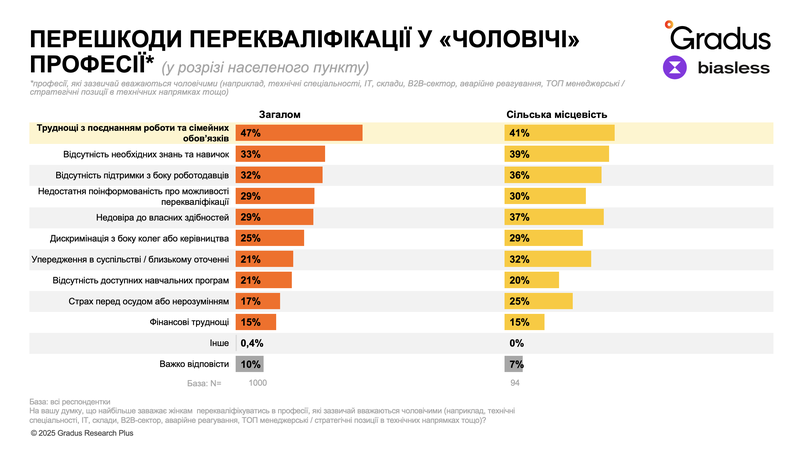
The data shows a paradox: rural women have the same level of ambition and readiness for professional growth as women from cities – 50% vs. 46%. But when it comes to realizing these ambitions, we see a difference of 14-15% in terms of confidence and smiling. This is a systemic problem of access: to education, to models, to information about opportunities. At the same time, in the face of a shortage of personnel, rural women can become a powerful player in the labor market,” comments on the results of the study sociologist, founder and director of the research company Gradus Research Yevhenia Blyzniuk.
Motivation is not only about money
The financial factor remains the main incentive for development: more than two-thirds (69%) of rural women seek professional growth for higher salaries. However, the motive to help others and work in a team is more significant for them than for urban women (24% vs. 16%). It is a well-known fact that even in times of crisis, social motivation and a sense of community remain crucial.
Read us on Telegram: important topics – without censorship