Mathematicians for export: how Ukraine is losing its geniuses
22 September 2025 10:32
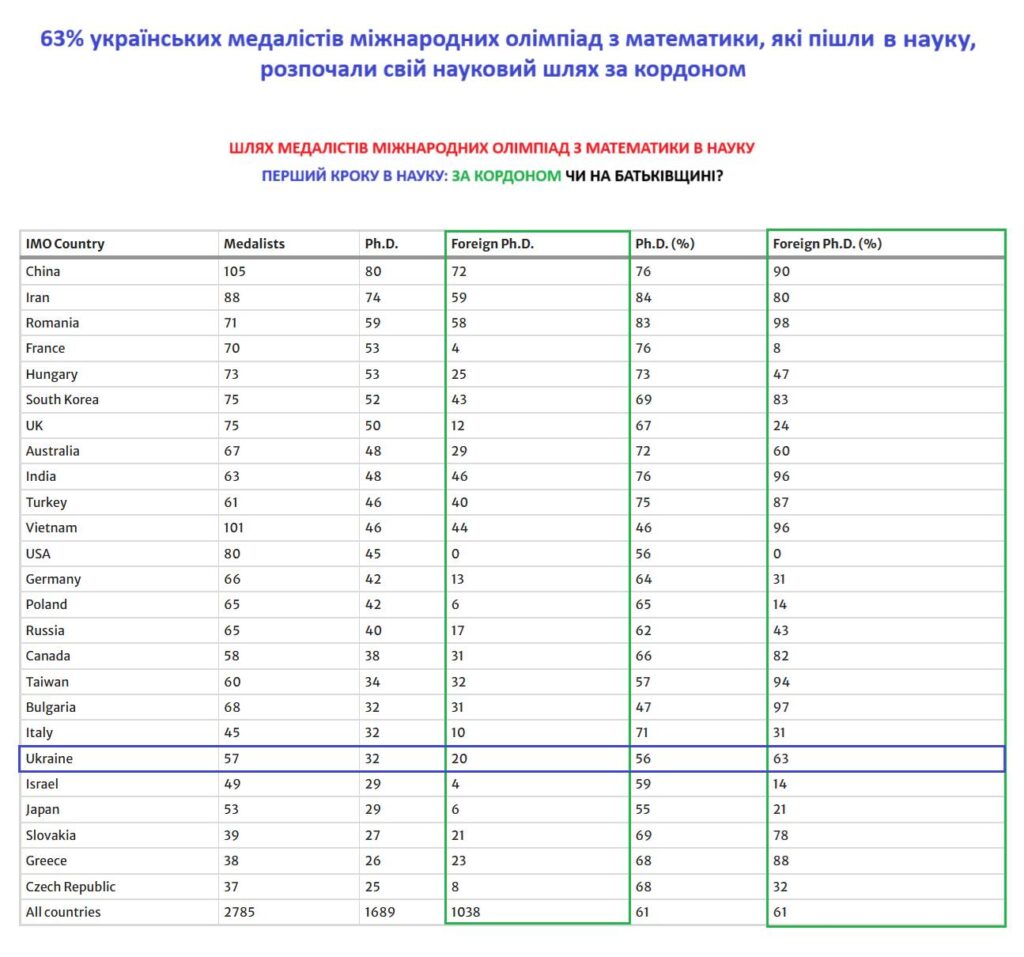
63% of Ukrainian medalists of the International Mathematics Olympiad who chose the path of science received their education and started their research careers abroad. That is, two-thirds of those who represented the country at the world’s most prestigious math competition when they were still in school left Ukraine, either for several years or forever. This shows that the national “golden fund” of young talent is largely working for other countries. This was stated by Oleksandr Kostiuk, Doctor of Economics, Doctor of Business Administration (DBA), Professor, Editor-in-Chief of the international scientific journal “Corporate Ownership and Control” on his Facebook page, "Komersant Ukrainian" reports
“Every year, six exceptionally talented high school students from each country participate in the International Mathematical Olympiad (IMO). These are definitely the pearls of each country’s national treasure. What is the fate of these talents? Do they stay in the country or not? Where do they study and how do universities compete for them?” Kostiuk emphasizes.
A new international study analyzed the career paths of 2,785 Defense Ministry medalists from 1986 to 2005 and revealed several patterns.
“The first is that the career paths of Defense Ministry medalists depend on their country of origin, despite the same level of mathematical ability. For example, the degree of education of medalists abroad differs significantly between countries in the same geographic region and with comparable income levels,” Kostiuk said in his commentary.
According to him, the degree of education of medalists abroad differs significantly even between neighboring countries with similar income levels. At the same time, the education of future scientists has a pronounced concentration in leading universities: The Massachusetts Institute of Technology (MIT) has produced more foreign medalists than any country other than the United States. In 19 of the 26 countries studied, the top two institutions produced more than 70% of the Olympiad winners at the undergraduate level.
Читайте нас у Telegram: головні новини коротко
“Second, the education of medalists abroad is highly concentrated. For example, MIT (Massachusetts Institute of Technology, USA) has produced more foreign medalists than any country other than the United States, both at the bachelor’s and doctoral levels. In general, in 19 out of 26 countries, the top two institutions trained more than 70% of medalists (bachelor’s degree). This means that the MoD will have to compete with top universities in the world for medalists,” Kostyuk emphasizes.
The study showed that about half of the medalists eventually work abroad, and education is a key channel for their migration. While the majority received degrees in mathematics, more than 75% of those who chose non-academic careers work in software, economics, and finance.
“Third, about half of the medalists end up working abroad. Education is an important channel for migrant medalists. Fourthly, although most medalists eventually received higher education in mathematics, more than three quarters of their non-academic jobs after receiving higher education are related to software or economics and finance,” the expert said.
Interestingly, most medalists who became scientists stayed in the field of mathematics. At the same time, people from higher-income countries tend to have better academic results.
“Fifth, most medalists who became scientists specialize in mathematics. Although the percentage of those who become mathematicians does not depend on the income level of the medalists’ country of origin, those from higher-income countries tend to have better academic results,” Kostiuk adds.
As for education abroad, 23% of all medalists studied at the world’s leading universities, half of them in the United States. Stanford, MIT, Princeton, Cambridge, and Harvard were the most attractive – these five institutions alone trained 200 medalists from different countries.
“Approximately half of the medalists who were educated abroad studied at US universities. Only seven countries have attracted more than ten medalists over the 20-year period we cover. There are ten institutions that have attracted more than ten medalists. Five of these institutions are ranked as the top five universities in the world for math by USNews (Stanford, MIT, Princeton, Cambridge, and Harvard). These five universities together have produced 200 medalists from other countries. Thus, countries around the world are trying to do everything possible to motivate their math medalists to stay in the country to pursue higher education. At the same time, US universities are active hunters for medalists in other countries,” Kostiuk emphasizes.
Ukrainian statistics are particularly telling.
“So, during the specified period of time, the career paths of 57 MoD medalists were determined, of which 32 eventually received a degree, with 20 of them receiving degrees from foreign universities and 12 in Ukraine. That is, two-thirds of the MoD medalists in mathematics who went into science began their scientific career abroad, which means that Ukraine has lost them for some time, and maybe forever,” the expert emphasizes.
He poses an important question: “How should Ukraine compete for its talented youth, including medalists of the International Mathematics Olympiad, with the world’s top universities? What incentives should the state and universities create? Does the Ministry of Education and Science of Ukraine collect data on the educational trajectories of these unique people?”
The author emphasizes that systematic research on the career paths of mathematical geniuses should be conducted not only by international authors but also by the Ukrainian government itself. After all, it depends on this whether the country will be able to preserve its talents and use their potential for the development of science and the economy.