Minister of Education of Poland calls to change Ukrainian textbooks on Volyn tragedy
19 July 2025 11:17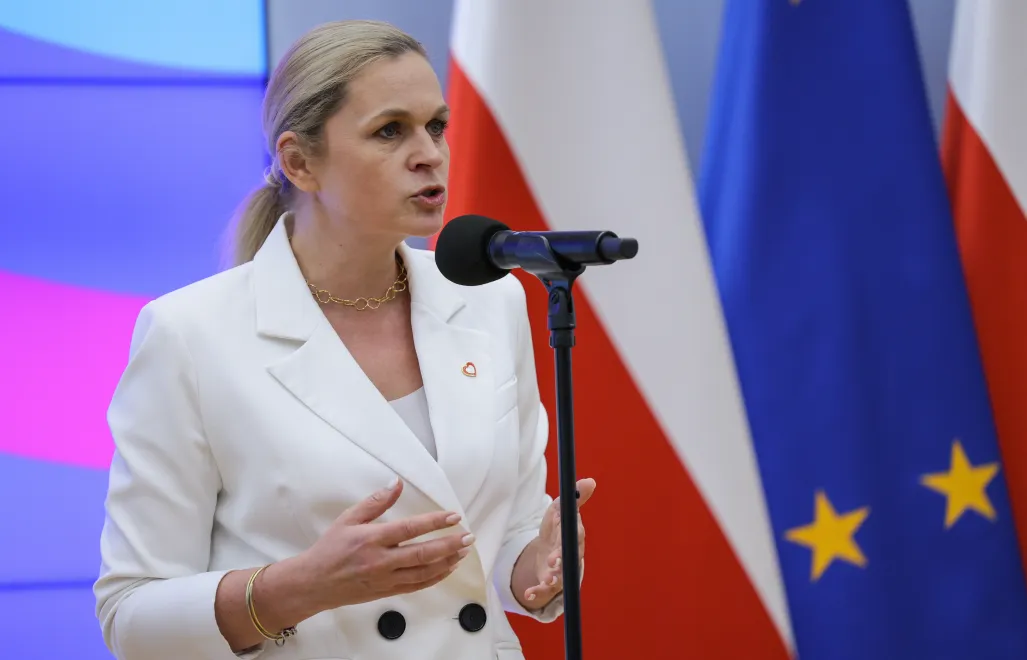
Polish Minister of Education Barbara Nowacka is dissatisfied with the content of school textbooks on the history of Ukraine, in particular those paragraphs that cover the sensitive topic of the Volyn tragedy. She addressed a letter to Ukrainian Minister of Education Oksen Lisovyi with a request to take immediate action and revise the content of Ukrainian textbooks.
This was reported by the PAR agency, "Komersant Ukrainian" reports.
According to PAP, in a letter from Novatska to the Minister of Education and Science of Ukraine Oksen Lisovyi, sent to the Polish Press Agency (PAP) on Wednesday, the Minister of National Education “regretfully” stated that “the Polish side is very concerned about the content of Ukrainian history textbooks covering the events in Volyn that took place between 1943 and 1947.”
She emphasized that “a particularly difficult period in the history of Volyn, and at the same time in Polish-Ukrainian relations, was the time of World War II and the mass crimes against the Polish population known as the Volyn Massacre committed by the Ukrainian Insurgent Army (UPA) and the local Ukrainian population.”
Nowacka with a letter to the Minister of Education of Ukraine
The head of the Ministry of National Education drew attention to the content of the textbook entitled “History of Ukraine” for the 10th grade of secondary school, published in 2023.
As she explained, she was referring to an excerpt from page 256:
“(The UPA) operated mainly in Volyn and Galicia. In 1943, it was led by Roman Shukhevych. During the two years of its existence, 30,000-40,000 soldiers joined the ranks of the UPA. UPA activists considered Ukrainian communists, Nazis, and Poles to be their enemies. The reason for the deterioration of Polish-Ukrainian relations was the mass murder of Ukrainians by the Home Army. It was an underground Polish army whose leadership wanted to return to the pre-war borders of Poland. Its victims were residents of the Kholm region, Podlasie, Galicia, and Volhynia. The bloody Polish-Ukrainian war, which claimed the lives of not only soldiers but also civilians, lasted until 1947.”
Nowacka asked the Ukrainian minister to “take immediate measures, including revising other textbooks and preparing new ones that will correspond to the current state of Polish-Ukrainian relations.”
She added that representatives of both countries control the content of textbooks within the framework of the bilateral Polish-Ukrainian expert commission on improving school textbooks on history and geography.
Nowacka also suggested that consideration be given to changing the rules of the commission’s work so that both sides could submit textbooks of common interest for review. She referred to the fact that “both the Ukrainian and Polish sides expressed concern about the content of history textbooks.”
At the same time, the minister said that during the 24th meeting of the Commission in Uzhhorod in January, one of its Ukrainian members proposed creating a joint history textbook. Therefore, she asked Lisnyi to take a position on changing the rules of the commission’s work and possibly start working on a joint textbook.
For many years, Poland and Ukraine have been divided by the memory of the role of the Organization of Ukrainian Nationalists (OUN) and the Ukrainian Insurgent Army (UPA), which committed genocidal ethnic cleansing of about 100,000 Polish men, women, and children in 1943-45.
While the Polish side viewed this as a crime of genocide (mass and organized) that deserves condemnation, Ukrainians viewed it as the result of a symmetrical armed conflict for which both sides were equally responsible. In addition, Ukrainians perceive the OUN and UPA as exclusively anti-Soviet organizations (because of their postwar resistance to the USSR), not anti-Polish.
Friday marked the 82nd anniversary of the culmination of the Volyn-Galician massacres. july 11, 1943, when UPA units attacked almost 100 Polish towns in Volyn, was the peak of the Volyn massacre. These events became known as Bloody Sunday.