Education Business in Figures: Which Areas Attract Investors and Which Areas Lagging Behind
25 September 2025 22:03 INFOGRAPHICS
In Ukraine, the largest number of private educational institutions is concentrated in the capital, Kyiv. This is reported by "Komersant Ukrainian" with reference to a study by YouControl.Market.
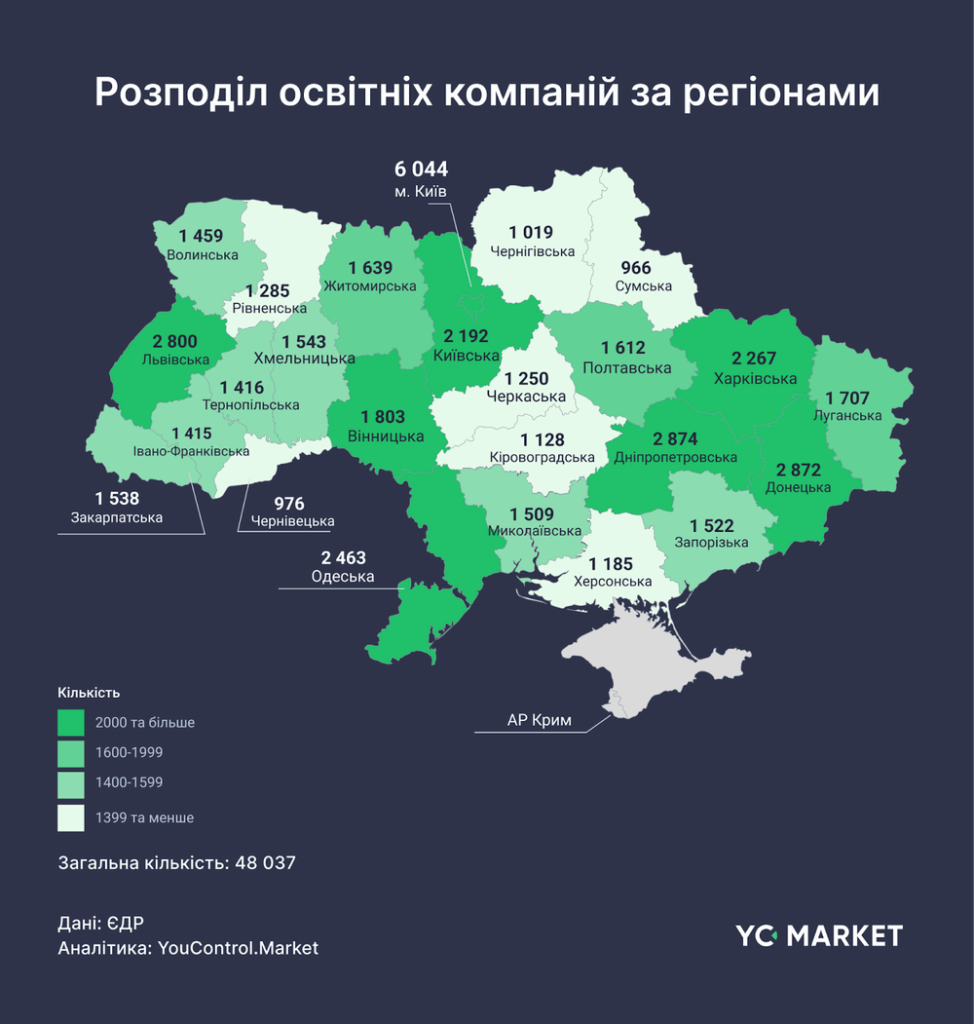
On the map of Ukraine, legal entities with educational activities are extremely unevenly distributed. The market is heavily weighted towards large cities and relatively safe regions. The capital confidently holds the lead: about 6 thousand educational institutions are registered here, which is about 12-13% of the total number of them in the country.
Kyiv has historically been a center of concentration for the education business. Numerous courses, private schools, universities, and kindergartens were opened here. The key factors are effective demand, high population density, and business activity. During the war, the capital retains its role as an educational hub, as the demand for educational services has not only remained but has grown in some segments.
Top 5 regions of Ukraine by number of educational institutions
The second largest region after Kyiv is Dnipropetrovska oblast with about 2.9 thousand educational institutions. The city of Dnipro is traditionally considered an industrial and business center, but the education sector is also actively developing here. The war has increased the demand for retraining and new professions, which has stimulated the opening of private courses and schools.
The third place goes to Lviv region with about 2.8 thousand legal entities in the education sector. Due to its relative safety, the region has become a haven for many educational institutions that have relocated from Kharkiv, Kyiv, and southern regions. Lviv is actively strengthening its position as a center of IT education and creative industries.
Odesa region ranks fourth with about 2,500 legal entities. Despite the military risks, Odesa remains an educational center in the South, particularly in maritime and humanitarian education.
Kharkiv region rounds out the top five with about 2,300 institutions. Before the war, Kharkiv was considered one of the most powerful university centers in the country. Now, some of the institutions are forced to work online or have partially relocated, but Kharkiv continues to hold significant positions due to its scientific and human resources potential.
Regions with the lowest scores
Less urbanized regions show more modest results. For example, in Kyiv region (excluding the capital), there are about 2.2 thousand legal entities in the field of education.
In Vinnytsia region, there are about 1.8 thousand institutions, and in Zhytomyr region, about 1.6 thousand. In other regions, the numbers are even lower, especially in the frontline areas. In particular, in Donetsk, Luhansk, and Kherson regions, part of the educational infrastructure is destroyed or is not actually functioning.
West and Center as new educational hubs
The war has changed the map of the education business. While Kharkiv and Kyiv used to be the leading cities, relatively safe regions in the center and west of Ukraine are now becoming new hubs of education.
Lviv, Ivano-Frankivsk, Ternopil, and Chernivtsi regions have seen an increase in private educational institutions. The reason is not only internal migration, but also the activity of local communities that invest in the development of schools, colleges and courses.
Thus, the education business proves its flexibility: it adapts to the challenges of war and responds quickly to the needs of society, forming new models of education.
Read also: IAPM, UCU and others: which private universities earned the most during the war
The fastest growing segments
The demand for education remains stable, but the market structure is changing. The following segments are growing most dynamically:
- iT and digital skills courses – due to the high demand for professions that allow working remotely;
- language schools – especially for learning English and German for those planning to work abroad;
- private kindergartens and schools – in regions with a high level of relocation;
- adult retraining programs with a focus on business management, logistics, and medicine.
Читайте нас у Telegram: головні новини коротко