Russia tests new 200-kilometer-range bombs: what intelligence says
5 November 2025 19:02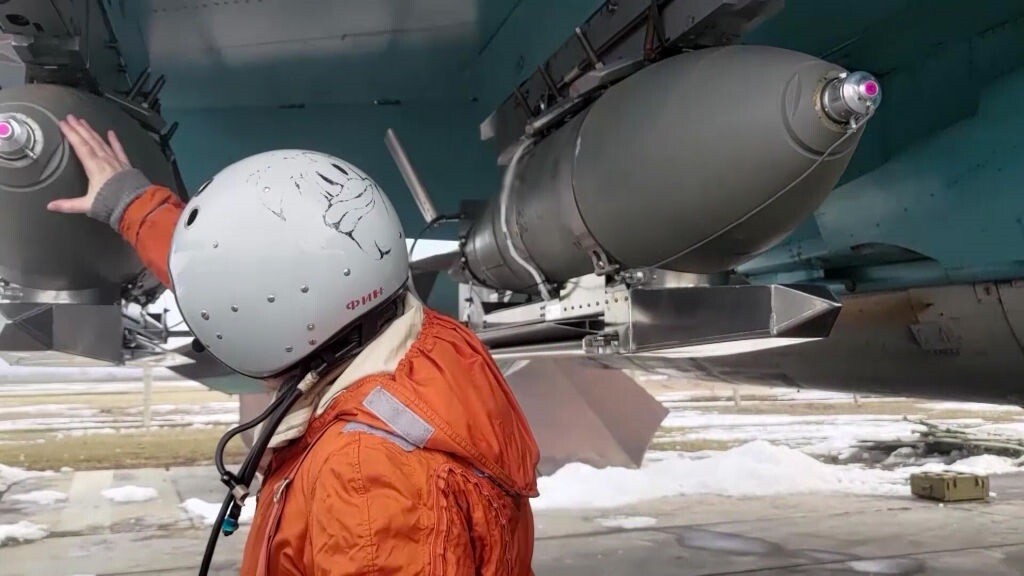
Russia has begun using new guided modular planning bombs with a range of up to 200 kilometers.
This was reported by Telegraf, citing sources in the Main Intelligence Directorate of the Ministry of Defense of Ukraine (GUR of the Ministry of Defense), "Komersant Ukrainian" reports.
The new munitions are equipped with a turbojet engine, which allows carrier aircraft to remain outside the range of Ukrainian air defense systems.
This means that Russian aviation can attack Ukrainian targets without entering dangerous space.
What is known about the new bombs
These are guided modular planning bombs (GMPBs), a modernized version of Russian KABs with a universal planning and correction module (UPCM).
Whereas previous models could fly up to 75 km, the new version with an engine increases the range threefold to 200 km.
The DIU reports that the main components for such munitions come from China, while some of the electronics are Western-made (USA, Switzerland), which may indicate that sanctions are being circumvented through third countries.
What the intelligence community says
According to the GUR, the new bombs have already been used against Dnipro and other cities.
Deputy Head of the department Vadym Skibitskyi previously stated that Russia had moved to mass production of such munitions under the names “Thunder-1” and “Thunder-2”.
During the latest tests, the range was up to 193 km.
New munitions complicate the work of Ukrainian air defense
If earlier Ukrainian systems could shoot down KABs while entering the airspace or on the approach to the target, now the aircraft will be able to attack from deep inside the territory of the Russian Federation or the occupied areas, remaining out of reach of most medium-range systems.
This potentially opens up the possibility of striking targets in the center and west of Ukraine, including energy, transportation and military infrastructure.
How this changes the balance in the air war
Military analysts note that Russia’s shift to long-range weapons is a sign of adaptation to Ukrainian air defense, which has significantly limited the capabilities of Russian frontline aviation over the past two years.
Russian pilots can now operate with greater security, which could increase the number of air attacks – especially in winter, when a new wave of attacks on the energy system is expected.
At the same time, experts say that the accuracy of such bombs remains relatively low, as the guidance system is based on commercial electronics and GPS signals, which Ukraine actively jams.
Therefore, it is likely that the scale of destruction may increase, but not the accuracy of the damage.
After suffering heavy losses in frontline aviation in 2022-2023, Russia shifted from missile attacks to attacks with planned bombs.
Since the spring of 2024, the number of uses of UMPCs has reached up to 2,000 per month, mostly in Donetsk, Kharkiv, and Kherson regions.
Currently, turbojet modifications of the UMPC are seen as the next stage in the development of this tactic – increasing the range while maintaining mass use.
Ukraine is likely to ask its partners more actively for long-range systems such as Patriot, SAMP/T, NASAMS, and F-16, which are capable of shooting down carriers before launch.
It is also expected that the allies will tighten export controls on electronic components that Russia continues to receive through intermediaries in China and the Middle East.
The emergence of the new 200-kilometer-range SSCMs is not just a technological upgrade. It is a shift in the balance of the air war, forcing Ukraine and its allies to respond to the new air threat while increasing sanctions pressure on suppliers of Western components to the Russian military-industrial complex.