US import tariffs break records: what will rise the most
5 September 2025 22:41 INFOGRAPHICS
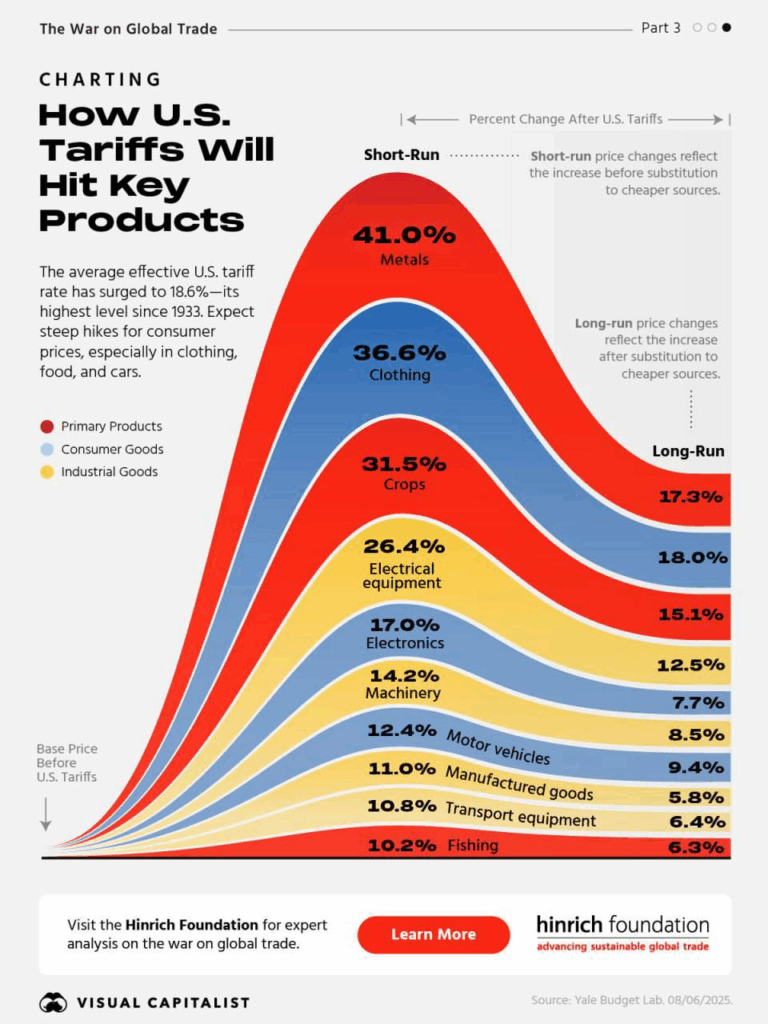
In 2025, the average effective tariff in the United States reached 18.6%, the highest level since 1933. The process is reported by "Komersant Ukrainian" with reference to an infographic prepared by Visual Capitalist based on data from the Yale Budget Lab.
Economic forecasting analysts are already warning that the increase in the average level of duties not only dramatically changes international trade, but also has serious consequences for end consumers around the world. It will lead to changes in prices for key goods in the short and long term.
Metals, clothing, and agricultural products will rise in price the most
In the short term – until business and logistics adapt – prices for
- metals: 41,0%
- clothing: 36,6%
- agricultural crops: 31,5%
Metals are one of the most sensitive categories, as the US import dependence in this area remains significant. The same applies to clothing, most of which is produced in countries with low labor costs. At the same time, rising agricultural prices could hit food prices, which has global implications, particularly for countries that import grain or food additives from the United States.
Industrial goods: electronics, machinery, cars
The medium-risk category in terms of price increases includes industrial goods, which are also subject to price pressure in the long run, albeit less than consumer goods:
- electrical equipment: 26.4% (short-term), 18.0% (long-term)
- electronics: 17,0% → 15,1%
- machinery and equipment: 14,2% → 7,7%
- cars: 12,4% → 8,5%
- other transportation equipment: 10,8% → 6,4%
Such goods usually have complex logistics chains and narrow specialization. Because of this, US manufacturers will not be able to quickly switch to local suppliers, which will keep prices high in the medium term.
Duties, consumer goods, and pressure on the end user
The increase in duties will primarily hit the consumer’s pocket. When imported components, raw materials, or finished goods become more expensive, retailers pass the burden onto the customer.
For example, clothing prices may remain 30% higher for at least 6 to 12 months until US retailers find cheaper alternatives or reorganize their supply chain. The same applies to electronics, cars, and even household appliances, which have become more expensive for the average American, and thus for buyers in other countries where these goods are exported from the United States.
Read also: Trump’s tariffs will amount to 10-15% for 150 countries
US raises tariffs: global implications for exporting countries
For Ukraine and other countries that supply raw materials or components to American factories, the new US customs policy means a decrease in demand. If American companies reduce their imports, this will affect Ukrainian exports, particularly of metals, agricultural products, and machinery.
At the same time, the increase in tariffs could open up new opportunities for Ukrainian producers, such as replacing Asian or European competitors if the US looks for alternative markets with less restrictive policies.
Читайте нас у Telegram: головні новини коротко
The increase in average tariffs in the US to 18.6% is a global signal that the era of “free trade” is coming to an end. The consumer will suffer the most, paying more for most goods, from clothing to electronics. But exporters like Ukraine should also prepare for the turbulence and use it as an opportunity.
Читайте нас у Telegram: головні новини коротко