“The one who gets to work”: Kernel, FUIB, Ajax Systems, and Epicenter talk about the staff shortage
24 September 2025 11:47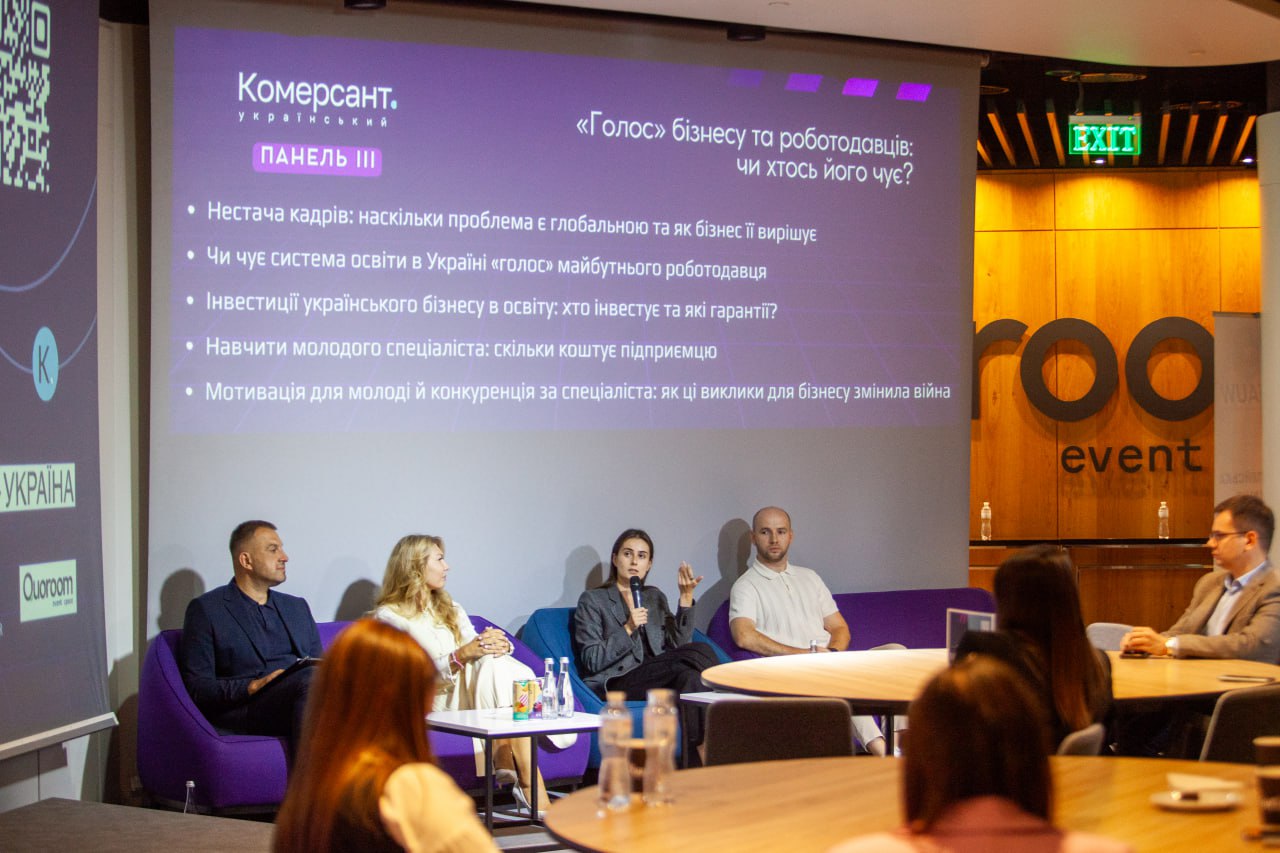 ANALYSIS FROM
Ukrainian businesses are facing an unprecedented staffing challenge: war, migration, and mobilization have exacerbated the shortage of workers in all sectors of the economy. At the same time, companies are not giving up and are launching their own programs to attract and retain young people. During the third panel “The Voice of Business and Employers: Does Anyone Hear It?” organized by Kommersant Ukrainian, representatives of leading companies shared their experience
Business must learn to hear young people: Kernel told how to retain staff in villages
The value of a person is the foundation of any company, and it is the work with young people that can bring real results to businesses. Natalia Teryakhina, HR Director at Kernel, spoke about this during the third panel “The Voice of Business and Employers: Does Anyone Hear It?”.
According to her, 70% of the company’s facilities are located in rural areas, so attracting and retaining young professionals there is a key task. For many years, Kernel has been creating jobs for graduates with no experience and supporting community development in villages.
“It is very important for us that young people stay in rural areas. We work both in terms of providing jobs and infrastructure for communities,” said Teryakhina.
The company pays special attention to educational initiatives. In particular, the company launched the Open AgroTech University project, which combines training, internships, and business education for students and graduates of agricultural and engineering specialties.
“Our goal was not just to attract young people to Kernel, but to expand the labor market itself. We cannot compete only for the candidates we already have. We need to create new specialists who meet modern business requirements,” emphasized Natalia Teryakhina.
In her opinion, the task of companies is not to buy out staff among themselves, but to develop young specialists, giving them the opportunity to apply their knowledge in modern production.
“Personnel shortage” in Ukraine: FUIB tells how it retains young specialists
Ukraine is experiencing an unprecedented shortage of workers – the market needs more than 500 thousand specialists. At the same time, about 40% of students plan to go abroad after their internship in search of better conditions. This was stated by Denys Goncharuk, FUIB’s Head of the Mass Positions Recruitment and Adaptation Department, during the third panel “Voice of Business and Employers”.
“This is not just statistics – it is the loss of young people. And we have to respond,” Denys Honcharuk emphasized.
To retain its staff, the bank has introduced internship and practice programs, under which 196 students registered last year, and 19% of them were employed. The bank also has a mentoring and coaching system in place, which has significantly reduced the turnover of young employees from 40% to 15%.
“We do not leave a young specialist alone. We support, invest, and motivate them. And it works,” summarized Denys Honcharuk
Ajax Systems invests in education: the company helps universities train a new generation of engineers
The war has exacerbated the problem of staff outflow and increased competition for highly qualified specialists in Ukraine. This is especially true for companies operating in high-tech industries.
During a public discussion, Olga Nagornyuk, Ajax Systems’ educational programs manager, said that finding experienced development engineers has become much more difficult today:
“Our sector has grown and been enriched by similar companies, especially in the field of Military Technologies. This is very important for the country, but it is a challenge for us. Specialists who were not so much in demand in the global market before have now become highly sought after,” explained Olga Nagornyuk.
According to her, the company decided to focus not only on recruiting but also on investing in cooperation with Ukrainian universities. Ajax Systems is developing an education support model that includes three key steps:
Infrastructure. Creation of modern laboratories equipped with equipment and materials where students can combine theoretical knowledge with practice.
A team of teachers. The company selects professional teachers to work in these laboratories and compensates them for part of their salaries, as this is an additional workload.
Engineering support. Ajax Systems specialists help determine the list of projects and the level of skills that students need to achieve to become competitive in the labor market.
“We try not to build education within the company, but to combine our expertise with the capabilities of universities. This helps to create a basis for training high-level engineers that we and the country need,” emphasized Nagornyuk.
Ajax Systems is convinced that investing in education and fundamental disciplines such as mathematics, physics, and engineering is a contribution not only to the company’s development but also to strengthening the technological future of Ukraine.
Today, businesses need anyone who can get to work
In Ukraine, the staff shortage has become even more acute due to the war, mobilization and migration. Businesses are experiencing a critical shortage of employees and are ready to hire virtually anyone who is able to work steadily.
This was stated by Olena Kolesnikova, Chairman of the Committee on Sustainable Development of the Federation of Employers of Ukraine, Head of the Industry Council of the Federation of Metallurgists of Ukraine, member of the NACEA.
“When I am asked to describe the candidate that business needs, I answer: the one who will make it. If they can come to work today and come back tomorrow, they are ours. No entrepreneur will refuse such a candidate,” Kolesnikova emphasized.
Kolesnikova also drew attention to stereotypes that are formed at school. In her opinion, education is often far removed from the realities of business, and students do not even know local companies in their regions.
“When I ask students what companies they know, no one can name them. They can name international brands, but not the businesses next door to them. We still haven’t learned to respect ourselves that much and to understand what opportunities we have and what cool companies are working in Ukraine,” Olena Kolesnikova said.
“Epicenter launches a project for young people: the company is training a new generation of leaders
Epicenter K, which currently employs more than 34,000 people, operates not only as a chain of shopping centers. The business covers the production of ceramic tiles, the agricultural sector, an online marketplace, energy, and even humanitarian demining. The company is convinced that the diversity of areas allows it to create new opportunities for young professionals.
Oleh Plakhtiy, Head of the HR Department at Epicenter K, emphasized that the average age of employees has increased from 27 to 41 in recent years. That is why in 2024, the company launched a large-scale project called the Epicenter of Opportunities, designed to attract young people and build clear career paths for them.
“We work with 160 educational institutions and change programs together so that students can immediately gain relevant knowledge and experience. We have created career maps for young professionals, internal courses, and a transparent evaluation system, without any “friends” or “foes.” We have already promoted 20 employees to their first managerial positions,” said Plakhtiy.
The company has also successfully launched a summer employment program for minors, which it plans to expand. Young employees are shown all areas of work, from logistics complexes to modern production facilities, demonstrating that it is possible to develop and build a career in Ukraine.
Thus, Ukrainian business understands that the only way to retain young people is to create conditions for their development – from first internships to career paths and community support. This not only provides companies with employees, but also forms the basis for economic recovery after the war.