Triumph of Sandu: Moldova reaffirms its pro-European course
29 September 2025 12:37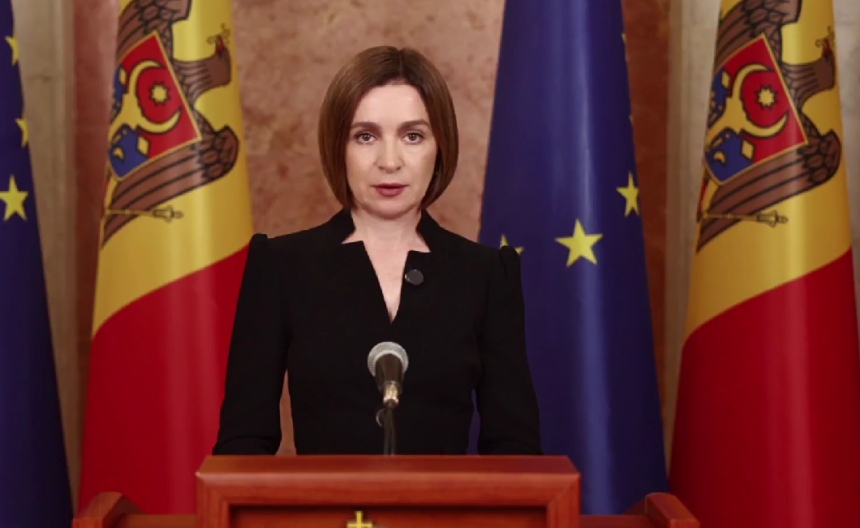
Despite the fact that the Central Election Commission of Moldova has not yet released the final election results, the processing of 99.91% of the ballots allows us to accurately determine the winners. The vote was an undeniable success for the current government, which has consistently promoted the country’s course toward joining the European Union.
This was reported by
Before the election day, there were several unknowns that could have significantly affected the balance of power in the parliament. The most important intrigue was whether President Maia Sandu’s party, Action and Solidarity (PAS), would be able to regain a mono-majority, competing with the pro-Russian Patriotic Bloc. Due to a number of factors, the final results were considered unpredictable.
However, the outcome exceeded the most optimistic expectations for PAS: the party won 50.16% of the vote, twice as much as its main opponents, who gained only 24.19%. This result will be complemented by “compensation” from those political forces that did not pass the threshold. Thus, Sandu’s party will once again be able to form a parliamentary majority on its own, almost similar to the previous cadence. This is an undeniable triumph for the government.
The secret of success lies in the high mobilization of the electorate, which feared a revenge of pro-Russian forces and the curtailment of the European course. Throughout the election day, Sandu personally appealed to citizens to come to the polls. The foreign diaspora, especially in the EU, also played an important role: as during the presidential race, it actively supported PAS, significantly boosting the party’s result.
Having received this mandate of trust, the president and her team now have the ability to appoint the government alone and continue to determine the country’s domestic and foreign policy course.
At the same time, the result of the vote was a serious blow to political forces oriented toward the Kremlin. Until the last moment, it was unclear whether they would be able to get enough MPs into parliament to form a coalition against Sandu.
At least two parties were on the verge of breaking the threshold. The first is Democracy at Home, which advocates unification with Romania and maintains close contacts with the far-right Romanian party AUR.
The second is the Alternative bloc, which tried to position itself as pro-European, although there was evidence of its cooperation with Russia.
An additional blow to the pro-Russian flank was the decision of the Moldovan CEC on the eve of the vote to withdraw the far-right Greater Moldova party from the race. Although its name remained on the ballots, all votes cast for it were declared invalid. This effectively “neutralized” part of the radical electorate. The rhetoric of the party’s leader, Viktoriia Furtune, who openly claimed the southern districts of Odesa region, added to the acuteness of the situation.
As a result, despite significant support from pro-Russian forces, Moldova once again chose the path of European integration. Sandu and her party now face the task of justifying this credit of trust – not only in relations with the EU, but also in carrying out deep internal reforms.
For Ukraine, the election results are of particular importance: Chisinau will continue to be a predictable and friendly partner. This means that another potential source of destabilization on Ukraine’s border has now been averted.
In the commentary
“The ruling Action and Solidarity party of President Maia Sandu won the parliamentary elections held yesterday. And now they are talking about about 50% of the votes, which can provide her with a mono-majority in the parliament. And we see that Russian forces are far behind, and this is a very good signal, first of all, for Moldova itself. That is, we can hope that the official Chisinau will continue its pro-Western, pro-European course of development. And I also think that Chisinau will continue to have close relations with Kyiv, with Ukraine, and thus we will be able to move together towards the European Union without any shocks for us. Because there were risks that pro-Russian forces could come back to power in Moldova, and thus it would be another geopolitical front, a pro-Russian geopolitical front near the borders of Ukraine, only from the southwestern side,” the political scientist said.
In his opinion, this did not bode well. After all, Ukraine needs this region to be stable, to be “pro-European, anti-Russian, and for Moldova to support us in the fight against Russian aggression.”
“It is very important that Moldova is located in such an important region, the Danube-Black Sea region. And, obviously, Russia wanted to have this foothold for itself, because Transnistria is clearly not enough for it. And if there were pro-Russian forces in Moldova, it would, first of all, most likely stop Moldova’s European integration, as we see in Georgia. And, secondly, official Chisinau would be very loyal to Moscow, and this would have consequences, in fact, in the cities near Ukraine, near the Odesa region, near the Black Sea.
Russia was betting very heavily on such a development. Fortunately, this did not happen, and this can already be considered a fait accompli. We continue to hope for close cooperation.
The only thing that remains intriguing now is what will happen next with our joint European integration. After all, we are now, let’s say, in the same package or in the same bundle with Moldova. Previously, the three of us were moving towards the European Union. I want to remind you that there was such a format as an associated trio. No one is talking about it anymore, actually, because Georgia has already dropped out of this format. Moldova and Ukraine remained.
But Ukraine is facing the threat that Hungary may block further accession to the European Union and, accordingly, the opening of these negotiation clusters that would allow us to move towards our dream goal.
In Moldova, this issue is much easier, but we see that the opening of the clusters has been put on hold for now. I think it was because of the consensus that was in place before, which is the consensus of Kyiv, Chisinau, and Brussels. So that this would not have negative consequences in the context of the views of Ukrainian society or give Russia the opportunity to speculate on this and let it rejoice in the fact that Ukraine was still unable to realize its European integration ambitions. And, by the way, there was information that we might have been separated even before the parliamentary elections in Moldova, because this would have given Maia Sandu additional electoral points, and she would have been able to win, her political force PAS would have been able to win, and this would have consolidated the state of affairs in Moldovan politics that has been taking place in recent years. And in this way, Moldova could further integrate into the EU. Now we see this step… there was no such scenario, and in Moldova, let’s say, which has this pro-Western course, Maia Sandu still won, and often, precisely because Moldovan citizens living both in Moldova and abroad did not want a new turn of Chisinau towards Moscow,” explained Stanislav Zhelikhovsky.
“But what will happen next? This is the question. I don’t think it will be that simple. I think that for the time being, our European partners may delay the opening of negotiation clusters for both Ukraine and Moldova, meaning that nothing will happen officially for now. But in any case, we will need to show the citizens of Moldova that they made the right choice. Because they hope that Moldova will eventually be integrated into the European Union, and this will enable the country to develop better.
And this is understandable. But if there is such a slowdown now, it may cause disappointment and pro-Russian forces will be able to play on this inside Moldova and Moscow will start to fuel it all.
So now we are all facing a serious dilemma of what to do next. I do not rule out that this status quo will remain until April, that is, until the parliamentary elections in Hungary take place. And it will be seen whether the government in that country will change or not, because it is highly likely that until April, the official Budapest will block our further movement towards the European Union, meaning Ukraine. If the government there changes, and forces come in that are more pro-European and not so pro-Ukrainian, but advocate normal relations with Ukraine, this will open up clusters, negotiating clusters for Ukraine to continue moving towards the EU, and, accordingly, for Moldova. I think this will be done simultaneously.
If this does not happen, and Viktor Orban’s party wins again, and he becomes prime minister again, this is a problem for all of us. And I think that there will be risks that we will still be divided: they will express regret and regret about this, but still, our European partners will go for it. I think that Romania will defend this issue, and perhaps support Moldova’s further movement towards the EU. Perhaps no one will put pressure, but it is still important that Moldova is able to maintain its pro-European course, that the PDS party and President Maia Sandu herself do not lose support in the country, and that they do not give additional leverage to pro-Russian forces.
So I think the situation here is really serious, and I think that for six months, I think that it will probably remain in this state of limbo, perhaps, if something does not change, for the better for all of us. And then it will all depend on how the elections in Hungary go,” he concluded.
As a reminder, almost 250 violations were recorded during the elections in Moldova