“It’s not just a bad idea, it undermines the foundations of the business climate,” lawyer on NABU’s plans to restrict ownership of enterprises
17 November 2025 12:20
The NABU’s initiative, which provides for the restriction of ownership rights to enterprises by the decision of the NABU Director and without the need for a court hearing, contradicts not only the Constitution but also the Criminal Procedure Code of Ukraine, which consistently provides for judicial control. This opinion was expressed in a commentary to "Komersant Ukrainian" by Volodymyr Bogatyr, a lawyer, Honored Lawyer of Ukraine .
The human rights activist believes that judicial control is a guarantee against arbitrariness and corruption risks on the part of prosecutors or law enforcement officers, including the NABU director. This is especially important in view of the decision of the Constitutional Court of Ukraine on the unconstitutionality of the appointment of the previous head of the Bureau.
“Judicial protection is not only the right to go to court after a violation of rights, but also the right to judicial control over decisions that may restrict constitutional rights. Giving the NABU Director the ability to restrict property rights without judicial control would actually mean delegating judicial functions to the executive body. This would be a direct violation of Articles 6, 19 and 62 of the Constitution of Ukraine, since only the judiciary has the authority to restrict constitutional rights, having institutional guarantees of independence and impartiality,” emphasizes Volodymyr Bogatyr.
Such a model would create a situation where the body interested in the outcome of the investigation decides on the application of coercive measures, which contradicts the principles of competition and objectivity of the process. This creates disproportionate pressure on business entities and paves the way for selective enforcement.
According to Article 9 of the Constitution of Ukraine, the European Convention on Human Rights and its First Protocol are part of national legislation. Article 1 of the Protocol guarantees everyone the right to peaceful enjoyment of their possessions. Thecase law ofthe European Court of Human Rights confirms that interference with property rights is possible only if there are adequate procedural guarantees, primarily access to an independent court. The absence of judicial control means the absence of an impartial arbitrator capable of assessing the validity and proportionality of the interference.
The lawyer explains that a comparative legal analysis of foreign legislation also demonstrates that even with broad powers of law enforcement agencies to combat economic crimes, the principle of judicial control remains. In addition, the European Commission has repeatedly pointed out that the concentration of executive powers without judicial oversight is incompatible with the rule of law.
Therefore, the NABU’s proposal is clearly “unconstitutional, contrary to the architecture of the CPC of Ukraine and the state’s international obligations, in particular Article 1 of Protocol No. 1 to the European Convention,” thelawyer is convinced.
“Concentration of such powers without judicial control is a recipe for abuse, pressure on business and raiding. The irony is that the anti-corruption body proposes a rule that itself creates new corruption opportunities. This is not a step forward, but a degradation of the legal system, so the parliament should categorically reject this initiative. The fight against corruption cannot be a pretext for the destruction of constitutional guarantees,” summarizes Volodymyr Bohatyr.
The document entitled “Action Plan for Implementation of the NABU Development Strategy,” published on the bureau’s website, refers to an initiative to amend the Criminal Procedure Code and the Law on State Registration of Legal Entities to allow temporary restriction of ownership of enterprises by decision of the NABU director.
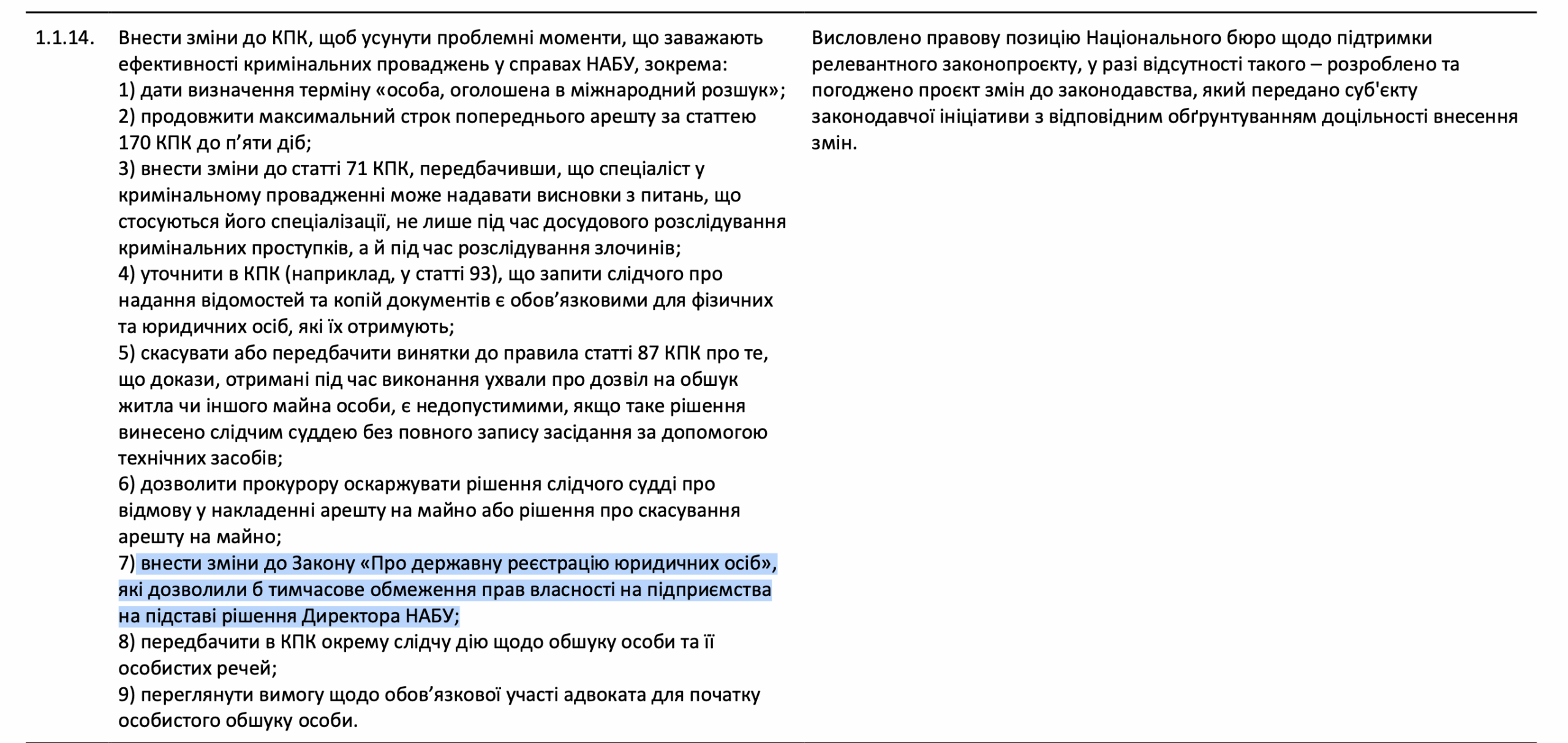
In addition, the NABU emphasizes the need to
- to revise the requirement for mandatory participation of a lawyer to start a personal search of a person;
- to allow the prosecutor to appeal against the decision of the investigating judge to refuse to seize property or the decision to cancel the seizure of property;
- repeal or provide for exceptions to the rule of Article 87 of the CPC that evidence obtained during the execution of a warrant to search a person’s home or other property is inadmissible if such a decision is made by an investigating judge without a full recording of the hearing using technical means.