Ukraine is preparing for the post-war elections: will we vote in “Diia”?
18 December 2025 17:42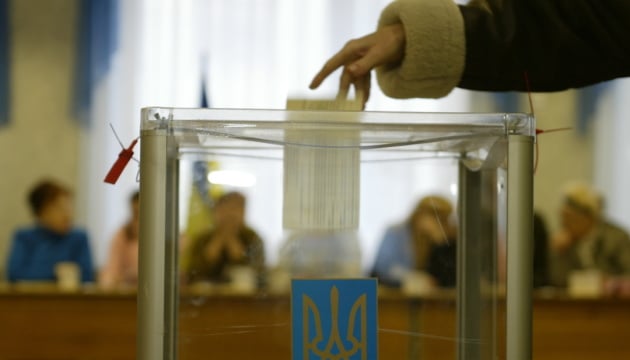
Over the past two weeks, Ukraine has been actively talking about elections: MPs, experts, and President Volodymyr Zelenskyy himself. Who is preparing the new electoral law and how law enforcement is preparing for the upcoming elections, we looked into
According to President Volodymyr Zelenskyy, elections are possible only if there is a ceasefire and security infrastructure is in place. He acknowledged that the topic of elections has been actively discussed in society, particularly after the corresponding initiative of the United States of America.
Zelenskyy says he is ready for elections
Zelenskyy has also emphasized several times that he is “ready to hold elections,” but they must be held legitimately.
“The United States requested presidential elections, and I said I would be ready for such elections. We did not consider the elections to the Rada and local elections,” he said today while talking to journalists.
The President also spoke about the electronic form of voting:
“I have always supported and raised the issue (of online voting – DS) since the beginning of COVID regarding legislative changes so that people can vote online. So far, we have not found a consensus with parliamentarians,” the president said.
The law enforcement bloc is preparing
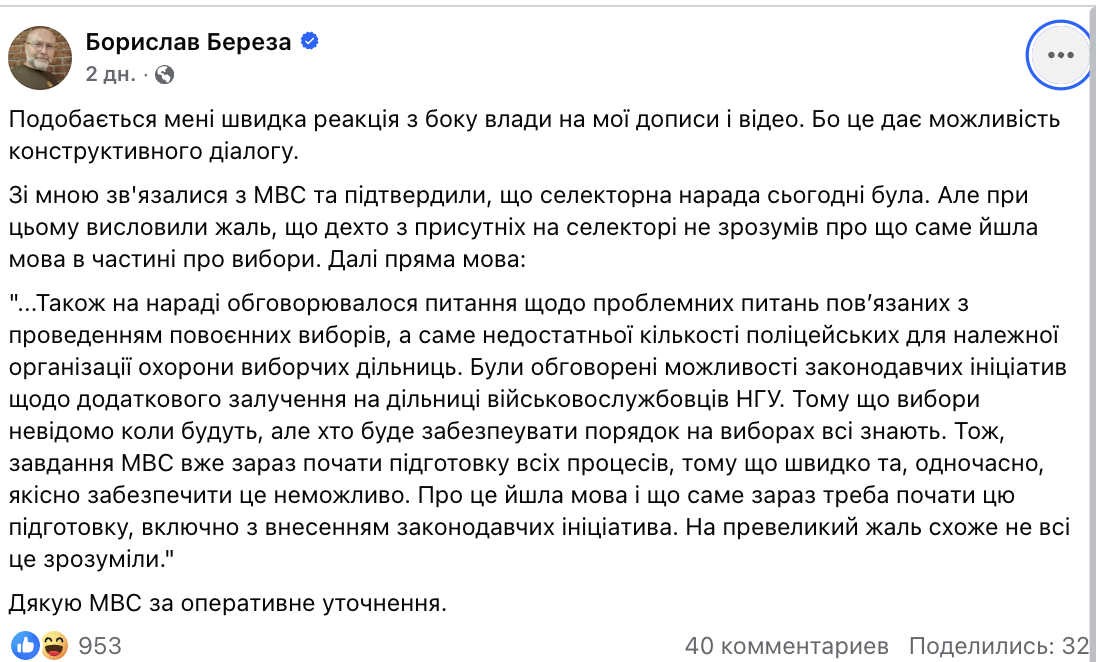
According to former MP Boryslav Bereza, the National Police is also preparing for the start of the election process. Citing his sources, he said that the issue of elections was discussed at a recent conference call at the National Police. In particular, police officers are initiating the preparation of legislative initiatives that would allow the involvement of NGU servicemen at polling stations due to the insufficient number of police officers.
How to vote
The new election law is being written in the Verkhovna Rada. The first mention of the preparation of an updated document appeared several months ago. Recently, it became known that the relevant legislative process will be led by MP and head of the Servant of the People faction Oleksandr Kornienko.
How Ukrainians will vote, especially those living in the temporarily occupied territories, on the frontline (where there is a 24/7 danger of shelling) and abroad, is perhaps the most sensitive issue today in the context of further recognition of the elections as legitimate.
The CEC’s position
Deputy Head of the CEC Serhiy Dubovyk immediately explains that it all depends on the law that MPs will write.
“The Central Election Commission proceeds from the existing legal framework. Today, elections are not held under martial law. I would like to draw your attention to the fact that the President of Ukraine, when he made statements regarding the elections, clearly emphasized the security aspects of the elections. Secondly, he asked the Verkhovna Rada of Ukraine to study the possibility of organizing and holding elections in a time of war, or under martial law, or under its lifting.
But the security factor comes first. In my personal opinion, as the deputy head of the CEC, the question of organizing preparations for the elections cannot be raised until the systematic shelling of the territory of Ukraine by heavy and strategic weapons is stopped.
Hypothetically speaking, it is necessary to develop legislation for post-war elections or for elections after the lifting of martial law. This is what the Central Election Commission has been emphasizing since 2022: that we need rules for organizing elections. We need to adopt either amendments to the code or a special law, perhaps for specific circumstances, which will change it a little. But everyone needs the rules by which elections will be held. Both state institutions and, first of all, the political infrastructure represented by political parties and public organizations and the media, which are also integral subjects of the electoral process.
Therefore, we welcome the start of the work of this working group and hope that it will result in the development and adoption of a draft law that will create clear rules for organizing elections in the post-war period.”
Remote voting
Remote voting, either online or by letter, is likely to become one of the mechanisms for holding elections, says political scientistRuslan Bortnik.
“Everything will depend on what result the elites want to get. Because potentially, it seems to me that all voting methods should be applied simultaneously. That is, polling stations should be open, and the election day should turn into an election week. That is, they should be open for seven days so that people do not crowd in and so that this does not pose an additional threat. There should also be an electronic form, either through Diia or the Taxpayer’s Cabinet, which every Ukrainian has. There can also be voting by mail, not only through Ukrposhta, but also through Nova Poshta, which has a strong presence throughout Ukraine,” he says.
According to the political scientist, while all the technical aspects of voting can be developed and defined, the issue of conducting political election campaigns is much more complicated.
“There is a problem with the election campaign itself, because democratic and legitimate elections require no censorship, equality of rights between the government and the opposition, and the ability to hold political meetings, rallies and demonstrations. Not only should all of this be allowed to ensure equality and competitiveness of the political campaign, but new procedures should be created to ensure that this is done with due regard to security factors. Because even if there is no active phase of hostilities and no missile threat, there will always be a terrorist threat. There will be a danger associated with a huge amount of ammunition and weapons in the hands of citizens. So we need new rules for regulating public and political activity. But these are not even the norms of the law, but rather special bylaws and legal acts of the Ministry of Internal Affairs or the government that would regulate this kind of political activity,” Ruslan Bortnik explained.
Voting of migrants
The political scientist notes that in the context of the elections, the authorities will try to attract migrants, refugees, and people in the occupied territories to vote.
“If the task is more narrowly technical, to hold elections quickly and in order to ensure new legitimacy, I think that residents of the occupied territories will not be able to vote. Refugees will be able to vote only partially, meaning only in embassies.”
The main stake will be placed on the internal mobilized patriotic electorate,” he predicts.
Voting in Action
According to Ruslan Bortnik, there have always been suspicions and a certain distrust of digital voting, because people do not understand how it works and cannot check it.
“Accordingly, these digital forms require the creation of stable professional commissions with international observation, so that international technical experts can observe the voting procedures, have access to all the logs in the system and thus verify the authenticity of the “vote”. A certain level of distrust always remains, and fraud is also possible. That is why we need good observation commissions, election commissions with the participation of the opposition, with the participation of international auditors, and then the level of falsification will be much lower. In general, no instrument can fully guarantee “purity,” the expert believes.
This is not the first time that voting in Diia during either elections or referendums has been considered. At least, this app is currently used for voting at the Eurovision national selection. Accordingly, as explained by