A war with Iran would affect more than just oil: The UN has released a new assessment
31 March 11:36
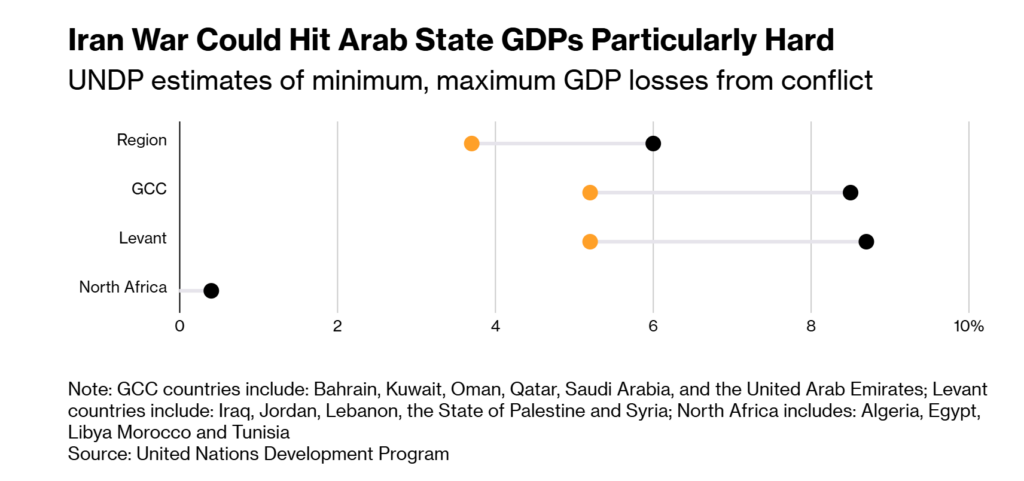
A war against Iran could deal a severe blow to the economies of Arab countries. According to a new assessment by the United Nations Development Programme, the total loss of gross domestic product in the Arab region could range from $120 billion to $194 billion. This represents a loss of 3.7% to 6% of GDP for the region as a whole. This was reported by [Komersant], citing Bloomberg.
The study also warns that the consequences could be not only economic but also social. In a worst-case scenario, the unemployment rate in Arab countries could rise by 1.8–4 percentage points, the region risks losing up to 3.6 million jobs, and up to 4 million more people could fall below the poverty line.
What exactly did the UN calculate?
The United Nations Development Programme has released an assessment of the economic and social consequences of war for Arab states. The document states that even a short-term military escalation in the Middle East could cause profound and far-reaching socio-economic consequences for the entire region.
In other words, the problem lies not only in the duration of hostilities but also in the very fact of a serious military escalation. Even if the war does not drag on for long, the impact on the economy, logistics, the labor market, and prices could be very significant. This follows directly from the UNDP’s assessment.
Which countries are at risk of suffering the most
According to the UN, the war could hit the countries of the Gulf Cooperation Council and the Levant the hardest. In both of these subregions, losses could exceed 5.2% of GDP. For the Gulf countries, this translates to a potential decline of 5.2–8.5%, amounting to $103–168 billion. For the Levant, the decline is projected at 5.2–8.7%, or $17.3–28.9 billion.
The Gulf Cooperation Council (GCC) countries include: Bahrain, Kuwait, Oman, Qatar, Saudi Arabia, and the United Arab Emirates; The Levant includes: Iraq, Jordan, Lebanon, the State of Palestine, and Syria; North Africa includes: Algeria, Egypt, Libya, Morocco, and Tunisia.
North Africa appears significantly less vulnerable in this assessment.
Why the war is affecting the entire region
The main reason is not only direct destruction but also large-scale disruptions to economic ties. The war has already driven up global energy prices and heightened nervousness in global markets.
Reuters previously reported that due to Iran’s strikes on Gulf countries’ infrastructure and the threat to energy transportation, markets are reacting with sharp price spikes, and governments in the region are warning of an existential threat to security and the economy.
The UN has also previously noted that an actual blockade or severe restriction of traffic through the Strait of Hormuz drives up prices for food and fertilizers, which is particularly dangerous for poorer countries. Thus, the consequences of the war extend far beyond the oil sector and affect the broader supply chain.
Watch us on YouTube: important topics – without censorship
Why the figure of nearly $200 billion is so important
The estimate of $120–194 billion means that this is not a local economic shock, but a potential large-scale regional blow. For comparison: even the lower end of this range represents massive losses for economies that depend on trade, transportation, oil, gas, tourism, and international investment. The figure of nearly $200 billion emerged as the key finding from a new UN study.
Bloomberg, citing this study, also emphasizes that the war could effectively “wipe out” nearly $200 billion in economic growth in the Middle East. In other words, this is not just a short-term fluctuation, but lost development potential.
What the social consequences might be
In addition to the drop in GDP, the UN warns of very serious pressure on the labor market and living standards. In the worst-case scenario, unemployment in the region could rise significantly, and millions of people risk losing their jobs or falling into poverty.
This means that the war could hit not only government budgets and companies, but also the well-being of households directly.
UN representative Abdallah Al-Dardari stated explicitly that this crisis is a serious warning sign for countries in the region. That is why the study emphasizes the scale of the risks right now, rather than after the conflict ends.
Why this matters to the world
The war in the Middle East is increasingly affecting the global economy. In addition to oil and gas prices, other commodity markets have already been hit. For example, aluminum prices surged following Iran’s attacks on plants in the UAE and Bahrain. This demonstrates that the war’s consequences are spreading to industry, logistics, inflation, and international trade.
For countries outside the region, particularly in Europe, this means higher energy risks, upward pressure on prices, and a potential slowdown in economic growth.
In other words, the UN’s new assessment concerns not only the Arab world but also the broader picture of global instability.
Read us on Telegram: important topics – without censorship