Europe has stocked up on 80% of its gas – it’s Russian gas
16 September 2025 10:38
The occupancy rate of European underground gas storage facilities (UGS) reached 80% over the weekend. This is reported by ExPro with reference to the data of the GIE association, "Komersant Ukrainian" reports.
European UGS facilities currently store about 86 billion cubic meters of gas. This is the lowest level since the beginning of Russia’s full-scale war against Ukraine, although reserves remain higher than in 2021.
From April to early September, almost 50 billion cubic meters of gas were pumped into European storage facilities, which is 30% (20 billion cubic meters) more than last year. As a result, the deficit of reserves decreased: while in April it was about 20 billion cubic meters compared to the three-year average, by the beginning of September it was already about 10 billion cubic meters.
The countries with the largest volumes of gas in UGS facilities are Germany (17.2 bcm, 75.1% occupancy), Italy (16.8 bcm, 90.1%) and France (10.4 bcm, 89.9%). High levels of reserves were also recorded in Poland (3.2 bcm, 95.6%) and Portugal (0.32 bcm, 99%).
According to the International Energy Agency (IEA), given the average injection rates of the last three years, the level of reserves may increase to about 87% by the end of October. This would be 6% below the three-year average, which could stimulate more active imports of liquefied natural gas in winter, especially in case of cold weather.
Дивіться нас у YouTube: важливі теми – без цензури
Gas is Russian
Despite the EU’s anti-Russian rhetoric, the gas in European LNG facilities is predominantly Russian. The EU remains the absolute leader in purchases of Russian liquefied natural gas (LNG), buying half of this Russian fuel. The EU is also a leader in purchasing Russian gas through the pipeline.
At the same time, natural gas is not subject to European sanctions at all – this is the biggest gap in the sanctions regime.
That is why more than 60% of European payments to Russia are for gas supplies, which are carried out both through pipelines and in the form of LNG. In fact, the EU remains the largest buyer of two types of Russian fuel at the same time – LNG and pipeline gas – ensuring stable financing of the Russian budget.
In August alone, the EU bought 773 million euros worth of gas from Russia.
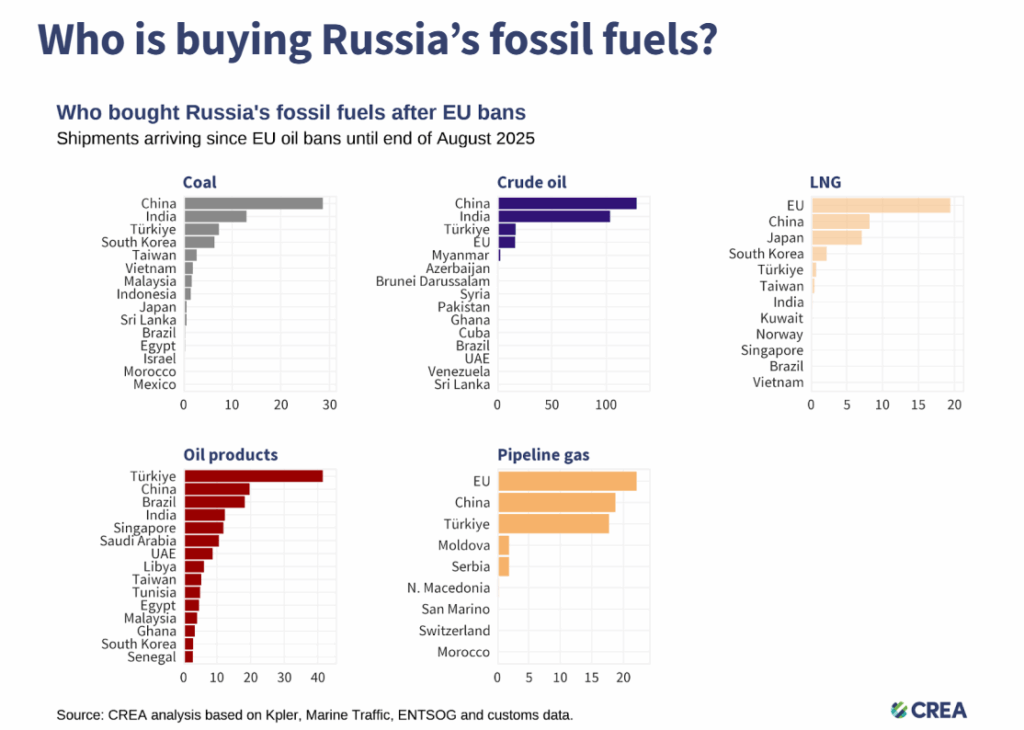
At the same time, the EU does not shy away from Russian crude oil, being its fourth buyer after China, India and Turkey.
In total, according to the Center for Research on Energy and Clean Air (CREA), since the beginning of Russia’s full-scale invasion, the EU has purchased 213 billion euros worth of energy from Russia.
For more information on European purchases of Russian energy raw materials, see How the EU Continues to Fund the Russian War Machine.
Читайте нас у Telegram: головні новини коротко