Zelensky at the UN General Assembly: “International law works only with friends and weapons”
24 September 2025 19:28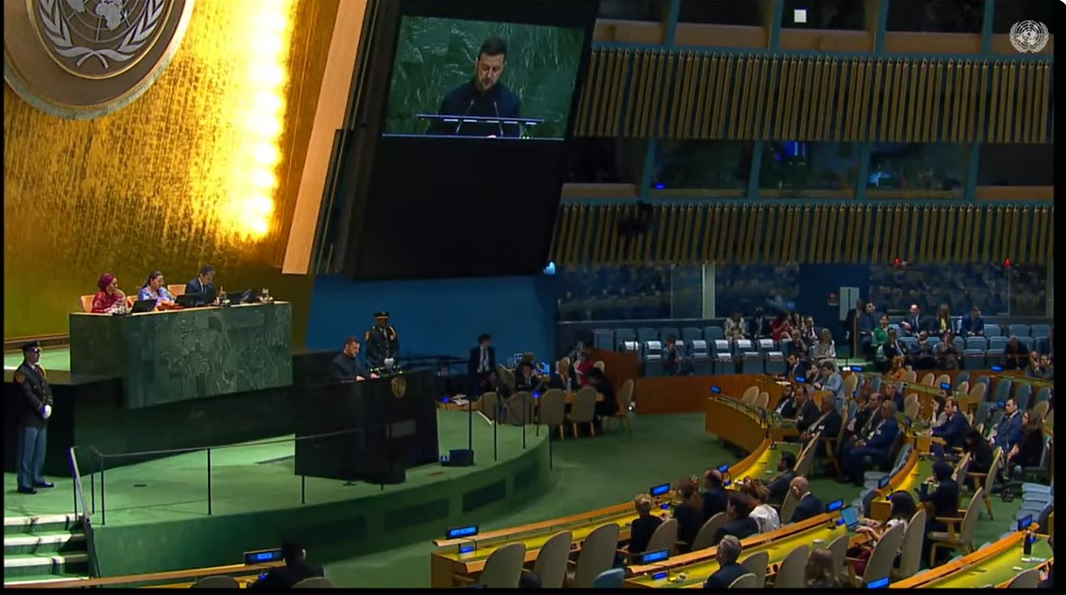
President of Ukraine Volodymyr Zelenskyy spoke at the general debate of the UN General Assembly on September 24, 2025, emphasizing the limited effectiveness of international institutions in stopping Russia’s war against Ukraine, "Komersant Ukrainian" reports.
According to him, international law “does not work” without strong allies and modern weapons.
“No one but ourselves can guarantee our security. But only with strong alliances, partners and weapons… Weapons decide who will survive,” Zelenskyy said.
Criticism of international institutions
The President criticized the weakness of global organizations that are unable to effectively stop bloodshed. He also called for new rules on the use of kamikaze drones and artificial intelligence in weapons.
“It is cheaper to stop Putin now than to try to protect every port and ship from terrorists and maritime drones,” he emphasized.
Situation at the front and Ukraine’s innovations
Zelensky recalled the thousands of Ukrainian children abducted by Russia and the latest blackout at the occupied Zaporizhzhia Nuclear Power Plant.
At the same time, he spoke about Ukrainian technological achievements:
- Drones with a range of 2-3 thousand kilometers;
- Production of weapons tested in real combat conditions;
- Plans to launch arms exports with the support of international partners.
“We had no choice but to create such drones… We agree to develop production with the support of our partners so that other countries do not have to start from scratch,” the President said.
Zelenskyy’s speech came amid rising tensions around Ukraine, exacerbated by Russia’s use of drones and unmanned aerial vehicles to attack critical infrastructure.
His message emphasizes Ukraine’s strategic dependence on international allies and technological support, while demonstrating an innovative approach to its own defense.
Ukraine seeks to strengthen defense alliances and develop its own arms production, which emphasizes the country’s role as a partner that can provide other states with proven security technologies.