China, Russia and hidden agreements: what lies behind Beijing’s “peaceful” statements
28 November 2025 18:10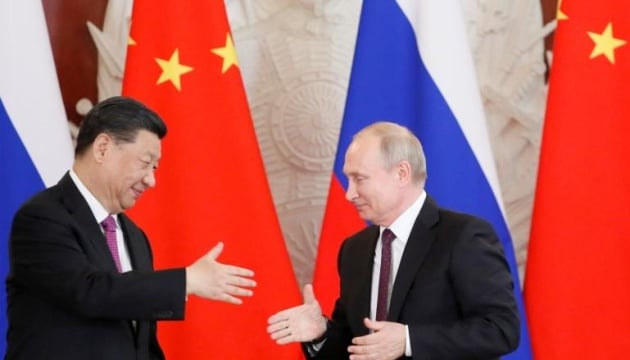
Beijing reiterated its support for a peaceful resolution of Russia’s war against Ukraine. At the briefing, Chinese Foreign Ministry spokesperson Mao Ning repeated the traditional formulas about “supporting all efforts for peace” and “cooperation with Ukraine and Russia.” But what is behind the diplomatic words? How China uses war as an instrument of a global game, not to seek peace – in the article
China has reiterated its support for a peaceful settlement of Russia’s war against Ukraine. At a briefing in Beijing, Chinese Foreign Ministry spokeswoman Mao Ning emphasized that China “supports all efforts to establish peace” and is working with all parties , “including Ukraine and Russia.” However, despite the loud statements, there is no real participation of China in the negotiations, and China continues to keep its distance, maintaining its own geopolitical game.
In her words, Mao Ning was extremely careful to refer to the war against Ukraine as the “Ukrainian crisis” – as is officially accepted in China, where the definition of aggressor is avoided. Her comment came after Russian Deputy Foreign Minister Sergei Ryabkov said in an interview with Sky News that Moscow was allegedly “negotiating with China” to end the war.
Beijing has avoided direct denials, but has not confirmed any real involvement. The spokeswoman repeated the general theses.
“China has always supported peaceful dialogue”, “we support all efforts that promote peace”, “China plays a constructive role” – Mao Ning
Beijing keeps its distance
However, these diplomatic formulas hide a much less optimistic reality: Beijing is not a party to any peace talks and does not participate in discussions of specific plans to end the war.
This is directly confirmed by political scientist Volodymyr Fesenko, who in an exclusive commentary for
When asked whether China is involved in the development or discussion of real peace plans, Fesenko answered unequivocally:
“There is no direct and official involvement of China in the negotiation process.”
He emphasizes that in fact, China is a cautious observer, actively collecting information, but not working to agree on any peace agreements:
“China is on the sidelines… The Europeans are influencing the negotiation process. This was confirmed by the negotiations in Geneva. Europeans were present there. There is currently no format for China’s participation in the negotiations to end the war in Ukraine,” Fesenko said
Fesenko emphasized the important difference between talks and negotiations. China holds conversations, sometimes at a high level, with the United States, Russia, and European countries. But these contacts have no impact on the real process.
“The Chinese are talking about it. But they are talking, not negotiating,” Volodymyr Fesenko
The political scientist adds that Chinese leader Xi Jinping mentioned the topic of war in conversations with both Donald Trump and Vladimir Putin, but only in theory.
“Theoretically, through some channels, it’s only at the level of conversations to know what’s going on,” Fesenko says
That is, Beijing simply wants to be aware of the situation, but does not interfere or take responsibility.
Chinese “peace plans”
Fesenko also draws attention to China’s “peace plans,” which were once actively discussed in the world press. According to him, all these are declarations without practical content:
“There was once a Chinese peace plan, but it was abstract,” Fesenko says
Then came a joint plan between China and Brazil, also without specifics.
“Then a slightly more concrete one appeared, but it is also a mostly abstract peace plan between China and Brazil.”
Most importantly, there have never been any negotiations on the implementation of these plans, Fesenko emphasizes:
“There are no negotiations on the implementation of these plans. There were and are no negotiations on the Chinese or Sino-Brazilian plan.”
The game is much bigger
Serhiy Yahodziysky, Doctor of Philosophy, Professor, Vice-Rector of the European University, suggests that China may have an influence on the peace plan for Ukraine, but the real picture is much broader than it seems publicly. According to him, the current geopolitical situation is part of a big game between the world’s leading powers.
“China can and most likely does have an influence. I am sure that a big chessboard is being played – a folded one, to use the words of 30 years ago. Something folded. And in this world, in this configuration that we do not see, there is something too tasty for the Russian Federation.”
Yahodziejski emphasizes that behind the scenes of public diplomacy, processes may be taking place in which China and Russia are linked not only by issues of war, but also by global strategic interests.
“And it is obvious that this has something to do with China. Perhaps also with the Arctic – there is a lot of attention to this region. It is possible that the United States and the Russian Federation are trying to divide the market for the construction of nuclear power plants, which is also being discussed around the world.”
The expert emphasizes that the peace processes around Ukraine fit into a broader geopolitical competition where the interests of the United States, China, Russia and other major players intersect.