This winter has been one of the coldest in the last 35 years: how winter crops survived the winter
23 February 14:03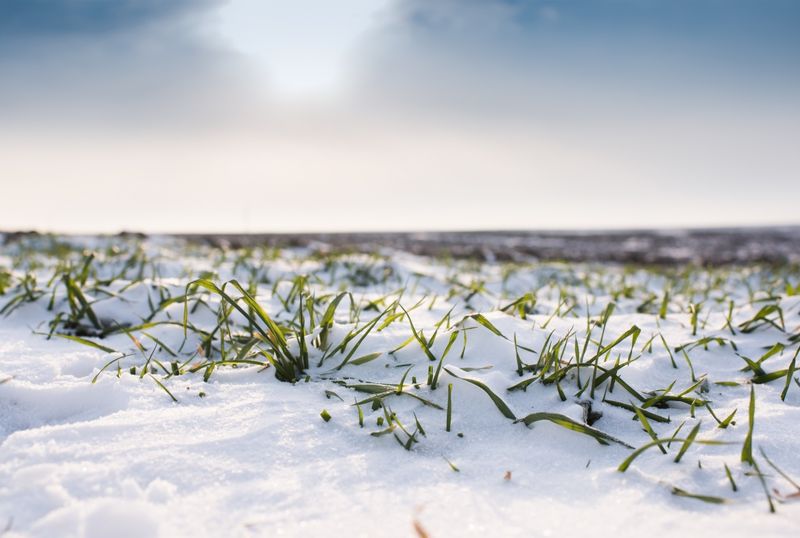 ANALYSIS FROM
“There is no such thing as bad weather.” Many farmers who are currently assessing the condition of their crops may disagree with this statement. Komersant investigated how winter crops in Ukrainian fields fared during the winter.
The recent frosts in Ukraine have not had a critical impact on the future harvest, and the situation is under control. This assessment was shared recently by Taras Vysotsky, Deputy Minister of Economy, Environment, and Agriculture of Ukraine.
“Preliminary results of monitoring the condition of winter crops do not give reason to talk about large-scale losses. In some farms, mainly in the central and southeastern regions, where there was insufficient snow cover or ice crust formed, there may be a need for partial reseeding. At the same time, there is no question of a national-scale problem,” the official said in an interview with one of the TV channels.
This winter will be remembered by many for its particularly severe frosts. However, as experts explain, the decisive factor for winter crops is not the frost itself, but the snow cover, how deeply the soil froze, and, of course, the condition of the winter crops at the onset of winter. These factors may vary from region to region.
For example, in the Odesa region, sowing was delayed last fall due to the weather. As a result, not all plants in the fields had time to develop and harden properly and were more vulnerable to the cold. In addition, there was no stable snow cover in the southern regions. The situation is more optimistic in the central and western regions of the country. Viktor Goncharenko, head of the Association of Farmers and Landowners of the Cherkasy region, explains.
“As of today, from what I have seen since the ice crust melted, most of the crops have survived the winter. We thought the picture would be worse. Although it snowed again a few days ago, rain is possible, and our wheat may still end up under a crust of ice. It will be possible to make a final conclusion about how the crops survived the winter somewhere at the end of March or even in April,” says the agrarian.
As explained by Tetiana Adamenko, head of the agrometeorology department at the Ukrainian Hydrometeorological Center, one of the features of this winter was that there was a stable winter weather pattern, i.e., with the exception of a few not very intense thaws, negative air temperatures were maintained not only at night but also during the day. This winter was also marked by severe frosts. However, as Tetiana Adamenko points out, in the ranking of the coldest winters since 1991, this winter ranks only fifth.
“It was even colder, much colder, in 1991. Then in 2003 and 2005, and the coldest and closest to us cold winter was in 2012. And that was the winter when the most winter crops were frozen in the last 20 years. It was in 2012. And it was in February. At that time, there was no snow in the southern and central regions, and Ukraine lost up to 30% of its winter crops. At the same time, the west, north, and even the center were covered with a reliable snow cover. But where there was no snow, in the Dnipropetrovsk, Zaporizhzhia, and Kherson regions, where there was no snow at all or less than 5 cm of snow cover, crops were destroyed by frost,” the expert explains.
It is no coincidence that Tetyana Adamenko, head of the agrometeorology department at the Ukrainian Hydrometeorological Center, mentioned the winter of 2012 in such detail — the picture is similar now.
“This year, the west, north, and part of the central regions, such as Cherkasy, the northeast, and half of Sumy, are covered with a reliable snow cover. This means that the plants overwintered perfectly because they were in good condition in the fall, well developed, and highly frost-resistant, so there will be no problems there at all. However, in regions such as Kirovograd, Poltava, and the southern regions, the snow formed and then melted, there were thaws, and then rains were observed, which eroded the snow cover. In other words, there was no stable snow cover there, as, for example, in the west, in the Zhytomyr region, where up to 40 cm of snow fell at the end of December and then 30-39 cm of snow remained there, which is quite a lot. But in the south and center, the snow cover migrated, sometimes more, sometimes less. That is, these areas caused and continue to cause us concern,” the expert emphasizes.
Tetiana Adamenko also explains that for winter crops, it is not so much the temperature in the air that matters, but the temperature in the soil at a depth of about 3 cm, i.e., where the root system is located.
“Temperature drops below minus 15 are harmful to crops. There were 2-3 such drops throughout the winter. So, again, we cannot say that there will be any significant damage. Only local problems are possible. This is another feature of this winter: there was no significant, deep freezing of the soil. This also affects spring processes and how quickly moisture will be absorbed by the soil. In other words, due to soil freezing during active spring processes, water stagnation and possibly crop waterlogging are possible. But again, this will be local in nature,” the expert believes.
The main winter crops grown in Ukraine are wheat, rapeseed, barley, and rye. They have different levels of frost resistance. Rye is the most frost-resistant, but, according to Tetiana Adamenko, it is not widely sown — only in the north.
“As for the central and southern regions, there is more winter barley, which is not very frost-resistant. However, there was no such drop in temperature as in the north, to minus 27-30 degrees, with snow. We believe, and calculations show, that everything turned out fine there, with the exception of some local damage. That is, primarily barley and, of course, rapeseed, which is the least frost-resistant of all winter crops. Although much depends on the stage at which they entered winter and how well they were prepared for winter. And, by the way, this time we can say that the crops were in excellent condition, with low density, well developed, hardened, and ready for winter. That is, there will be losses, but they will be local in nature. Wheat is also excellent, it is frost-resistant,” the expert notes.
She also said that some fields still have an ice crust, which, if it lasts for 10 days, could also damage the crops. In short, the weather may still hold some surprises. That is why experts are not rushing to make final conclusions. Viktor Goncharenko, head of the Association of Farmers and Landowners of the Cherkasy Region, continues.
“It often happens that wheat looks good all winter, all samples are normal, but in March the crops die. For example, there have been cases where wheat gets trapped under a thick layer of ice and can suffocate in three weeks or a month. Another scenario is when everything freezes in March and then thaws, causing soil deformation and root breakage, and the root system dies. Or another scenario. Now, you can see on the internet that small lakes have formed in the fields. That is, at first the ground froze, entered autumn and winter, and now everything has melted and water has flooded the fields. Large areas are now under water. And further developments will depend largely on how the ground thaws. If the soil thaws and this water enters the soil, then the situation will be easier. If the crops remain trapped — either under water or under ice — for a long period, then, of course, there will be losses,” notes the agronomist.
According to Tetiana Adamenko, the first more or less accurate and objective conclusions about the condition of winter crops can be made in early March, when plant vegetation resumes, the fields turn green, and it will be possible to talk about how rapeseed, barley, and wheat survived the winter.
Author: Serhiy Vasilevich